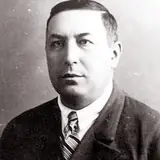
Akiba Rubinstein
Akiba Rubinstein was the world title's nearest miss. For two years before the First World War he was, by the reckoning of history, the strongest player alive, and a match with the champion Emanuel Lasker had been arranged for the autumn of 1914 — until the guns of August erased it. He never got another chance. What he left instead was a body of work so pure that masters still study it a century on: rook endings of crystalline logic, opening ideas that seeded the modern repertoire, and a positional sense Tartakower could only describe as something the gods had begun a thousand years before. He was a quiet, fragile man whom illness slowly took from the board, and he is remembered for the beauty he made and for the crown that war kept just out of his reach.
◈A rabbi's path abandoned
Rubinstein was born on 1 December 1880 in Stawiski, in Russian-ruled Congress Poland, the youngest of twelve children in a devout Jewish family. He was raised toward the rabbinate and steeped in Talmudic study — the disciplined, patient reasoning of that schooling would echo, years later, in the way he handled a chessboard.
He came to the game late, learning it only in his teens. But it took hold completely. After a fifth-place finish at a tournament in Kiev in 1903 he abandoned his religious studies for chess and settled in Łódź, sharpening his play against the city's leading master, Gersz Salwe. Within a few years the late starter from Stawiski would be measuring himself against the strongest players on earth.
◈The years of mastery
The rise was swift. In 1907 Rubinstein won the great international tournament at Carlsbad and the All-Russian Masters' tournament, and shared first at Saint Petersburg — a single season that announced him as a contender for the very top.
Then came 1909. At Saint Petersburg he finished level with Emanuel Lasker — the reigning World Champion, the man who had held the title since 1894 — and beat him in their individual game. To draw alongside Lasker in a tournament and defeat him face to face in the same event was to serve notice that the succession had a name. From here the chess world began to speak of Rubinstein not as a challenger-in-waiting but as the likely next champion.
◈The perfect year, and the match that war erased
1912 was one of the greatest single years any player has ever had. Rubinstein won the strongest tournaments of the season in succession — San Sebastián, Pöstyén, the German Championship at Breslau, and Vilna — a sweep that left no doubt about who stood at the summit. By the measure of modern statistical rankings (Chessmetrics) he was the world's strongest player from 1912 to 1914, ahead even of Lasker.
A World Championship match between Rubinstein and Lasker was arranged for October 1914. It was the match the chess world had been waiting for, and the one Rubinstein had earned. Then the First World War broke out, the match was cancelled, and it was never rescheduled. He had peaked at exactly the wrong moment in history. The war scattered the chess calendar for years, and when play resumed Rubinstein — older, poorer, and increasingly troubled — never again commanded the moment as he had in 1914. He remains the strongest player never to contest a match for the world crown.
◈The art of the endgame
What sets Rubinstein apart is the sheer purity of his chess. He was the supreme endgame artist of his age, and above all a master of rook endings — positions other masters dreaded he wove into wins of inevitable, almost mathematical grace. Savielly Tartakower's verdict has never been bettered: Rubinstein, he said, was the rook-and-pawn endgame of a game God began with himself a thousand years ago.
His finest single game came early — at Łódź in 1907, with the black pieces against Georg Rotlewi, a cascade of sacrifices that ends in a forced mate and is remembered simply as Rubinstein's Immortal, one of the most beautiful games in the literature. Yet his real legacy was structural. He played his openings with an almost humble quiet and then generated relentless pressure from sound positions, and his ideas seeded the modern game: variations bearing his name survive in the French Defence, the Nimzo-Indian, the Four Knights, the Tarrasch Defence and the Symmetrical English, and his hand shaped the Meran. "Most of the modern openings," the grandmaster Boris Gelfand has said, "are based on Rubinstein."
◈Vienna, Hamburg, and the gathering silence
Even past his absolute peak the old brilliance flared. He won Vienna 1922 ahead of the rising Alexander Alekhine, and at the 1930 Hamburg Olympiad he led Poland to the team gold from board one with an extraordinary unbeaten run — thirteen wins and four draws, a result that ranks among the great Olympiad performances.
But a darkness was closing in. Rubinstein suffered from anthropophobia — a profound, illness-driven fear of people — with schizophrenic symptoms, and it shaped his behaviour at the board in ways contemporaries found uncanny: he would make his move and then retreat to a far corner of the playing hall, as far from his opponent as the room allowed, until it was his turn again. By around 1932 the condition forced him to withdraw from competitive chess altogether. He was barely past fifty, and the board fell silent for the last thirty years of his life.
“Rubinstein is the rook and pawn endgame of a game that God started with himself a thousand years ago.”
“Most of the modern openings are based on Rubinstein.”
◈From the archive
◈Legacy
After his withdrawal Rubinstein lived in poverty and quiet, his genius unrecognised by the wider world even as masters kept studying his games. In 1950 FIDE named him among the very first players to hold the official title of Grandmaster — a belated salute to a career the war had cut short of its crown. He died in Antwerp on 14 March 1961, aged eighty. Since 1963 the Rubinstein Memorial at Polanica-Zdrój has been played in his honour, and his rook endings remain a standard text for anyone learning how the pieces are meant to be handled. He is remembered as one of the greatest players never to wear the crown — and as the man who taught the endgame to sing.