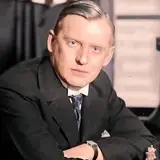
Alexander Alekhine
Alexander Alekhine made chess into theatre. Out of the wreckage of a vanished Russia he carried himself to the highest seat in the game, took the crown from a man almost no one believed could be beaten, and spent the next two decades proving — over San Remo, Bled, the Olympiad boards of France, and the wreck of a continent at war — that no position was too quiet for him to ignite. He prepared like an athlete, calculated like a machine and finished like an executioner; his combinations are still studied move for move a century on. He lived hard and uneasily, fell once and clawed the title back, and died alone in a Portuguese hotel still the World Champion of chess — the only man ever to do so.
◈A Moscow childhood, and an internment camp
Alekhine was born in Moscow on 31 October 1892 into a wealthy noble household — his father a landowner and Privy Councillor, his mother the daughter of an industrialist. He learned the moves from his mother and from his older brother Alexei, and by his early teens correspondence chess and the Moscow club scene had him hooked. In 1911 he entered the Imperial School of Jurisprudence in St Petersburg and kept playing; by twenty he was one of the strongest masters in Russia.
Then the world ended. In July 1914 he was at Mannheim for the great German Chess Federation congress when war was declared. He was rounded up with the other Russian players and interned at Rastatt for six weeks before being allowed home in September. The Russia he returned to would soon vanish in revolution; by the early 1920s he had crossed Europe to Paris, where he applied for residence, enrolled at the Sorbonne, and would later use the title Dr. Alekhine. France naturalised him on 5 November 1927 — while he was in Buenos Aires playing for the crown of the world.
◈Buenos Aires, 1927
No one thought he could beat José Raúl Capablanca. The Cuban had not lost a serious game in eight years; he had won the New York 1927 tournament ahead of Alekhine just months before; even Alekhine's own backers expected a hammering. The challenger answered by becoming the first modern chess professional in the strict sense of the word. He stopped smoking and drinking for the match, trained his body, and broke down every Capablanca game on record until he knew them as well as the champion did.
The match opened on 16 September 1927 in Buenos Aires and ran until 29 November — thirty-four games, the longest formal world championship match for the next fifty-seven years. Alekhine won the very first game; he held his nerve through 25 draws; he won the 34th and the title. The final score was +6 −3 =25. Capablanca demanded a rematch and never received one. The fourth World Chess Champion had not lost a single game to him in his life until that summer in Buenos Aires.
◈Reign — San Remo, Bled, and two crushings of Bogoljubov
In office Alekhine became something the chess world had not quite seen before: a champion who entered open tournaments and obliterated them. At San Remo 1930 he scored +13 =2 with no losses, finishing three-and-a-half points clear of Nimzowitsch. At Bled 1931 he managed +15 =11 — again unbeaten — and finished five-and-a-half points clear of Bogoljubov. For France he played board one at the Olympiads from 1930, taking individual gold at Prague 1931 and again at Folkestone 1933.
He defended the title twice against Efim Bogoljubov, his old Russian-emigrant rival. The 1929 match, fought across Wiesbaden, Heidelberg, Berlin, The Hague and Amsterdam, ended +11 −5 =9; the 1934 rematch, fought across twelve German cities, ended +8 −3 =15. Neither was ever in doubt. By the middle of the decade Alekhine had been the strongest player in the world for nearly ten years.
◈Zandvoort, and the long climb back
Then in 1935 he came undone. The challenger was Max Euwe, the modest mathematician from Amsterdam, no one's idea of a champion-in-waiting. The match ran 3 October to 16 December across Zandvoort and the Netherlands, and Alekhine — drinking heavily, by his own later admission unprepared — let the title go: Euwe +9 −8 =13. The Dutch went into the streets.
The contract guaranteed him a rematch, and Alekhine spent two years preparing for it as if his life were on the line. He stopped drinking, returned to training, and came back to the Netherlands in the autumn of 1937 a different player. Across twenty-five games he scored +10 −4 =11 and reclaimed the crown — the first dethroned World Champion ever to win it back. He would carry it for the next nine years.
◈War, controversy, and a hotel room in Estoril
The war ruined everything. Trapped in Europe after the fall of France, Alekhine took a sanitation officer's post in the French army, and after the armistice he kept playing in tournaments under German occupation. In March 1941 articles appeared in the German-language Pariser Zeitung under his name, splitting the chess world into a supposed Aryan and Jewish schools and dismissing Réti and Nimzowitsch as cheap bluff. Alekhine later said the articles had been rewritten without his consent under threat to his property and his Jewish wife, Grace; he disavowed them in post-war letters. The authorship has never been settled. He spent the rest of the war ill, isolated, and shunned by much of the chess world.
He went to Spain and then to Portugal hoping to play. On the evening of 23 March 1946 he ate dinner alone in his room at the Hotel do Parque in Estoril; the next morning the maid found him dead at his table, a chess set and an unfinished meal beside him. The official cause was a heart attack, though an autopsy witness told Chess Life a piece of meat had choked him; some still suspect foul play. He had been scheduled to play a title match against Mikhail Botvinnik. He was the first World Champion to die while holding the crown.
“During a chess competition a chess-master should be a combination of a beast of prey and a monk.”
“I consider the success of my chess career to be the result of three things: firstly, self-knowledge; secondly, a firm comprehension of my opponent's strength and weakness; thirdly, a higher aim — artistic and scientific accomplishments which place our chess on equal rank with the other arts.”
“[Alekhine] had great imagination; he could see more deeply into a situation than any other player in chess history.”
“I can see the combinations as well as Alekhine, but I cannot get to the same positions.”
◈From the archive
◈Legacy
FIDE settled the empty throne in 1948 with a tournament of the five strongest players alive; Mikhail Botvinnik won and the modern title lineage began. The body of Alexander Alekhine was reinterred at Cimetière du Montparnasse in Paris in 1956, and Moscow held the first Alekhine Memorial in his honour the same year — Botvinnik and Smyslov shared first. His name lives in the openings: Alekhine's Defence (1.e4 Nf6), Alekhine variations of the French, the Sicilian, the Ruy López, the Slav, the Vienna, the Queen's Gambit Accepted, the Budapest. His two volumes of My Best Games of Chess are still in print. He is studied today for what he insisted chess could be: an art with the rigour of a science — combinations not pulled from the air but seen, hours in advance, in positions where nobody else thought anything was there.