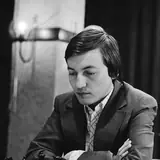
Anatoly Karpov
He never struck when a slow tightening would do. Anatoly Karpov wrapped himself around a position and squeezed — taking away one square, then another, until an opponent who had made no visible mistake suddenly found he could no longer breathe. They called him the boa constrictor, and the name fit a champion who won not by storm but by attrition, by a purity of technique the game had not seen since Capablanca. He inherited the crown under an asterisk, when Bobby Fischer would not defend it — and then spent a decade proving, tournament after tournament, that he would have earned it anyway.
◈A champion forged in the Urals
Karpov was born on 23 May 1951 in Zlatoust, an industrial town in the Ural Mountains, and learned the moves at the age of four. The talent was obvious early and was fed by the Soviet machine: as a boy he studied by correspondence at the chess school of Mikhail Botvinnik, the patriarch of Soviet chess. Botvinnik's first verdict on the pupil who would become world champion was famously wrong — he saw little there — but the homework he set sharpened the boy anyway, and Karpov spoke warmly of that schooling for the rest of his life.
At fifteen, in 1966, he became the youngest Soviet to hold the National Master title. In 1969 he won the World Junior Championship, and in 1970, at nineteen, FIDE awarded him the grandmaster title. The climb from there was relentless and almost without setback — the quiet, methodical accumulation of results that would become his signature at the board.
◈The crown nobody handed lightly
The road to the title ran through the 1974 Candidates, and Karpov walked it past a gauntlet of giants: he beat Lev Polugaevsky, then the former champion Boris Spassky, and finally — in the Candidates final — Viktor Korchnoi, edging the match +3 −2 =19. The winner was to challenge Bobby Fischer for the world championship.
That match never happened. Fischer demanded conditions FIDE would not grant in full, and in 1975 the federation's president Max Euwe declared the title forfeited. Karpov became the twelfth World Chess Champion without playing a single game for the crown — a beginning that would have crushed a smaller competitor under the weight of the asterisk beside his name. Karpov answered it the only way he could: he went out and won nearly everything in sight, becoming the most active and dominant champion the game had known, and silencing the question of whether he deserved the title by simply refusing to lose.
◈The art of the squeeze
Karpov's chess was the chess of restriction. He took no needless risks; he placed his pieces on their best squares, denied the opponent counterplay, and waited for the smallest inaccuracy to convert into a bind that grew tighter with every move. Where Tal sacrificed and Kasparov stormed, Karpov constricted — and the comparisons reached back past his own century to José Raúl Capablanca, whose effortless clarity his technique most resembled.
He described the philosophy himself, and it reads like a confession of temperament: Let us say the game may be continued in two ways: one of them is a beautiful tactical blow that gives rise to variations that don't yield to precise calculation; the other is clear positional pressure that leads to an endgame with microscopic chances of victory. I would choose the latter without thinking twice. The 1974 game against Wolfgang Unzicker at the Nice Olympiad is the textbook example — a slow, suffocating masterpiece in which Black is given nothing to do but watch his own position close in around him.
◈Korchnoi, and a Cold War on sixty-four squares
The man Karpov beat for the right to the crown became the great antagonist of his reign. Viktor Korchnoi defected from the Soviet Union in 1976, and when he twice fought his way back to challenge the champion, the matches carried the full freight of the era — the loyal Soviet titleholder against the exile the state had branded a traitor.
At Baguio City in the Philippines in 1978 the match ran to the very edge: Karpov led, Korchnoi clawed it level, and the champion finally took the last decisive game to win +6 −5 =21. The 1981 rematch at Merano was no contest at all — Karpov won so crushingly, +6 −2 =10, that it entered chess lore as the Massacre in Merano. For seven years he had turned back every challenger the world could send.
◈Five matches with Kasparov
Then came Garry Kasparov, thirteen years his junior, and the fiercest rivalry the game has ever produced. Their first match, in 1984–85, became an epic of endurance: it ran past five months and forty-eight games before FIDE president Florencio Campomanes controversially terminated it with no result, citing the players' health. When they met again in 1985, Kasparov won the title 13–11. Karpov never beat him in a match again, though he came agonisingly close — drawing the 1987 Seville match 12–12 (only to lose the title on the tie, the champion retaining), and falling 11½–12½ in 1986 and again in 1990. Across five world-championship matches the two played 144 title games, the longest such series in history.
Losing the crown did not end him. When Kasparov broke away from FIDE in 1993, Karpov took the FIDE world title, holding it across the decade — defeating Jan Timman in 1993, Gata Kamsky in 1996, and Viswanathan Anand in the 1998 knockout final. And in 1994, at Linares, the supposedly fading champion produced perhaps the greatest tournament result in history: 11/13 against the strongest field ever assembled, finishing two and a half points clear of Kasparov himself, at a performance rating of around 2985.
“Let us say the game may be continued in two ways: one of them is a beautiful tactical blow that gives rise to variations that don't yield to precise calculation; the other is clear positional pressure that leads to an endgame with microscopic chances of victory. I would choose the latter without thinking twice.”
“If you want to become a World Champion you should avoid playing in Open tournaments.”
“This boy doesn't have a clue about chess, and there's no future at all for him in this profession.”
◈From the archive
◈Legacy
Karpov's reign and his decade-long war with Kasparov are remembered as a golden age of world-championship chess, and his own record of tournament victories — more than 160 first places — has never been matched. He gave his name to a school of patient, technical, restraining play that shaped generations of grandmasters, founded chess academies, and lent his fame to chess promotion and charitable work around the world; an asteroid, 90414 Karpov, was named in his honour. He inherited a crown some said was unearned, and answered the doubt the way he answered everything across the board — quietly, thoroughly, and without ever letting his grip loosen.