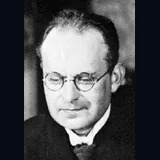
Aron Nimzowitsch
Aron Nimzowitsch never wore the world crown, and for most of his life the chess establishment treated him as a heretic and a crank. He answered with a book. My System taught a whole century how to think about a chessboard — that the centre could be held with pieces instead of pawns, that an opponent's plan could be strangled before it was born, that a passed pawn was a criminal to be locked away. He died poor in a single rented room in Copenhagen, convinced he had been cheated of the recognition he was owed. He was right about the recognition, and right about the chess: the game we play today is, in large part, the game he imagined.
◈A son of Riga
Aron Nimzowitsch was born in Riga in 1886, in what was then the Russian Empire, into a Jewish merchant family. He learned the moves from his father and went to Berlin in 1904, nominally to study philosophy — but the city's coffee-house chess swallowed him whole, and he never really left the board again.
History was not kind to his footing in the world. The Russian Empire that issued his papers dissolved in 1917, leaving him stateless for five years until, in 1922, he settled in Copenhagen and took Danish citizenship. There he would live the rest of his life, often in a single rented room, scraping a living from tournaments, exhibitions and the books that would outlast him. He carried, by every account, the wound of a man who believed the world owed him a recognition it kept withholding.
◈The war on dogma
Chess in Nimzowitsch's youth had a high priest: Siegbert Tarrasch, who taught that the centre must be occupied by pawns, that pieces existed to support that occupation, and that wing play and cramped set-ups were simply errors. Generations of amateurs took these rules as gospel. Nimzowitsch took them as a target.
He argued — and, more dangerously, demonstrated — that the centre could be controlled from a distance, by pieces and by pressure, that a position could be deliberately surrendered space in order to be counter-attacked, that the rules Tarrasch carved in stone were at best useful approximations. The feud between the two men was bitter, public and personal; it ran through the chess press for years. Out of it grew the hypermodern school, the movement Nimzowitsch is rightly called the father of, and a clutch of openings — the Nimzo-Indian Defence, the Nimzowitsch Defence, the Nimzo-Larsen Attack — that bear his name to this day.
◈My System
What made Nimzowitsch immortal was not a match result but a method. Across My System (1925–27) and Chess Praxis (1929) he did something no one had done so completely before: he turned the intuitions of positional chess into a teachable vocabulary. He named the blockade, the freezing of an enemy pawn and the square in front of it. He named overprotection, the lavishing of defenders on a strong point until it radiated energy outward. Above all he named prophylaxis — the art of foreseeing and forbidding the opponent's plan before advancing your own.
He taught it in prose nobody could forget. "The passed pawn is a criminal," he wrote, "who should be kept under lock and key. Mild measures, such as police surveillance, are not sufficient." His method against any enemy strength was a three-word drill that students still recite: first restrain, then blockade, finally destroy. The books were dense, eccentric, gloriously self-assured — and they reorganised how the chess world thought. My System has never been out of print since.
◈Carlsbad, and the summit
For a stretch in the late 1920s and early 1930s the eccentric from Copenhagen was, by the retrospective rankings, the third strongest player on Earth — behind only José Raúl Capablanca and Alexander Alekhine, the two men who held the world title between them. He won Copenhagen 1923, Marienbad 1925, Dresden 1926, and at San Remo 1930 finished second, behind only Alekhine at his terrifying peak.
His monument was Carlsbad 1929. In a twenty-two-player field that included Capablanca, Spielmann, Rubinstein, Vidmar, Euwe and Bogoljubov, Nimzowitsch finished first with 15 out of 22 — half a point clear of Capablanca and Spielmann. It was the greatest tournament triumph of his life and, on paper, the calling card of an obvious world-championship challenger. Yet the match never came: the money could not be raised, the politics never aligned, and the one opponent he could never solve was Capablanca himself, against whom he scored not a single win in eleven games. The crown stayed just out of reach of the man who had taught everyone else how to reach for it.
◈The man who was too much of an artist
Nimzowitsch was as singular off the board as on it. His friend and chronicler Hans Kmoch documented a vanity and a persecution complex that shaded into comedy: at the dinner table he was convinced he was always served the smaller portion, and would not be talked out of it even when the plates were swapped. Losing a Berlin game to Friedrich Sämisch, he is said to have leapt onto the table and cried, "Why must I lose to this idiot?"
The most famous Nimzowitsch story — probably apocryphal, entirely in character — has him protesting to an arbiter that an opponent had set an unlit cigar on the table, reasoning that "the threat is stronger than the execution." Savielly Tartakower, who knew him well, offered the kindest diagnosis: "He pretends to be crazy in order to drive us all crazy." Behind the eccentricity was a thin-skinned artist who needed, as Kmoch put it, only a little praise to blossom — and who got far too little of it in his lifetime.
“The passed pawn is a criminal, who should be kept under lock and key. Mild measures, such as police surveillance, are not sufficient.”
“First restrain, then blockade, finally destroy.”
“He pretends to be crazy in order to drive us all crazy.”
“He was too much of an artist to be able to prove he was right, and was regarded as something of a madman in his time. He would be understood only long after his death.”
“A great and profound chess thinker, second only to Steinitz.”
◈From the archive
◈Legacy
Nimzowitsch died of pneumonia in Copenhagen on 16 March 1935, aged forty-eight, and was buried in the city's Bispebjerg Cemetery — still, after a decade as a Danish citizen, a man of one small rented room. The title he was so clearly built for never came. But the Dutch grandmaster Jan Hein Donner caught what time would prove: he was "too much of an artist to be able to prove he was right," a man "regarded as something of a madman in his time" who "would be understood only long after his death." And so he was. My System has never gone out of print and is routinely named among the most influential chess books ever written; the prophylaxis and blockade he codified became the common language of positional play, carried forward by Botvinnik, Petrosian — who as a boy spent ration money on Nimzowitsch's Chess Praxis — Larsen, Korchnoi and every player who has since fianchettoed a bishop and dared to leave the centre alone. The Nimzo-Indian Defence remains a mainline weapon at the very top of the game. The heretic became the orthodoxy.