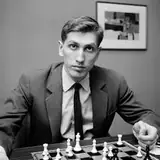
Bobby Fischer
He arrived like a meteor and left the same way — a lone American boy from Brooklyn who taught himself to beat the entire Soviet chess machine, then walked away from the game at the height of his powers. Bobby Fischer chased perfection with a single-mindedness that bordered on the inhuman: he wanted to win every game, with both colours, against everyone, forever. For one incandescent stretch around 1971 he seemed to be doing exactly that, sweeping the world's strongest players aside by scores no one had thought possible. In the summer of 1972, in a hall in Reykjavík, he won the title every American had been told belonged to Moscow — and chess was never again a game the rest of the world could ignore.
◈The boy from Brooklyn
Robert James Fischer was born in Chicago on 9 March 1943 and raised, after his parents separated, in Brooklyn by his mother Regina, a nurse and teacher. He learned the moves in 1949, at six, with his elder sister Joan, from the instructions that came with a set bought at a candy store. The game took hold of him with a completeness that worried his mother; she once placed an advertisement looking for other children to play with him. He found his footing at the Brooklyn and Manhattan chess clubs, where the master Carmine Nigro became his first real teacher — "possibly not the best player in the world," Fischer said, "but a very good teacher."
The talent was volcanic and quick. At thirteen he produced, against Donald Byrne in New York in 1956, a game so dazzling it was christened the Game of the Century. At fourteen he won the United States Championship for the first time. At sixteen he dropped out of high school to give his life entirely to chess. "You don't learn anything in school," he said. He would go on to win every U.S. Championship he ever entered — eight of them — and in 1963/64 he produced the single most perfect result the event has ever seen: eleven wins in eleven games, a clean 11–0 sweep of the strongest field in the country, still the only perfect score in the championship's history.
◈The youngest grandmaster
In 1958, at the Portorož Interzonal, the fifteen-year-old qualified for the Candidates and was awarded the Grandmaster title — at fifteen years and six months, the youngest the world had then seen. The chess world struggled to make sense of him. "It was interesting for me to observe Fischer," David Bronstein admitted, "but for a long time I couldn't understand why this 15-year-old boy played chess so well."
Through the 1960s Fischer was unmistakably one of the best players alive, yet the world title kept slipping out of reach amid disputes over the Soviet-dominated qualifying system, which he believed — with some justice — was rigged by collusion among the Soviet players. He withdrew, returned, withdrew again. He also kept working: his book My 60 Memorable Games (1969), annotated with merciless honesty, became one of the most admired collections in chess literature. The frustrations were real, but the strength was only growing.
◈The march of 1971
Then came the run that no one had ever matched and no one has matched since. Fischer won the 1970 Palma de Mallorca Interzonal by a colossal margin, scoring 18½ out of 23, and entered the Candidates matches as a man possessed. In the quarter-final at Vancouver he met Mark Taimanov, who arrived with two grandmaster seconds; Fischer came alone and won six games to nil. "Well," the beaten Taimanov said, "I still have my music."
In the semi-final he faced Bent Larsen — a man who had finished ahead of him on first board at the previous Olympiad — and beat him by the identical, almost unbelievable score of 6–0. By the time Tigran Petrosian, the former world champion, finally won a single game from him in their final match, Fischer had reeled off twenty consecutive wins against the elite of world chess. He took that match too, 6½–2½. "After the sixth game," Petrosian said, "Fischer really did become a genius." Garry Kasparov would later write that no player had ever shown a superiority comparable to Fischer's 12–0 across the Taimanov and Larsen matches.
◈Reykjavík, 1972
The challenge was set: Fischer against Boris Spassky, the reigning World Champion, in Reykjavík in the summer of 1972. It became the Match of the Century — broadcast in American prime time, front-page news around the world, a Cold War fought across sixty-four squares. The stakes were enormous, and so were the nerves: Fischer almost didn't come, complaining about money and conditions until the British financier Jim Slater doubled the prize fund to an unheard-of $250,000.
It began as a disaster for him. He lost the first game to a careless error and then forfeited the second, refusing to play in front of the cameras; he trailed 0–2 before he had truly begun. He had never beaten Spassky in his life. Then, with the match moved to a quiet back room, the meteor caught fire — and Fischer overwhelmed the champion, winning the title 12½–8½. He was the eleventh World Chess Champion, the first American ever to hold the crown, and the first non-Soviet to take it in twenty-four years. When he came home, New York held a Bobby Fischer Day, and membership of the U.S. Chess Federation doubled in a single year.
◈The vanishing
And then, at the very summit, he stopped. When the time came to defend the title against Anatoly Karpov in 1975, Fischer set out conditions FIDE would not fully grant — a match to ten wins, no game limit, and a clause that let the champion keep his title on a 9–9 tie. The world body accepted most of it but rejected that last clause by a handful of votes. Fischer did not reply by the deadline, and on 3 April 1975 Karpov became champion by default. Fischer never played a competitive game as World Champion again, and he would not be seen across a tournament board for almost twenty years.
He surfaced once more, in 1992, for an unofficial rematch with Spassky in war-torn Yugoslavia, then under United Nations sanctions; he won 10–5, but playing there violated a U.S. executive order, and his own government issued a warrant for his arrest. He never returned home. The later years were bleak — long stretches of isolation, increasingly bitter and extreme public statements, a detention in Japan in 2004 over a revoked passport — until Iceland, remembering 1972, granted him citizenship by act of its parliament. He died in Reykjavík on 17 January 2008, aged sixty-four. Even in exile his mind kept working at the game: he gave chess the time-increment clock that now bears his name, and invented Fischer Random Chess — Chess960 — to set the board free from the opening theory he feared had drained it dry.
“All I want to do, ever, is play chess.”
“I like the moment when I break a man's ego.”
“After the sixth game, Fischer really did become a genius.”
“Well, I still have my music.”
“For a long time I couldn't understand why this 15-year-old boy played chess so well.”
◈From the archive
◈Legacy
Fischer's reign on the board lasted only three years, but his shadow over chess has never lifted. He raised the game from a Cold War curiosity to front-page news, sent membership of the U.S. Chess Federation soaring, and set a standard of preparation, fighting spirit and sheer competitive will that every champion after him has measured against. His later life was a long exile — stateless, estranged, his public statements grown bitter and extreme — until Iceland, the country that had crowned him, granted him citizenship in his final years; he died in Reykjavík in 2008 and is buried there. He left two lasting inventions the chess world still uses every day: the Fischer clock, whose time increment after each move is now standard at every level of the game, and Fischer Random Chess — Chess960 — his answer to a game he feared had been studied to death. Bobby Fischer Teaches Chess and My 60 Memorable Games remain in print. He is remembered, beyond all the controversy, as perhaps the purest competitive talent the game has ever produced.