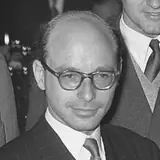
David Bronstein
He came one game short of the throne, and spent the rest of his life being told it was a failure — yet no champion ever taught the chess world to dream the way David Bronstein did. For him the board was not a battlefield to be conquered but a canvas, and chess is imagination was not a slogan but a creed he played by until he was seventy. He revived gambits the masters had buried, helped rebuild the openings from the ground up, wrote what many call the finest tournament book ever printed, and in 1951 stood within a single move of taking Mikhail Botvinnik's crown. He never wore it. He is remembered, instead, as the most imaginative player chess has known — and as the greatest who never became World Champion.
◈A boy from Bila Tserkva
Bronstein was born in 1924 in Bila Tserkva, in the Ukrainian SSR, to a Jewish family, and learned the moves at six from his grandfather. In Kiev he came under the guidance of the International Master Alexander Konstantinopolsky, the teacher who shaped his early game. The talent announced itself fast: a second place in the 1940 Ukrainian Championship earned him the Soviet Master title at just sixteen.
What set him apart from the start was not calculation but vision — an appetite for the move nobody else would consider. Where the Soviet school prized iron technique and the accumulation of small advantages, Bronstein wanted the position to come alive, to bristle with possibility. It was a temperament that would carry him to the very threshold of the world title, and, in the end, keep him from crossing it.
◈The fastest rise in the Soviet ranks
After the war his ascent was meteoric. He took third in the 1945 USSR Championship — the strongest national event on earth — and then tied for first in both 1948 and 1949, sharing the second of those titles with Vasily Smyslov. In 1948 he won the Saltsjöbaden Interzonal outright, and in 1950 FIDE awarded him the Grandmaster title. He was, for a time, the youngest grandmaster the world had ever seen — a distinction he held until a young Tigran Petrosian took it from him in 1952.
He represented the Soviet Union at four Olympiads in the 1950s and never lost a team match, collecting four team gold medals and a fistful of board prizes. By the start of the decade he was, by common consent, one of the two or three most dangerous players alive.
◈One game from the crown
The road to the title ran through his closest friend. At the 1950 Candidates Tournament in Budapest, Bronstein finished tied for first with Isaac Boleslavsky — the two had been friends since the late 1930s — and beat him in a playoff in Moscow to win the right to challenge for the world championship. Years later, in 1984, he would marry Boleslavsky's daughter Tatiana.
The 1951 match against Mikhail Botvinnik went the full twenty-four games. Each man won five; fourteen were drawn; the score finished level at 12–12. Bronstein led by a point with two games to play — and then lost the twenty-third and drew the twenty-fourth. Under FIDE's rules a tied match left the title with the holder, and Botvinnik kept his crown. Bronstein had come within a single game of the championship of the world, and would never be that close again. Garry Kasparov, who revered him, judged that on the strength of his play Bronstein ought to have won.
◈Chess is imagination
No one in the modern era did more to keep chess an art. Bronstein revived the King's Gambit in serious top-level play long after it was thought a relic, and — alongside Boleslavsky and Efim Geller — rebuilt the King's Indian Defence into one of Black's great fighting systems. Two opening lines still carry his name: the Bronstein–Larsen Variation of the Caro–Kann and the Bronstein Variation of the Scandinavian. He courted complications, trusted intuition over routine, and paid for it in chronic time-trouble at the board.
His masterpiece was a book. Zurich International Chess Tournament 1953 — his account of the Candidates event he played in — is regarded by many as the finest tournament book ever written; it sold more than three hundred thousand copies in the Soviet Union alone, and taught generations to look at a position and ask not what is correct but what is interesting. Even Botvinnik, his great rival, conceded the imagination while noting its cost: he believed Bronstein's failures came from underrating endgame technique and faltering in simple, quiet positions.
◈The price of conscience, and a long twilight
Bronstein paid for his independence off the board as well as on it. In 1976 he refused to sign the official Soviet denunciation of Viktor Korchnoi after Korchnoi's defection. His state stipend was suspended, and he was barred from major tournaments for more than a year; he was kept out of high-class events again for stretches of the mid-1980s. The imagination that made his chess could not be reconciled to a system that demanded conformity.
He looked forward as readily as he looked inward. In 1973 he proposed adding a small time increment for every move played — an idea now built into every digital chess clock in the world. And he simply never stopped: he was still beating elite grandmasters into his fifties, delighting in matches against the early chess computers, and in the 1994–95 Hastings he shared first place at the age of seventy. He died in Minsk in December 2006, and was buried there, near the family of the friend he had once edged out for a shot at the world title.
“In every combination there is a piece which works harder than the others. The only problem is how to find this piece and put it to work!”
“By not winning the title I have put a shadow on my chess career, and it is a little sad that I have read and heard for more than 40 years that I am not a good player.”
“After Tarrasch and Nimzowitsch he is perhaps the most outstanding populariser of the game, a genuine teacher of the chess world.”
““For the sake of brilliance it is worth taking a risk!” That is how Bronstein played, even in his advanced years.”
◈From the archive
◈Legacy
Bronstein is remembered as the most imaginative player chess has produced, and as the greatest of all those who never became World Champion. The crown eluded him by a single game, but his real legacy needed no crown: the gambits he resurrected, the King's Indian he helped build, the time increment that ticks on every modern clock, and Zurich 1953, the book that taught the chess world to value the beauty of an idea over the safety of a result. He played, to the very end, as if the point of the game were not to win but to imagine — and in doing so he won something more lasting than a title.