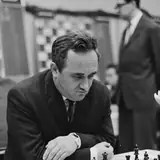
Efim Geller
He never wore the crown, and for thirty years he frightened everyone who did. Efim Geller was the eternal Candidate — six times he came within sight of the world title and six times the door closed — yet he beat Botvinnik, Smyslov, Petrosian and Fischer more often than they beat him, and he taught his rivals how their own openings actually worked. Botvinnik said it plainly: before Geller, nobody understood the King's Indian. He was the rarest kind of great player — the one whose ideas outlived his results, and who made the whole chess world stronger by refusing to be champion of it.
◈Out of Odessa
Geller was born in Odessa in 1925, into a Jewish family, and came to chess by a side door. He was a genuine athlete first — a sure-handed basketball player on a strong Odessa side, good enough that the game might have been his life. It was his basketball coach, himself a chess enthusiast, who told the young man to put the ball down and concentrate on the board. The Second World War then swallowed the years in which a prodigy normally ripens, and Geller's real ascent did not begin until peace returned.
When it came, it came fast. In 1949 he won a Soviet Championship semi-final qualifier at Tbilisi with 11½/16 and advanced to the final — and there, a virtual unknown, he tied for third and fourth at the 17th USSR Championship in Moscow with 12½/19, behind only David Bronstein and Vasily Smyslov. International Master followed in 1951; the Grandmaster title came in 1952. He had announced himself not with patience but with fire — the early Geller was a fierce, original attacker, and that aggression never fully left him even as his understanding deepened.
◈The man who explained the King's Indian
Geller's deepest mark on chess was made in the opening. Together with Isaac Boleslavsky and Bronstein he was among the first to grasp that the King's Indian Defence — long dismissed as a cramped, passive set-up — was in truth a coiled counter-attacking weapon, Black inviting the centre forward only to detonate it. He played it, analysed it and proved it against the very best, until Mikhail Botvinnik delivered the verdict that follows Geller's name to this day: before Geller, we did not understand the King's Indian.
His theoretical reach went far beyond one defence. He was a central figure in the Sicilian — his quiet 6.Be2 against the Najdorf became a main line, and it was with such restrained, deeply prepared systems that he repeatedly cut down Bobby Fischer. The Geller Gambit against the Slav (1.d4 d5 2.c4 c6 3.Nf3 Nf6 4.Nc3 dxc4 5.e4) bears his name, and his work on the Ruy Lopez and the Queen's Gambit Declined shaped how those openings are played still. Garry Kasparov's judgement: Geller's contribution to modern opening theory is surpassed only by the very greatest World Champions.
◈So near the crown
Six times across the cycles from 1953 to 1971 Geller reached the Candidates — the small circle of players one match away from challenging for the world title — and six times he was turned back. He played the Candidates at Zurich 1953 and Amsterdam 1956. His closest approach came at Curaçao 1962: after finishing second to Fischer at the Stockholm Interzonal, he scored 17/27 in the Candidates Tournament and tied for second — a single half-point behind Tigran Petrosian, who went on to take the crown.
In the match era that followed he beat Smyslov 5½–2½ in 1965 before losing to Boris Spassky by the same score; Spassky stopped him again at Sukhumi in 1968, and Viktor Korchnoi did so in 1971. He kept arriving at the threshold and kept being denied. If the title is the only measure, Geller failed at it longer and more honourably than almost anyone in history.
◈The scourge of champions
And yet the head-to-head ledger tells a different story — one in which Geller is the hunter, not the prey. He finished his career with a winning record against a remarkable row of world champions: +4 −1 against Botvinnik, +5 −3 against Petrosian, +11 −8 against Smyslov, and most famously +5 −3 against Bobby Fischer, an edge almost no one else of that generation could claim. Botvinnik, who knew the field as well as any man alive, reckoned Geller the strongest player in the world in the late 1960s.
The Fischer record was no accident. Geller had studied the American coldly and found the seam in his armour: it was clear to me that the vulnerable point of the American Grandmaster was in double-edged, hanging, irrational positions, where he often failed to find a win even in a won position. So Geller dragged him into exactly those waters — with the quiet Sicilian, with deep preparation — and beat him there again and again.
◈The long autumn
Few great players aged so gracefully. Geller poured his understanding back into the next generations as a second and trainer — he was in Spassky's camp for the 1972 match against Fischer in Reykjavik, and later helped prepare Anatoly Karpov, the champion who would carry the Soviet banner for a decade. His own play refused to fade: in 1979, at the age of 54, he won the Soviet Championship at Minsk — twenty-four years after his first title and still, to this day, the oldest man ever to win it.
He went on winning into an age when most masters have long retired: clear first at Dortmund in 1989, and World Senior Champion in 1992 (after sharing the 1991 title with his old rival Smyslov). His books — among them Grandmaster Geller at the Chessboard and The Application of Chess Theory — pass the same lucid, theory-first mind on to readers who never saw him play. He died in Moscow in 1998, aged 73.
“It was clear to me that the vulnerable point of the American Grandmaster was in double-edged, hanging, irrational positions, where he often failed to find a win even in a won position.”
“Just as it is wrong to work on chess by studying only the first 10–15 moves, so it is wrong to play one and the same opening system, even though it be rich in variations and nuances.”
“Before Geller, we did not understand the King's Indian.”
“Geller's contribution to modern opening theory is surpassed only by the very greatest World Champions.”
◈From the archive
◈Legacy
Geller is the standing argument that greatness and the world title are not the same thing. He never became champion, yet he beat the champions, trained the champions, and rewrote the openings the champions played — the King's Indian he made respectable, the Sicilian and Ruy Lopez systems he deepened, the gambit that carries his name. He won a national championship at 54 and a world seniors title at 67, competitive almost to the end. Among the many strong players who never reached the summit, Geller stands first: the eternal Candidate whose ideas, half a century on, are still being played.