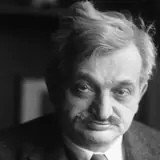
Emanuel Lasker
For twenty-seven years no one could take the crown from Emanuel Lasker, and for a long time the chess world could not explain why. He was not the prettiest player of his age, nor the most dogmatic; he simply would not lose. A doctor of mathematics who counted Albert Einstein among his friends, a philosopher who saw chess as a model of struggle itself, Lasker treated the board as a contest between two human beings rather than a search for abstract truth — and he understood the human across from him better than anyone alive. He held the world title longer than any champion before or since, and when the chess of the future finally caught up with him, it found he had been waiting there all along.
◈The cantor's son from the Neumark
Emanuel Lasker was born on Christmas Eve 1868 in Berlinchen, a small town in the Prussian Neumark, the son of a Jewish cantor. At eleven he was sent to Berlin to study mathematics, and there his elder brother Berthold — himself a strong master — taught him the game. The boy proved an immediate menace: short of money for his studies, he supported himself by playing for stakes in the cafés of Berlin, learning chess not as a science but as a livelihood and a fight.
He earned the master title at the Breslau congress of 1889, then spent the early 1890s sharpening himself in England and the United States, winning match after match against the leading players of the day. By 1894, still only twenty-five, he had cleared a path to the one man who stood above all others — the first World Champion, Wilhelm Steinitz.
◈Toppling the old king
The 1894 match, played across New York, Philadelphia and Montreal, was meant to be a coronation for the ageing Steinitz. Instead Lasker won it convincingly, 10½–5½, and at twenty-five became the second World Chess Champion. When sceptics murmured that Steinitz had simply grown old, Lasker answered them in the 1896–97 rematch at Moscow, crushing the founder of modern chess theory by an even wider margin.
Across the same decade he proved he was no mere match-player. He won the great quadrangular tournament at St Petersburg in 1895–96, took first at Nuremberg in 1896 ahead of the world's elite, and then produced two of the most dominant tournament performances ever recorded — London 1899, where he scored 23½ of 28 and finished a colossal margin clear of the field, and Paris 1900 with 14½ of 16. For a few years the gap between Lasker and everyone else looked unbridgeable.
◈The longest reign
Lasker defended his title rarely but emphatically. Frank Marshall, the brilliant American attacker, failed to win even a single game in 1907 (+8 −0 =7). Siegbert Tarrasch, the great theoretician who believed chess obeyed laws Lasker seemed to flout, went down +8 −3 =5 in 1908. David Janowski was swept aside. Only Carl Schlechter, in 1910, came within a whisker — the match finished level at 5–5, and Lasker kept his crown by the narrowest possible thread.
His final masterpiece as champion came at St Petersburg in 1914. Trailing the young José Raúl Capablanca by half a point with the leaders meeting in the final group, Lasker beat the Cuban in their individual game and overhauled him to win the tournament outright — a result so admired that, by a story long attached to it, the visiting Tsar conferred the title of grandmaster on the five finalists.
The First World War froze the chess world, and when peace returned Lasker was past fifty. In 1921, in the heat of Havana, Capablanca finally took the crown; Lasker, unwell, resigned the match without winning a game. Yet he was far from finished. At New York 1924, aged fifty-five, he won the strongest tournament of the era ahead of both Capablanca and Alekhine, undefeated. And at Moscow 1935, sixty-six years old and called out of retirement, he finished undefeated in third place — a performance hailed at the time as a biological miracle.
◈The fighter and the psychologist
Lasker's contemporaries struggled to define his strength. Richard Réti famously claimed that Lasker deliberately played inferior moves to lure opponents onto ground where the human mind, not the position, would decide the game. For half a century that became the legend: Lasker the psychologist, who won by reading men rather than positions.
Modern eyes see something else. Analysts such as Andrew Soltis and Vladimir Kramnik have shown that Lasker's apparently strange choices were usually the most resilient and resourceful moves on the board — a willingness to accept dynamic imbalance and defend with iron precision that the dogmatic chess of his day simply could not understand. To Lasker, the game was Kampf — struggle — the title he gave one of his books, and his whole philosophy of contest. He believed a slight disadvantage made a player more alert and inventive, and he proved it across a thousand fighting games. As Tarrasch, who never quite solved him, admitted: Lasker occasionally loses a game, but he never loses his head.
◈The mathematician, the philosopher, the exile
Chess was only one of Lasker's lives. In 1902 he took a doctorate in mathematics at Erlangen, and in 1905 published work on the primary decomposition of ideals that Emmy Noether would later generalise into the Lasker–Noether theorem, foundational to abstract algebra and algebraic geometry. He wrote philosophy, befriended Albert Einstein — who called him one of the most interesting people I came to know in my later years — and became one of Europe's strongest Go players, as well as an expert at bridge. He invented his own game, Lasca, and his Lasker's Manual of Chess remains one of the deepest books ever written on the game.
His last years were shaped by catastrophe. When the Nazis came to power in 1933, Lasker and his wife Martha, both Jewish, were driven from Germany and stripped of their property. They fled first to England, then to the Soviet Union, where Lasker renounced his German citizenship, was given a post at Moscow's mathematics institute and trained the Soviet team. In 1937 the couple emigrated to the United States. He died in New York in January 1941 — penniless, but unbroken, the longest-reigning champion the game has ever known.
“On the chessboard, lies and hypocrisy do not survive long. The creative combination lays bare the presumption of a lie; the merciless fact, culminating in a checkmate, contradicts the hypocrite.”
“Lasker occasionally loses a game, but he never loses his head.”
“Emanuel Lasker was undoubtedly one of the most interesting people I came to know in my later years.”
◈From the archive
◈Legacy
Lasker died in New York on 11 January 1941, a refugee and a charity patient at Mount Sinai Hospital, and was buried at Beth Olam Cemetery in Queens. The Nazis had stripped him of his home, his savings and his country; he spent his last years in exile in England, the Soviet Union and finally the United States, still playing world-class chess into his late sixties. For decades his peers wrote him off as a lucky psychologist who won by confusing weaker minds, but modern analysis by masters from Réti to Kramnik has overturned that verdict: Lasker was a player decades ahead of his time, the first truly universal champion. His name outlived chess itself — the Lasker–Noether theorem, born from a 1905 paper and completed by Emmy Noether, remains a cornerstone of modern algebra. He held the highest title in chess for twenty-seven years. No one has come close since.