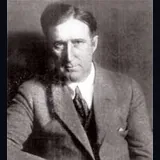
Frank Marshall
Frank Marshall played chess the way a magician works a crowd — daring you to believe the trick is over, then pulling one more impossible thing out of a ruined position. For twenty-seven years he was the champion of American chess, and across the great European tournaments of the golden age he stood among the very best in the world. He lost more than his share to the giants of his era, but he lost the way an artist loses: swinging, conjuring, refusing to go quietly. He gave chess the swindle — the resource hidden in the wreckage — and at least one move so beautiful that, by legend, the spectators showered the board with gold.
◈The breakthrough at Cambridge Springs
Marshall was born in New York City in 1877 and came of age in the world of American chess in the closing years of the nineteenth century, an era still lit by the afterglow of Paul Morphy. He learned the game young and rose through the clubs and congresses as a tactician of obvious gifts, but it was at the Cambridge Springs International Congress of 1904 that he announced himself to the world.
Against a field that included World Champion Emanuel Lasker, Marshall scored 13 out of 15 and finished clear first — undefeated through the entire tournament, a point and a half ahead of Lasker and David Janowski. He beat the great Harry Nelson Pillsbury along the way. It was one of the finest tournament results an American had ever produced, and it carried him onto the European stage as a player the champions had to reckon with.
◈The challenger
In 1907 Marshall did what every ambitious master of the age dreamed of: he challenged Emanuel Lasker for the World Championship. The match wound across America — New York, Philadelphia, Washington, Baltimore, Chicago, Memphis — from January to April. It was a humbling. Lasker won eight games, drew seven, and lost none; Marshall did not win a single game.
He never reached that summit again, yet he remained, for a decade and more, a fixture among the world elite. At the colossal St. Petersburg 1914 tournament he finished fifth, behind only Lasker, José Raúl Capablanca, Alexander Alekhine and Siegbert Tarrasch — four of the towering names of chess history. Marshall belonged in that company, and everyone knew it.
◈The art of the swindle
If Marshall has one permanent gift to the chess vocabulary, it is the swindle — the trap sprung from a position that looks already lost, the resource conjured out of the wreckage. He raised it to such an art that the historian Andrew Soltis wrote his ability to recover positions that looked irretrievable had "taken on magical proportions." Marshall even titled one of his books Marshall's Chess "Swindles".
His chess was tactical, sharp, restlessly inventive — and unafraid to gamble. He understood better than almost anyone the psychology of a game half-won, summed up in his own dry remark: "The hardest thing in chess is to win a won game." Less celebrated, but real, was a fine technical touch; behind the fireworks stood a strong endgame player who simply preferred the spectacular when it was on offer.
◈Gold coins at Breslau
The single most famous moment of Marshall's career came at Breslau in 1912, against Stepan Levitsky. With the Black pieces, Marshall finished the game with 23...Qg3 — a queen planted in the heart of White's position on a square attacked three different ways. Whichever way White captured, he was lost; if he declined, he was mated. It is one of the most beautiful moves ever played, ranked third by the chess writer Tim Krabbé in his catalogue of the game's most fantastic moves.
And then the legend: that the watching spectators were so overcome they showered the board with gold coins. The story survives chiefly in Marshall's own memoirs, and the historian Edward Winter has gently flagged that no independent account confirms it — but true or embroidered, it has become inseparable from the move, and from the man. The win lives in this archive.
◈The Marshall Attack, and a debt repaid by Capablanca
Marshall's name is stamped on the openings he pioneered. The boldest is the Marshall Attack in the Ruy Lopez — 8...d5, a pawn flung into the center to ignite a furious kingside assault. By the most popular account he kept the idea in reserve for years and finally unleashed it on Capablanca in their 1918 New York game. Capablanca, calculating over the board, found the narrow path and won — but the line bore Marshall's name forever after, and at the elite level White players still resort to "Anti-Marshall" systems rather than face it head-on.
His relationship with Capablanca ran deeper than that one famous loss. Marshall was among the very few players ever to beat the Cuban with the Black pieces, a feat he managed at Havana in 1913 — that game survives here. And it was Marshall who, in an act of generosity that helped change chess history, insisted on the young, untitled Capablanca being included in the great San Sebastián tournament of 1911 over the objections of established masters. Capablanca won it.
◈The dean of American chess
From 1909 to 1936 Marshall reigned as Champion of the United States — a span of twenty-seven years, the longest any American has ever held the title. He gave it up only when he chose to, ceding it to a championship tournament won by the young Samuel Reshevsky.
In 1915 he founded the Marshall Chess Club in New York, which became a home for American chess and remains so today. In the 1930s he captained United States teams to four consecutive gold medals at the Chess Olympiads, driving his squads with a competitor's ferocity — when he found teammates had taken easy draws, he is said to have lectured each in turn that draws do not win matches. He set down his life in My Fifty Years of Chess (1942), and gave countless thousands their first sight of master play through his tireless simultaneous exhibitions — including a marathon of 155 games at once in Montreal in 1922.
“The hardest thing in chess is to win a won game.”
“His ability to recover positions that looked irretrievable took on magical proportions.”
◈From the archive
◈Legacy
Marshall died on 9 November 1944. The Marshall Chess Club he founded in 1915 still stands in a Greenwich Village townhouse, one of the oldest and most storied chess clubs in the United States and a working monument to the man. His name is permanent in the language of the openings — the Marshall Attack in the Ruy Lopez and the Marshall Gambit in the Semi-Slav remain mainline weapons at the highest level, more than a century on. He bridged two ages of chess, learning the game in the swashbuckling Romantic tradition of Morphy and carrying its daring into the modern era, and he is remembered as the dashing American who, in a Europe full of champions, was always worth the price of admission.