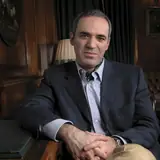
Garry Kasparov
He was the storm at the centre of modern chess. Garry Kasparov did not so much defeat his opponents as overwhelm them — outworking, out-preparing and outthinking the strongest generation the game has ever seen, then sustaining the pressure for two unbroken decades. From a boy in Baku named Garik Weinstein he became, at twenty-two, the youngest world champion in history, and for the next fifteen years no human held the crown but him. He played a machine and lost to it, and made even that loss one of the most-watched moments in the history of the game. He is the standard by which every contemporary champion is still measured.
◈A Baku boy named Garik
He was born Garik Kimovich Weinstein in Baku on 13 April 1963 — Jewish on his father Kim's side, Armenian on his mother Klara's, named, he later said, after the American president Harry Truman. When his father died in 1971 the boy was seven; at twelve he took his mother's surname and became Garry Kasparov. Klara would remain his closest adviser for the rest of her life.
The talent declared itself early. At ten he was admitted to Mikhail Botvinnik's chess school and trained there under Vladimir Makogonov; at eleven Botvinnik himself wrote that the future of chess lay in the hands of this young man. He won the Soviet Junior Championship in Tbilisi in 1976 at thirteen with 7/9, and again in 1977 with 8½/9. International Master at fifteen, Grandmaster at seventeen after the Malta Olympiad of 1980 — by January 1984, at twenty, he was the youngest world No. 1 the game had ever known, and he would hold the top spot for the next 255 months.
◈The five matches with Karpov
From 1984 to 1990 he played one opponent more than any other — Anatoly Karpov, the man who held the crown — over five world championship matches and 144 games, the longest rivalry in the history of the title. The first, in Moscow in 1984–85, ran to 48 games and was abandoned 5–3 in Karpov's favour by FIDE President Florencio Campomanes without a winner, citing the health of the players; both men were furious.
The rematch, also in Moscow, was now best-of-twenty-four. On 9 November 1985 Kasparov won game 24 with Black in a Sicilian to take the match 13–11 and the crown — at twenty-two, the youngest world chess champion in history. He defended in 1986 (London and Leningrad) 12½–11½, in 1987 at Seville 12–12 (retaining as champion after winning the final game), and in 1990 (New York and Lyon) 12½–11½. Across all 144 games Kasparov scored 21 wins to Karpov's 19, with 104 draws. No two players have ever contested the world title so often.
◈The split that broke FIDE
In 1993 the challenger was Nigel Short, and the dispute with FIDE over the bidding for the match boiled over. Kasparov and Short walked out, founded the Professional Chess Association (PCA), and played their match in London in September; Kasparov won 12½–7½. FIDE expelled both men, crowned Karpov its own champion, and for the next thirteen years there were two world champions at once.
Kasparov defended the PCA title against Viswanathan Anand at the World Trade Center in New York in 1995, winning four games to one with thirteen draws. A 2007 interview would have him call the 1993 break with FIDE the worst mistake of his career: the schism, he said, had hurt the game in the long run.
◈Deep Blue
He was, by then, also the human face of chess against the machine. In February 1996 in Philadelphia he played IBM's Deep Blue over six games and won 4–2, losing game 1 — the first time a reigning world champion had lost a tournament-condition game to a computer — and then recovering to take the match.
The rematch in New York in May 1997 has become one of the most-watched events in the history of the game. After six games Deep Blue won 3½–2½, with Kasparov resigning the deciding sixth game after only nineteen moves; it was the first time a reigning world champion had lost a match to a computer under tournament conditions, and the moment is still cited as the inflection point at which the machines passed the strongest human alive.
◈Losing the crown, leaving the board
In London in the autumn of 2000 he defended the classical title against his former pupil from the Botvinnik school, Vladimir Kramnik. Kramnik answered every White Ruy López with the Berlin Defence — a long-disused endgame line — and held every Black game; Kasparov could not win a single one. Kramnik won the match 8½–6½, with two wins to none. After fifteen years Kasparov was no longer world champion.
He kept playing, and kept winning tournaments — Linares again and again, peak rating 2851 in July 1999 (a record that would stand until Magnus Carlsen reached 2861 in January 2013). On 10 March 2005, after winning Linares for the ninth time, he announced his retirement from professional play. He was forty-one, world No. 1, and had concluded there was no chess goal left for him: the title remained fractured and there was no longer a unified crown to fight for.
◈The pen, the school, the dissident
Out of competitive chess he became its most prolific modern writer. The five-volume My Great Predecessors (2003–06) traces the entire line of world champions from Steinitz to Fischer and Korchnoi, and the first volume won the British Chess Federation Book of the Year in 2003. How Life Imitates Chess (2007) and Winter Is Coming (2015) followed; in 2009–10 he briefly coached the teenage Magnus Carlsen, who broke 2800 that October and became world No. 1 under his tutelage.
And he turned, openly and at risk, against the Kremlin. He helped found the United Civil Front and The Other Russia coalition, was arrested at street protests, and in 2007 declared a bid for the 2008 Russian presidency before withdrawing, citing official obstruction. In June 2013 he left Russia, citing fear of persecution; in February 2014 he took Croatian citizenship, and now lives with his family in New York. He has chaired the Human Rights Foundation and founded the Renew Democracy Initiative. The same intensity that made him impossible to beat at the board he has spent, since, on a quieter and more dangerous game.
“Chess is mental torture.”
“The biggest problem I see among people who want to excel in chess — and in business and in life in general — is not trusting their instincts enough.”
“The future of chess lies in the hands of this young man.”
◈From the archive
◈Legacy
He held the world No. 1 ranking for 255 months — more than twenty years — won eleven Chess Oscars, took fifteen consecutive elite tournaments between 1981 and 1990, and lifted team gold at every one of his eight Olympiads. He raised the rating ceiling so high that only one player has ever surpassed him. He helped invent the modern professional chess tournament, modern computer-aided opening preparation, and the modern champion-as-public-intellectual. My Great Predecessors is the definitive history of the title he held, written by the man who held it longer than anyone since Lasker. When the machines finally passed us, it was his hands they were tested against. He is the thirteenth world champion, and the line that began with Steinitz still runs, in living memory, through him.