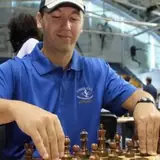
Gata Kamsky
Gata Kamsky is the great American hope who walked away at the summit and came back to climb it again. A Tatar boy carried out of the Soviet Union by a father who would settle for nothing less than the world title, he became, before he was old enough to vote, the youngest player ever to reach the world's top ten and the first American since Bobby Fischer to play for the championship of the world. Then — at twenty-two, with the crown still in sight — he simply stopped, and traded the board for a university lecture hall for eight years. That he returned at all was remarkable; that he returned to win the World Cup and four more U.S. titles is the kind of second act chess almost never grants.
◈A Tatar boy and his father
He was born Gata Rustemovich Kamsky in Novokuznetsk, deep in Soviet Siberia, in 1974, into a Tatar family whose name carried weight: his grandfather, Gataullah “Kamsky” Sabirov, founded the Tatar Drama Theater in Kazan. His father Rustam, a former boxer, became his coach and manager and drove him with a famously uncompromising intensity.
The talent was enormous and early. At twelve Kamsky defeated the veteran grandmaster Mark Taimanov in tournament play and earned the National Master title in the same year. He won the Soviet under-20 championship twice over, in 1987 and again in 1988, while still a boy among young men.
◈Defection, and the American hope
In 1989 Kamsky and his father left the Soviet Union for the United States, helped to settle by Allen Kaufman of the American Chess Foundation and the businessman James Cayne. America had not had a genuine world-title contender since Fischer, and here, suddenly, was a teenager who might be one.
He did not disappoint. FIDE awarded him the grandmaster title in 1990, when he was sixteen, and within weeks of that birthday he had climbed to world No. 8 — the youngest player ever to break into the top ten. In 1991 he won the first of his U.S. Championships. The American chess world, starved of a champion for two decades, had found its standard-bearer.
◈The road to the crown
The mid-1990s were Kamsky's surge. With the title split between the FIDE and PCA cycles, he ran both gauntlets at once. In the PCA Candidates he beat the young Vladimir Kramnik in the 1994 quarterfinal and Nigel Short in the semifinal at Linares, before losing the final to Viswanathan Anand at Las Palmas in 1995 by 4½–6½.
The FIDE road carried him further. He drew his 1994 semifinal with Anand 4–4 and took it on rapid tiebreaks, then crushed Valery Salov 5½–1½ in the 1995 final at Sanghi Nagar. It made him the challenger — the first American since Bobby Fischer to play a match for the championship of the world.
◈Elista, 1996
The match was held in Elista, the capital of the Russian republic of Kalmykia, over twenty games against Anatoly Karpov — the reigning FIDE World Champion and one of the greatest players who ever lived. Kamsky struck early, winning the second game with a Greek gift bishop sacrifice on h7.
But Karpov's class told over the distance. The former champion won six games to Kamsky's three, with nine draws, taking the match 10½–7½. Kamsky had come within reach of the highest title in the game and been turned back by a legend at the peak of his match craft. He was twenty-two years old.
◈The vanishing — and the long way back
What he did next was almost without precedent. Ranked among the very best players in the world, Kamsky gave up professional chess entirely. Between 1996 and 2004 he played virtually no rated games. He earned a bachelor's degree from Brooklyn College in 1999 and went on to study law at the Touro Law Center — eight years away from the arena at the very age most grandmasters are at their strongest.
He came back in June 2004, and the comeback was no nostalgia tour. In 2007 he won the Chess World Cup, seeded eleventh, beating Peter Svidler, Ruslan Ponomariov and a teenage Magnus Carlsen on the way to defeating Alexei Shirov in the final. He lost a hard 2009 Candidates match to Veselin Topalov in Sofia, then in 2011 beat the same Topalov in the Kazan Candidates quarterfinal before falling to Boris Gelfand on tiebreaks. And he made the U.S. Championship his own again — winning in 2010 and 2011 back to back, then 2013 and 2014, five titles spread across twenty-three years. His rating peaked at 2763 in 2013, higher than it had ever been before the long absence.
◈France, the board, and the camera
A patient, granite-solid positional player — in his later years a devoted champion of the London System — Kamsky has always preferred the open battlefield to the closed elite circuit, playing in huge open tournaments where anyone can sit across from him. In 2025, after thirty-six years representing the United States, he transferred to the French Chess Federation.
Today he lives in France, where he teaches chess to students, and he shares the game with a far wider room than any classroom: he streams and posts his chess on Twitch as igmgatakamsky and on his YouTube channel, bringing the thinking of a former world-championship finalist to anyone who wants to watch a grandmaster work.
◈From the archive
◈Legacy
Kamsky's career is one of the strangest and most stirring in modern chess: a prodigy who reached a world-championship match before he was old enough to rent a car, vanished into the classroom for eight years, and returned to win the World Cup and keep on winning U.S. titles into his forties. He remains the only American between Bobby Fischer and the present generation to have played for the world crown, and for a generation of American players he was proof that the summit was reachable from their own country. He now passes that knowledge on from France — one student, and one stream, at a time.