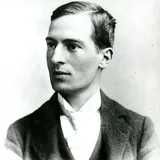
Harry Pillsbury
He came out of nowhere. In the summer of 1895 a twenty-two-year-old American almost unknown in Europe sat down against the entire ruling aristocracy of chess — the world champion, two former champions, the great theoreticians and tacticians of the age — and walked out ahead of them all. Harry Nelson Pillsbury played fast, fearless, attacking chess, carried whole tournaments of games in his head at once, and astonished audiences with feats of memory that bordered on the supernatural. He was, on the evidence of those years, very possibly the strongest player alive. He was also already dying. An illness contracted at the height of his powers hollowed him out over a single decade, and he was gone at thirty-three — the great might-have-been of the chess world, a champion who never got his title shot.
◈A New England boy and the game
Harry Nelson Pillsbury was born on 5 December 1872 in Somerville, Massachusetts. He came to chess comparatively late and learned it with frightening speed: within two years of taking the game seriously he was beating established experts, and in April 1892, not yet twenty, he won a match against the reigning World Champion Wilhelm Steinitz — who, it is true, had given him the odds of a pawn, but who did not give such odds to fools.
Boston's strong chess clubs sharpened him. He played the open, attacking style of the new generation, with a particular taste for the Queen's Gambit, and he had two gifts that set him apart from any contemporary: a prodigious memory and the capacity to calculate several complicated positions at once. Few outside America had heard of him when, in 1895, he sailed to England to test himself against the world.
◈Hastings, 1895
The Hastings tournament of 1895 was one of the strongest ever assembled — the reigning world champion Emanuel Lasker, the former champions Wilhelm Steinitz and the field's great theoretician Siegbert Tarrasch, alongside Mikhail Chigorin, Isidor Gunsberg, Carl Schlechter, Dawid Janowski and the rest of the world's elite. Into this company walked the unknown American, twenty-two years old.
He won it. Pillsbury finished first ahead of the entire firmament, taking the scalps of the champion and the ex-champions along the way, and overnight he was famous on two continents. It remains one of the most astonishing tournament debuts in the history of the game — a player nobody in Europe rated, beating everybody who mattered, at the first time of asking. His handling of the Queen's Gambit did much to popularise the opening, and his win over Tarrasch in that event is among the celebrated games of the era.
◈The shadow over St Petersburg
On the strength of Hastings, Pillsbury was invited to the great six-round quadrangular at St Petersburg in 1895–96 against Lasker, Steinitz and Chigorin — effectively a contest to decide who would challenge for the world title. He led the field after the first half with 6½ points from 9, playing the best chess of his life.
Then he collapsed. Wracked by violent headaches, he scored only 1½ from his last 9 games and finished third. It is widely believed that he had contracted syphilis shortly before the event; the disease that would kill him had begun its work. Garry Kasparov later judged that a victory at St Petersburg might have forced a world-championship match against Lasker — the title shot that, on talent alone, Pillsbury had earned and that he would never receive.
◈The blindfold marvel
If Hastings made Pillsbury famous, his exhibitions made him a legend. He was among the greatest blindfold and simultaneous players who ever lived, conducting as many as twenty-two games at once without sight of a single board, holding every position in his head and switching between them at will. At Hannover in 1902 he played twenty-one blindfold games simultaneously against the participants of the tournament's Hauptturnier.
His memory seemed to have no floor. Shown a long list of unfamiliar and tongue-twisting words, he would recite it back forwards and backwards — and then repeat the feat, perfectly, the following day. Edward Lasker, who watched him, never forgot it. For audiences of the 1890s and 1900s, Pillsbury's mind was as much the spectacle as his chess.
◈Champion in the long decline
Even as his health failed, Pillsbury remained a force. In 1897 he beat Jackson Showalter to take the United States Chess Championship, a title he would hold without interruption until his death. He kept travelling, kept playing, kept attacking — Munich, Vienna, Monte Carlo, Hannover — wringing brilliant games out of a body that was betraying him.
His finest late hour came at Cambridge Springs in 1904, where he met Emanuel Lasker again. The two men had been bound together by rivalry since Hastings; across their careers they finished level, five wins each. At Cambridge Springs, Pillsbury produced one of the great attacking games of his life and beat the world champion in a Queen's Gambit — a flash of the old wizardry from a man with two years to live. The disease would not be denied much longer. His health broke down completely, and on 17 June 1906 Harry Pillsbury died in Philadelphia, thirty-three years old.
“I have a poor memory for everything but chess.”
“Pillsbury gave a marvellous performance, winning 13 of the 16 blindfold games, drawing two, and losing only one.”
“Had he won at St Petersburg, Pillsbury might well have forced a match with Lasker for the world title.”
◈From the archive
◈Legacy
Pillsbury died on 17 June 1906 in Philadelphia, his mind and body destroyed by syphilis, three years short of his thirty-fourth birthday. He had held the United States championship unbroken from 1897 until his death and had never relinquished it on the board. What he left behind is measured less in titles — he was denied the one that mattered — than in the awe of those who saw him: the man who won Hastings on his first appearance among the masters, who could conduct twenty blindfold games at once and recite a stranger's word-list backward the next morning, who pioneered the Queen's Gambit attacks that still bear his fingerprints. Garry Kasparov reckoned that a healthy Pillsbury would have forced a world-championship match with Lasker. The illness wrote a different ending. Chess remembers him as one of its brightest flames and its saddest losses — the Wizard of Hastings, who burned out before the world could crown him.