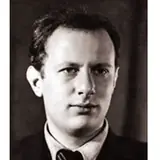
Isaac Boleslavsky
Isaac Boleslavsky never wore the crown, and he never seemed to want the noise that came with it. Yet few players in history changed how the game is played at the deepest level. While champions traded blows under the lights, this gentle, bookish man from the banks of the Dnieper sat with his board and his library and quietly overturned the rules of the opening — teaching the Sicilian to push its e-pawn into the centre and accept a weakness no master before him had dared accept, and helping lift the King's Indian from a dubious experiment to one of the great defences of modern chess. He came within a single playoff of a shot at the world title, then spent his finest years not chasing it himself but standing behind the men who did.
◈A boy from the Dnieper
He was born in 1919 in Zolotonosha, a small town in the Ukrainian SSR, to a Jewish family, and he came to chess the way he would come to everything — through reading. He taught himself the moves at nine, and the books did the rest. By 1933 he was schoolboy champion of Dnipropetrovsk; in 1936 he took third prize in the All-Union Junior Championship at Leningrad; and in 1938, still only nineteen, he won the championship of Ukraine.
The next year he qualified for the USSR Championship — the strongest national tournament on earth — and in the 1940 final he tied for fifth and sixth with no less a figure than Mikhail Botvinnik. A self-taught provincial had walked, in barely half a decade, into the front rank of Soviet chess.
◈The quiet revolution
Boleslavsky's monument is not a trophy but an idea. In the Sicilian Defence he advocated meeting White's central knight with the move ...e5 — planting Black's own pawn in the centre at the cost of a backward pawn on d6 and a permanent hole on d5. For generations such concessions were considered simply bad. Boleslavsky showed that the dynamism Black received in return — piece activity, open lines, the initiative — was worth far more than the static weakness. The structure became known as the Boleslavsky Variation, and the d5 square it surrenders is still called the Boleslavsky hole; the analyst Hans Kmoch christened a related pawn formation the Boleslavsky Wall in his classic Pawn Power in Chess.
He did the same service for the King's Indian Defence. Together with his fellow Ukrainians David Bronstein, Efim Geller and Alexander Konstantinopolsky, Boleslavsky took a defence that respectable opinion held to be unsound and turned it into one of the most popular and combative answers to 1.d4 in the game. Lev Polugaevsky, no easy man to impress, wrote that any player — even the very strongest — could and should learn from Boleslavsky's games, especially his Sicilians, praising his virtuoso feeling for the dynamics of the opening.
◈So close to the summit
His own assault on the title peaked in a single, cruel cycle. In 1945 he finished second in the 14th USSR Championship and was awarded the Soviet Grandmaster title; that same year, in the famous USSR–USA radio match, he defeated the great American Reuben Fine. When FIDE handed out its first International Grandmaster titles in 1950, Boleslavsky's name was among them.
Then came the 1950 Candidates Tournament in Budapest — the event that would decide Botvinnik's first post-war challenger. Boleslavsky was the only player to go through it undefeated, and he led for most of the way. But Bronstein surged at the finish to catch him, forcing a playoff. Over fourteen games the two friends could barely be separated; Bronstein edged it by a single point, +3 −2 =9, and went on to draw his title match with Botvinnik. It was the closest Boleslavsky would ever come, and he never again reached such heights — at Zürich 1953, the next Candidates, he finished only in the lower half.
◈The man behind the champions
What he did next defined him as much as his own games. The very rival who had denied him in Budapest, David Bronstein, married Boleslavsky's daughter Tatiana — and Boleslavsky served as Bronstein's second in the 1951 World Championship match against Botvinnik, which Bronstein drew 12–12. Having moved to Minsk in 1951, he became a fixture of Belarusian chess, winning the republic's championship and representing the USSR at the 1952 Helsinki Olympiad, where he scored seven points from eight games.
From 1963 to 1969 he was the trusted assistant of Tigran Petrosian, helping prepare the openings that carried Iron Tigran to the world title against Botvinnik and to its defence against Spassky. In 1968 he captained the Soviet students' team to the world championship. The man who came one game short of a title shot of his own spent his prime making world champions of others — and did it without a trace of bitterness.
◈Books and the board
Those who knew him remembered the character before the chess. "Boleslavsky was a man of exceptional modesty and great culture," wrote the grandmaster Alexey Suetin. "If it is difficult to imagine Boleslavsky without chess, it is simply impossible to imagine him without books." He knew history, classical literature and poetry, and he poured the same scholarly patience into the chessboard that he poured into a library shelf.
It made him one of the most respected analysts and opening theoreticians of his age — a writer and teacher whose authority rested not on titles won but on the depth and honesty of his work. He was, in the truest sense, a chess scholar: a player who studied the game less to beat people than to understand it.
“I am convinced that any player, even the very strongest, can and should learn from his games — especially the Sicilians!”
“Boleslavsky was a man of exceptional modesty and great culture. If it is difficult to imagine Boleslavsky without chess, it is simply impossible to imagine him without books.”
◈From the archive
◈Legacy
Boleslavsky died in Minsk on 15 February 1977, aged fifty-seven, after a fall on an icy street fractured his hip and a hospital infection took the rest. He left behind a body of theory still argued over at the highest level: every "Boleslavsky Variation" and "Boleslavsky Wall" in a modern openings manual carries his name into games he never saw. He had been, to the last, what Suetin called him — a man impossible to imagine without his books — and a collection of his best games, published in English in 1990, won the year's prize for the finest chess book in Britain. The summit eluded him, but the map he drew of the opening is still the one the world plays by.