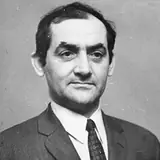
Leonid Stein
Leonid Stein was the great attacker the world title never came to find. In an age when the road to the crown ran through the Soviet Championship — the deepest tournament on earth — he won it three times, and three times a single bureaucratic clause stood between him and a shot at the world title. He played a fierce, intuitive, Alekhine-coloured chess that asked questions almost no one could answer over the board; Bobby Fischer thought enough of him to ask for a match. Then, at thirty-eight, with his best chess plainly still ahead of him, his heart simply stopped. He is remembered for the brilliance he did leave behind, and for the title he was never allowed to reach.
◈A late and sudden arrival
Stein was born in Kamianets-Podilskyi, in the Ukrainian SSR, in November 1934. He came to serious chess late by Soviet standards — he served in the Red Army, winning its individual championship in 1955 and 1956, and reached the National Master title only at twenty-four. There was nothing precocious about the ascent; what there was, once it began, was force.
He played his first Soviet Championship at Tbilisi in 1959 and took the Ukrainian title in 1960 and again in 1962. The Grandmaster title followed in 1962. Within a few years a player who had arrived without fanfare was beating, one after another, the strongest men in the world.
◈Champion of the Soviet Union — three times
To win the Soviet Championship in the 1960s was, by common consent, a harder thing than to win most international tournaments: the field was an unbroken wall of world champions, challengers and candidates. Stein broke through it three times. At Leningrad in 1963 he finished level with Boris Spassky and Ratmir Kholmov and won the title in a playoff. At Tallinn in 1965 and Tbilisi in 1966 he took it outright, back to back.
Three Soviet crowns in four years placed him, beyond argument, among the very best players alive — and he held a station inside, or just outside, the world's top ten from 1963 until his death.
◈The rule that cost him the crown
Stein's tragedy was written into the regulations. A FIDE rule then in force limited the number of qualifiers from any single country to three — and the country with too many strong players was always the Soviet Union. Three times he played the Interzonal well enough to reach the Candidates, and three times the rule shut the door.
At the 1962 Stockholm Interzonal he tied for 6th–7th, a result that would have qualified almost anyone; he finished behind one Soviet too many, and Pal Benko took the last place instead. At Amsterdam in 1964 he scored 16½ out of 23 for fifth — sufficient to qualify for any non-Soviet player — and was blocked again, behind Tal, Smyslov and Spassky. At Sousse in 1967 he tied for 6th–8th and at last had his chance in a playoff in Los Angeles, only to fall to Reshevsky and Hort. The match for the world title that his strength deserved never came.
◈Moscow 1967, and the chess of an attacker
His masterpiece as a tournament player came at Moscow in 1967, the great international staged for the fiftieth anniversary of the October Revolution. Stein won it — ahead of the reigning World Champion Tigran Petrosian, the former champions Vasily Smyslov and Mikhail Tal, and Boris Spassky and Paul Keres besides. There were other triumphs: a share of first with the young Anatoly Karpov at the 1971 Alekhine Memorial in Moscow, and a share of first with Petrosian at Las Palmas in 1973. He was a feared team player too, taking individual gold on first reserve at the 1964 Tel Aviv Olympiad with 10 out of 13.
His chess drew on Chigorin and Alekhine — a highly intuitive, natural attacking style, willing to risk a sound position rather than drift toward a draw, yet never as reckless as Tal in courting the unclear. He handled the King's Indian, the Grünfeld and the Sicilian as living, dangerous weapons. The head-to-head ledgers tell the rest: he held even scores against Botvinnik, Smyslov and Petrosian, and plus scores against Tal, Spassky and Keres.
◈Fischer wants a match — and a heart that stopped early
After the 1966 Havana Olympiad, Bobby Fischer reportedly went to Fidel Castro and asked to play a match against Stein in Cuba — no draws, first to ten wins. Stein answered that he, or any Soviet master, was ready to meet the American champion at any time the next year. Nothing came of it, but the proposal tells you how the most demanding judge of all rated Leonid Stein.
The end came without warning. On 4 July 1973, at the Rossiya Hotel in Moscow, as he prepared to leave with the Soviet team for the European Team Championship in Bath, England, Stein died of a heart attack. He was thirty-eight. His widow and children later settled in the United States.
“I myself, or any of the Soviet masters, am ready to play a personal match against the United States champion, Robert Fischer, at any date and hour set for the coming year, 1967.”
“I would like, after the Olympiad, to play a match with Stein here in Cuba — no draws, to see who is first to win ten games.”
◈From the archive
◈Legacy
Stein left no world title and no long late career — only the games, and the sense of a height never reached. He had been a champion of the strongest chess nation on earth three times over, a tournament victor over every great player of his generation, and, by the judgement of Fischer himself, worth a match for the highest stakes. His friend and second Eduard Gufeld, with Efim Lazarev, gathered his best games into the book Leonid Stein: Master of Risk Strategy, so that the brilliance would not be lost with the man. He is remembered as one of the finest attacking players never to contest the world championship — kept from it not by any rival across the board, but by a rule, and by a heart that gave out far too soon.