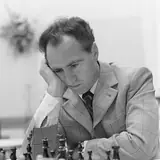
Lev Polugaevsky
Lev Polugaevsky never wore the world crown, and he is remembered all the same — because he gave chess something the champions could not, a way of loving the game in the silence between rounds. While others slept he sat alone with a board, chasing a single Sicilian line down corridor after corridor until the truth gave way. Out of that solitary labour came a variation that carries his name to this day, two volumes that map a maze no one else dared to enter, and a handful of games so deeply prepared that he had, in a real sense, already won them at home. He was the patient miner of chess, and the gold he brought up is still in circulation.
◈A talent that ripened slowly
Polugaevsky was born on 20 November 1934 in Mogilev, in the Byelorussian SSR, and came to chess around the age of ten — late, by the standards of the prodigies who filled the Soviet ranks. He was not one of them. Where Tal flashed and Spassky flowed, Polugaevsky climbed: first under the candidate master Alexy Ivashin, who taught him in 1948, then in the orbit of the international master Lev Aronin, whom he credited above all others for his development, and in study sessions with the great tactician Rashid Nezhmetdinov between 1950 and 1953.
His rise was unhurried and entirely earned. The Soviet master title came only in adulthood; the Grandmaster title followed in 1962. For years he was a working man as much as a chess player — he kept his post as an engineer until 1973, fitting world-class chess around a profession. It was the perfect apprenticeship for the player he became: one who trusted not talent alone but the long discipline of work.
◈Champion of the Soviet Union
To win the Soviet Championship in those decades was, by common consent, harder than winning many a world title — the field was simply the strongest on earth. Polugaevsky did it twice. In 1967 he shared the championship with Mikhail Tal; in 1968 he won it outright, defeating Alexander Zaitsev in a play-off. In 1969 he tied for first once more and lost the deciding play-off to Tigran Petrosian — three years at the very summit of the most brutal national arena in chess.
Abroad he was just as dangerous, winning the strong Mar del Plata tournament in 1962 and again in 1971, and earning a place on the Soviet team for the 1970 “Match of the Century” against a Rest of the World side — selection that by itself marked him among the handful of best players alive. By July 1972 the rating lists placed him at 2645, third in the world. He played in seven Chess Olympiads between 1966 and 1984, the Soviet team taking gold in every one of them but 1978, when Hungary edged them into second.
◈The labyrinth
Polugaevsky's true monument is an opening. He fell in love with the Sicilian Defence and, within it, the sharpest of all its branches, the Najdorf. There he authored the line the whole chess world now calls the Polugaevsky Variation: after 1.e4 c5 2.Nf3 d6 3.d4 cxd4 4.Nxd4 Nf6 5.Nc3 a6 6.Bg5 e6 7.f4, the audacious 7...b5, throwing a pawn forward into the most dangerous attacking position White can build. It was not a move so much as a wager on analysis — that Black's resources, if dug deep enough, would hold. Generations have tested it and it endures.
He poured that obsession into The Sicilian Labyrinth, a two-volume work of some five hundred pages he spent two and a half years building — his magnum opus, and a guided tour of a maze he had walked more thoroughly than any man living. For Polugaevsky, home analysis was not preparation for the art; it was the art. “Analysis,” he wrote, “is a glittering opportunity for training.”
The most famous proof came at the 1969 Soviet Championship in Moscow, against Mikhail Tal — the Magician from Riga himself. Working alongside Boris Spassky, who was then preparing his world-title match, Polugaevsky had searched the resulting position to its depths. He recalled afterwards that the position on the board as late as the twenty-fifth move had already appeared in his analysis on the very morning of the game. He beat Tal in a game he had, in truth, half-won before sitting down.
◈So near the summit
For all his strength, the world title stayed just beyond him, and the same name kept barring the door. In the Candidates cycle of 1977 he defeated the brilliant young Brazilian Henrique Mecking in the quarter-final, only to fall to Viktor Korchnoi in the semi-final. He tried again in the next cycle, and in 1980 he beat Tal in the quarter-final — a measure of how high he still stood — before Korchnoi stopped him once more in the semi-final.
Twice within sight of a title match, twice turned back by the same indomitable opponent. There is a particular cruelty in it: the most thorough preparer in chess history could prepare for everything except the man who stood between him and the challenge. He never became World Champion, and he wears that absence the way Rubinstein and Keres wear theirs — as proof not of any lack, but of how merciless the era was.
◈The writer and the man
What he could not win he chose instead to give away, in books written to a standard almost no one else kept. Grandmaster Preparation, Grandmaster Performance and Grandmaster Achievement let readers inside the mind of a man for whom chess was a vocation rather than a contest. He was scathing about lazy work: “Ninety per cent of all chess books you can open at page one and then immediately close again for ever,” he said. “You should take at least two years for a book, or not do it at all.” He held himself to exactly that.
In his last years he settled in Paris. In October 1994 the chess world honoured his sixtieth birthday with a tournament in Buenos Aires in which every game had to open with a Sicilian — a gift to the man who loved the opening more than anyone; the book of it was titled Sicilian Love. He came as guest of honour, but illness kept him from playing. Within the year he was gone.
“Analysis is a glittering opportunity for training: it is just here that capacity for work, perseverance and stamina are cultivated, and these qualities are, in truth, as necessary to a chess player as a marathon runner.”
“Ninety per cent of all chess books you can open at page one and then immediately close again for ever. You should take at least two years for a book, or not do it at all.”
◈From the archive
◈Legacy
Polugaevsky died of a brain tumour in Paris on 30 August 1995, aged sixty. He left no world title, but he left something rarer: a body of analysis that the strongest players alive still consult, and a variation of the Najdorf that bears his name in every opening book printed since. The chess world remembered him as the head of the Sicilian clan — the man who proved that home preparation, pursued with enough love and stamina, could be a form of art in its own right. He was the supreme example of the chess truth-seeker: never champion of the world, but for half a century the most thorough mind ever bent over a single opening.