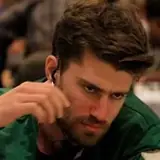
Marc Esserman
Most masters treated the Smith-Morra Gambit as a relic — a hustler's trick, refuted decades ago and beneath serious play. Marc Esserman never believed them. From Miami to Harvard Yard to the open-tournament circuit, he poured a lifetime into a single pawn sacrifice the chess world had pronounced dead, then went looking for grandmasters to convince. He found them. Across the board he is an unrepentant romantic in the age of the engine — a player who would rather burn a position to the ground for the attack than grind out a safe half-point — and when the smoke clears, more often than the odds allow, the king stranded in the centre is not his own.
◈A Miami boy in Harvard Yard
Esserman was born in Miami, Florida, in 1983 and took up chess at the age of seven. The talent showed early and showed loud: two national scholastic team titles in 1994 and 1995, and a perfect 7–0 run through the K–8 section of the 1997 Super Nationals, the largest rated tournament ever held in the United States.
He went on to Harvard College, where for four years he captained the chess club and organised international exchanges. The academic setting never softened his chess. If anything it sharpened a contrarian streak already forming in him — a conviction that the textbooks were wrong about one opening in particular, and that he could prove it.
◈The much-maligned Morra
The Smith-Morra Gambit — 1.e4 c5 2.d4 cxd4 3.c3, named for Pierre Morra and the Texan Ken Smith — offers a pawn in the Sicilian for fast development and open lines toward the Black king. For generations the consensus of strong players was that it was simply unsound: a pawn given away for a club-level ambush that real opposition would refute. Esserman set out to overturn that verdict.
He has played and analysed the Morra for most of his life, reviewing thousands of games to map its forests of complications. Rarely has one person done so much to revive a variation long thought dead. Where others memorised lines, he argued for the gambit on its merits — domination of squares and relentless pursuit of pieces — treating the sacrificed pawn not as a gamble but as an investment he could always redeem at the board.
◈Felling grandmasters
Belief is cheap; scalps are not. From 2008 onward Esserman began converting his faith into wins over titled players. He beat grandmaster Eugene Perelshteyn at the 2008 World Open, and that same year, in Miami, he hunted down GM Victor Mikhalevski and checkmated him in the middle of the board. In 2009 — the year he earned the International Master title — he downed four-time U.S. Champion Alexander Shabalov at the Eastern Class Championship and turned away GM Zbynek Hracek, who had declined the Morra rather than face it head-on.
The victories piled into titles of his own: co-winner of the 2009 Eastern Class Championship, the 2010 New York State Championship, and the 2011 Liberty Bell Open in Philadelphia. But the game the chess world remembers came at the 2011 U.S. Open. Across the board sat Loek van Wely, a world top-ten grandmaster rated near 2700 — and Esserman, with the gambit everyone said could not survive contact with elite opposition, sacrificed a knight on d5, blew open the centre, and forced resignation in twenty-six moves.
◈Mayhem in the Morra
In 2012 the Scottish house Quality Chess published Mayhem in the Morra!, Esserman's 360-page case for the defence — part repertoire, part manifesto, opening with a chapter pointedly titled The Much Maligned Morra. It was received not merely as an opening manual but as literature: The Boston Globe called him “a Balzac of chess writers,” and three-time U.S. Champion Larry Christiansen wrote that there was “no greater authority in the world on this line.”
The most telling endorsement came from his victim. Loek van Wely, recalling their U.S. Open game, admitted that he had been “crushed in an impressive way” and was forced “to consider the Morra seriously for the first time in my life.” A gambit dismissed as a toy now had a book, a champion, and converts among the very grandmasters who had scorned it.
◈A romantic out of time
Commentators reach instinctively for Mikhail Tal when they describe Esserman's play — GM Kevin Spraggett noted his reputation for “Tal-like masterpieces” — and the comparison is apt. His chess belongs to the romantic tradition of attack first and count the cost later, a sensibility that runs against the cautious, engine-checked grain of modern tournament practice.
He carried it to the elite stage at the 2016 Gibraltar Masters, defeating former World Championship challenger Nigel Short and then, true to himself, wheeling out his beloved Morra against five-time World Champion Viswanathan Anand; the game was drawn by repetition, though more than a few onlookers thought he had let a win slip. Beyond the board he has written for Chess Life and taken the gospel of the attack to a new generation online — streaming chess on Twitch as whyyyyyyysoserious, posting to a YouTube channel under his own name, and coaching as the self-styled Masster of Mayhem — all while bringing the same appetite for calculated risk to the poker table.
“I got crushed in an impressive way, leaving me both groggy and completely mad, forcing me to consider the Morra seriously for the first time in my life.”
“There is no greater authority in the world on this line than Marc Esserman and he lays it all out there in this book.”
“Esserman had already established a reputation for producing some Tal-like masterpieces.”
“Because of his energetic style, we would call him a Balzac of chess writers and we grant him high marks.”
◈From the archive
◈Legacy
Esserman never chased a world title, and the record book will not rank him among the champions. His legacy is stranger and, in its way, rarer: he took an opening the establishment had buried, knelt at its grave, and brought it back to life with his own hands — proving in tournament after tournament that romance and soundness need not be enemies. Mayhem in the Morra! stands as the definitive text on the gambit, and a generation of players from club halls to grandmaster ranks now reach for 3.c3 because one stubborn American refused to believe it was dead. In an era that prizes the safe and the engine-approved, he kept faith with the attack.