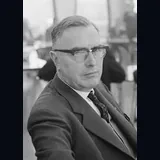
Max Euwe
Max Euwe never let chess become his whole life, and that is precisely what makes his story remarkable. He was a doctor of mathematics, a schoolteacher, a husband and father who played the world's hardest game on weekends and evenings — and for two years he was its champion. In the autumn of 1935 this courteous Dutch amateur did what no professional had managed in eight years: he took the crown from Alexander Alekhine. He held it with grace, lost it with grace, and spent the rest of a long life giving chess back more than he ever took — seventy books, a generation of pupils, and, at the end, the most honourable presidency the game's troubled politics has known.
◈The mathematician from Watergraafsmeer
Machgielis Euwe — Max to everyone — was born in the Watergraafsmeer district of Amsterdam on 20 May 1901. He learned the moves as a small boy and played his first tournament at the age of ten, reportedly winning every game; but chess was never allowed to crowd out the rest of his mind. He read mathematics at the University of Amsterdam under the shadow of the great intuitionist L. E. J. Brouwer, and in 1926 took his doctorate under Roland Weitzenböck. He taught mathematics in Rotterdam and then at a girls' lyceum in Amsterdam, and he carried that teacher's clarity to the board for the rest of his life.
He remained, by choice, an amateur — a player who earned his bread elsewhere and came to the sixty-four squares unbought and unhurried. In 1928 at The Hague he won the World Amateur Championship with a commanding 12 out of 15, and across three decades he would take the Dutch national title a record twelve times. The professional world began to understand that the polite professor from Amsterdam was something more than a gifted dilettante.
◈The road to the title
Through the late 1920s and early 1930s Euwe sharpened himself against the very best, testing his logical, opening-deep style on the strongest opponents alive. He had a mathematician's appetite for variations and would stride into the most fearsome complications when calculation told him they were sound. In 1931 he defeated the legendary José Raúl Capablanca in tournament play — a result that announced him as a genuine contender for the highest title.
When the chance came to challenge Alexander Alekhine, the reigning champion and one of the most brilliant attackers the game had produced, few outside the Netherlands gave the amateur a serious hope. Euwe prepared the way a scientist prepares — methodically, without illusion — and walked into the match of his life carrying his nation's expectations on a teacher's modest shoulders.
◈The Pearl and the crown
The 1935 World Championship match ran from 3 October to 16 December, a marathon of thirty games carried across thirteen Dutch cities — it was the first title match in which the players used seconds to help analyse adjourned positions. Alekhine started like the champion he was, winning games one, three, seven and nine to open a daunting lead. Then the tide turned. Euwe steadied, struck back, and game by game hauled himself level and ahead.
Game twenty-six, played at Zandvoort, became famous as the Pearl of Zandvoort — a deep, strategically perfect win that is still cited as one of the finest games of the entire match. When the dust settled, Max Euwe had won 15½–14½ and become the fifth World Chess Champion, and the only Dutchman ever to hold the title. A nation that had never produced a champion suddenly had one, and chess clubs sprang up across the Netherlands in his wake.
◈Reign, rematch, and a logical art
Euwe wore the crown as he wore everything — with modesty and good humour. He was admired for the lucidity of his play and for an opening knowledge so thorough that he reshaped theory in several lines. Yet his contemporaries also noticed that his very evenness of temper could cost him: Gennadi Sosonko thought Euwe's modesty a handicap at the summit, and the champion sometimes lacked the ruthlessness to grind out a position gone sour.
The rematch came in 1937, and a transformed Alekhine — who had given up alcohol and tobacco to prepare — reclaimed the title decisively, 15½–9½. Euwe accepted the loss without bitterness and simply kept playing and, above all, kept teaching. He went on to write more than seventy chess books — more than any other World Champion — including The Road to Chess Mastery, Judgement and Planning in Chess and Strategy and Tactics in Chess. His instructional work Practische Schaaklessen became a textbook even in the Soviet chess schools that produced his rivals.
◈The honourable president
In 1970, at the age of sixty-nine, Euwe took on the presidency of FIDE, the world chess federation, and gave the game one last great service. Where chess politics ran on Cold-War expediency, he insisted on principle. He interpreted the rules flexibly to bring Bobby Fischer into the cycle that produced the epochal 1972 match against Spassky; he defended the right of defectors such as Viktor Korchnoi and Gennadi Sosonko to compete; and in 1977 he ruled that women could not be barred from open events.
A mathematician who had become a professor of the new science of computing, Euwe was also an early believer in computer chess, taking the machines seriously long before they could beat a master. He served until 1978, and the verdict of his peers was unambiguous. Anatoly Karpov granted that “he was a very good FIDE President”; Korchnoi called him the last honourable one.
“Strategy requires thought; tactics require observation.”
“Whoever sees no other aim in the game than that of giving checkmate to one's opponent will never become a good chess player.”
“Max Euwe was, without a doubt, the best President FIDE ever had.”
“He was the last honourable president of FIDE.”
“Euwe won the 1935 match on merit.”
◈From the archive
◈Legacy
Max Euwe died of a heart attack in Amsterdam on 26 November 1981, aged eighty. He had been appointed Officer of the Order of Orange-Nassau in 1936 and promoted to Commander in 1979. His city remembers him at the Max Euweplein, a square set with a giant outdoor chessboard and his statue, beside the Max Euwe Centrum that houses one of the world's great chess libraries. He is honoured twice over: as the amateur who climbed, on his own quiet terms, to the very top of a professional's game, and as the rare administrator who put integrity above power. The schoolteacher from Watergraafsmeer gave chess a champion, a teacher, and a conscience.