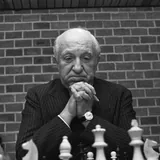
Miguel Najdorf
They called him Don Miguel, and he filled a room the way few players ever have — big voice, bigger appetite for the attack, a showman who treated the chessboard as a stage. Beneath the flamboyance was one of the great survivors of the twentieth century. Miguel Najdorf sailed to Buenos Aires for a chess tournament in 1939 and never went home; the war took everyone he loved, and he answered the silence the only way he knew how — by playing chess loud enough, he hoped, for the lost to hear. He became Argentina's greatest player, by one reckoning the second-best player alive, and the man whose name a million players speak every time they reach for the Sicilian.
◈Mojsze from Grodzisk Mazowiecki
He was born Mojsze Mendel Najdorf on 15 April 1910 in Grodzisk Mazowiecki, near Warsaw, into a Jewish family; in Poland he went by Mieczysław. He came up through the strong chess life of interwar Warsaw and fell under the wing of the great Savielly Tartakower, whom he would call, for the rest of his life, simply my teacher — and from whom he inherited a love of wit as sharp as his combinations.
In Warsaw in 1935, playing Black against a master named Glücksberg, the young Najdorf produced one of the most beautiful games of the century. He gave up all four of his minor pieces — both bishops and both knights — to strip the enemy king bare, and delivered mate with a pawn. Chess remembers it as the Polish Immortal. By the late 1930s he was a fixture of the Polish Olympiad teams and one of the most dangerous attacking players in Europe.
◈The ship that never sailed home
In August 1939 the Polish team crossed the Atlantic to play the 8th Chess Olympiad in Buenos Aires. While they sat at the board, Germany invaded Poland and the Second World War began. Najdorf, a Jew, did not go back. He had arrived in Argentina on 21 August 1939; he stayed, and became a citizen in 1944.
The cost was absolute. His wife Genia, his daughter Lusia, his parents Gdalik and Raisa, and four siblings were all murdered in the Holocaust. He had said goodbye without knowing it was goodbye. Many years later, by pure chance in a New York subway, he met a surviving cousin — nearly the only family the war had left him.
◈Forty-five boards, eyes closed
Out of that grief came something astonishing. Najdorf staged blindfold simultaneous exhibitions — playing dozens of opponents at once without sight of a single board — and set world records doing it: 40 games in 1943, and at São Paulo in 1947 a staggering 45 games at once, winning 39, drawing 4 and losing only 2. No one would surpass it for sixty-four years.
He gave a haunting reason for the feat. He hoped that word of so strange a spectacle might travel back across the ocean, and that somewhere in Europe his family would read his name and know he was alive. They were already gone. He performed it anyway, again and again — a memorial in the shape of a circus act.
◈The peak years
After the war Najdorf was among the very best players alive. He swept Prague and Barcelona in 1946, and by retrospective rating he stood as the world's No. 2 from 1947 to 1949, behind only Botvinnik — whom he had beaten in their very first meeting, at Groningen 1946, before the Soviet became world champion. In 1950 FIDE named him one of its inaugural Grandmasters, and that same year he won Amsterdam with 15/19, finishing ahead of his great American rival Samuel Reshevsky.
He finished fifth in the 1950 Candidates at Budapest and equal sixth at Zurich 1953 — the strongest tournament of its age — where he produced a celebrated brilliancy against Mark Taimanov, the grandmaster who was also a concert pianist. Taimanov had better go and play his piano! Don Miguel announced afterward. The bitterest chapter was a title he was never allowed to chase: he won the Prague qualifier outright, yet amid Soviet pressure was left out of the 1948 World Championship.
However high he climbed, his deepest mark on chess needed no crown. The Najdorf Variation of the Sicilian — 1.e4 c5 2.Nf3 d6 3.d4 cxd4 4.Nxd4 Nf6 5.Nc3 a6 — became the chosen weapon of Bobby Fischer and Garry Kasparov, and remains to this day one of the sharpest main lines in the game.
◈Don Miguel
Eight times Champion of Argentina, he was the gravitational center of South American chess for half a century. He was never merely a professional — for years he sold life insurance — yet he wrote a beloved chess column in Clarín, spoke eight languages, and once sat down for a casual game with Che Guevara. He held José Raúl Capablanca and Bobby Fischer to be the greatest players who ever lived.
His second family in Argentina — his wife Adela and their daughters Mirta and Liliana — gave back something the war had taken. Liliana remembered her father as a man of vivid contradictions, jovial and generous and grieving all at once. He never stopped playing: he contested his final Argentine Championship at the age of 81 and remained a dangerous blitz player to the very end.
“When Spassky offers you a piece, you might as well resign then and there. But when Tal offers you a piece, you would do well to keep playing, because then he might offer you another.”
“Taimanov had better go and play his piano!”
“I believe that I am inferior to none of the players who are to participate in the next world championship.”
“A mixture of extremes: violent-tempered, but compassionate and loving, selfish at times but also generous to a fault, jovial and a bon vivant, but also sad because of the terrible losses of the Holocaust.”
“As long as chess survives, so will the name Najdorf.”
◈From the archive
◈Legacy
Najdorf died in Málaga, Spain, on 4 July 1997, aged 87, still crossing oceans for the game as he had since 1939. He had taken the worst the century could do to a man and answered it with noise, warmth, and beauty over the board — eight Argentine crowns, a fistful of the world's great tournaments, the most famous blindfold feats ever performed, and a defense that bears his name in every opening book ever printed. He never wore the world champion's crown; he did not need to. Every time a player meets 1.e4 c5 and reaches for 5...a6, Don Miguel is still at the board.