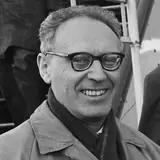
Mikhail Botvinnik
Before there was a Soviet chess machine, there was Mikhail Botvinnik — the engineer who built it. He treated the board the way he treated a power grid: as a problem to be solved by preparation, discipline and relentless analysis, and in doing so he invented the way champions have studied ever since. He was the first Soviet player to hold the world title and he held it, on and off, for fifteen years, twice losing the crown and twice climbing back to take it again — the second time at the age of fifty. They called him the Patriarch, and the name fit twice over: father of the modern game, and teacher of the three champions who would inherit it.
◈The engineer's son
Botvinnik was born in 1911 in Kuokkala, a Finnish village then inside the Russian Empire, to a family of Russian Jews — his father a dental technician, his mother a dentist. He came late to chess, learning the moves in the autumn of 1923 at the age of twelve from a school friend, but he came fast: he won his school championship the following winter, and in 1925, aged fourteen, he beat the reigning World Champion José Raúl Capablanca in a simultaneous exhibition in Leningrad.
In 1927, at sixteen, he qualified for the final of the Soviet Championship — the youngest player ever to do so at that time. Yet he never let chess swallow the rest of his life. He studied electrical engineering at the Leningrad Polytechnic Institute, graduating in 1931, and would go on to earn a doctorate in the field in 1951. To the end he insisted he was an engineer who played chess, not the reverse — and it was precisely that outsider's discipline that he brought to the board.
◈The first Soviet champion of the world
When Alexander Alekhine died in 1946 still holding the title, the championship was vacant for the first time in history. FIDE settled the succession with a tournament of the world's best, played across The Hague and Moscow in 1948. Botvinnik won it decisively — 14 points from 20 games, three full points clear of the field — and became the sixth World Chess Champion. He was the first Soviet player to wear the crown, and in a country that treated chess as proof of its system, that made him something more than a sportsman.
He carried the weight of that role for the rest of his career. Where Capablanca had been natural genius and Alekhine ferocious imagination, Botvinnik was method made flesh: the patriarch around whom an entire national school would form.
◈Fifteen years, and the men who came for the crown
Botvinnik defended the title in a series of marathons against the strongest players alive. In 1951 David Bronstein pushed him to the wire and the match finished level at 12–12, so Botvinnik kept the crown; Vasily Smyslov did the same in 1954, another 12–12 draw. Then the title began to slip and return. Smyslov beat him in 1957 — and under the rematch clause that critics nicknamed the “Botvinnik rule,” the deposed champion came straight back in 1958 and won the title back.
The pattern repeated against the young Mikhail Tal, the magician from Riga, who tore the crown away in 1960. Botvinnik went home, studied Tal's attacking style to its roots, and returned in 1961 to win the rematch 13–8 — at the age of fifty, the oldest man ever to win a world championship match. His reign finally ended in 1963 against Tigran Petrosian, and by then FIDE had abolished the automatic rematch, so there was no second chance. He had been champion, in three separate spells, across fifteen years.
◈The scientific method
Botvinnik's real revolution was not any single game but the way he prepared for all of them. He approached chess as a science: a narrow, deeply analysed opening repertoire; exhaustive study of his own games, the classics, and every future opponent; physical conditioning; even training games played in deliberately noisy, smoke-filled rooms so that nothing could rattle him at the board. This is the blueprint every professional has followed since.
His style matched his method. He favoured the slow, structural openings — the English and the Queen's Gambit with White, and famously never once played 1.e4 in any of his world championship matches — and he was willing to accept a weakness if it bought a lasting advantage. He freely admitted that pure calculation was not his greatest strength, yet he produced long-range positional sacrifices of startling depth. His name is stamped on the theory books: the sharp Botvinnik Variation of the Semi-Slav and the Botvinnik System in the English Opening are still played at the highest level.
◈The school and the engineer
In 1963 Botvinnik founded the chess school that would shape Soviet — and world — chess for a generation. Through its doors passed three future World Champions: Anatoly Karpov, Garry Kasparov and Vladimir Kramnik. On meeting the young Kasparov he said, “The future of chess lies in the hands of this young man” — a prophecy he lived to see fulfilled.
Away from teaching, the engineer never stopped working. From the 1950s he poured himself into computer chess, developing the PIONEER program that tried to make a machine search the way a master does — selectively, by chess principles rather than brute force — and hoped to apply the same decision-making to Soviet economic planning. He had married the Bolshoi ballerina Gayane Ananova in 1935, and worked on his programs almost to the day he died, nearly blind, financing the projects himself through lectures when the state lost interest.
“Chess is the art of analysis.”
“I am a Jew by blood, a Russian by culture, and Soviet by upbringing.”
“Botvinnik tried to take the mystery out of chess, always relating it to situations in ordinary life. He used to call chess a typical inexact problem similar to those which people are always having to solve in everyday life.”
“Botvinnik's chess career was the way of a genius, although he was not a genius.”
◈From the archive
◈Legacy
Botvinnik died in Moscow on 5 May 1995, aged eighty-three. He is remembered as the Patriarch of the Soviet Chess School — not the most naturally gifted champion, by his own account, but the one who discovered that talent could be organised, that preparation could be made a science, and that a chess player could train like an athlete and study like a scholar. Reuben Fine reckoned he stood at or near the top of the chess world for thirty years, a span matched only by Lasker and Steinitz. The proof of his method is the dynasty that followed: the three world champions he taught carried his discipline into the computer age, and every grandmaster who opens a laptop to prepare is, knowingly or not, still working in Botvinnik's shadow.