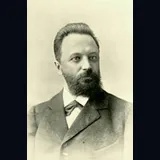
Mikhail Chigorin
Mikhail Chigorin came to chess too late, from too far away, with too little behind him — an orphan from a powder town outside St. Petersburg who did not take the game seriously until he was nearly twenty-five. And then, almost single-handed, he made Russia a chess country. He never wore the world crown; twice he reached for it and twice it slipped away, once by a single moment of madness. But he played the most beautiful, headlong, defiant chess of his age, refused to bow to the new scientific dogma even as it conquered the world, and lit the fire that would one day become Soviet chess. He was the last great Romantic, and he went down swinging.
◈An orphan of Gatchina
Chigorin was born in 1850 at Gatchina, where his father worked at the Okhta gunpowder works outside St. Petersburg. Both parents died while he was a boy, and at ten he was placed in the Gatchina Orphans' Institute. A schoolteacher showed him the moves of chess when he was sixteen, but the game did not take hold; he finished his schooling, became a minor government clerk, and only around 1874 — already a grown man — fell completely under its spell.
When it came, the obsession was total. He abandoned the security of his civil-service post for a precarious life over the board, in a country that as yet had no chess culture worth the name. There were no Russian masters ahead of him to learn from and no tournaments to win. Almost everything he would become, he would have to build himself.
◈Russia's first master
In 1876 he founded Chess Sheet — Shakhmatny Listok — a magazine he wrote and edited until 1881, fighting to give Russian players a voice though it never gathered more than a few hundred subscribers. He proved his strength in match play, defeating the leading Russian masters Emanuel Schiffers and Semyon Alapin by wide margins, and was soon recognised without dispute as the best player his country had produced.
Then he carried that reputation abroad. At Berlin 1881 he tied for third in his first great international tournament; at London 1883, in one of the strongest fields ever assembled, he placed fourth. The provincial Russian who had taught himself the game now sat among the giants of the European chess world — and beat a good many of them.
◈Two marches on the crown
At New York 1889 Chigorin tied for first with Max Weiss in a marathon double-round tournament, and the result carried him to the very summit of the game: a match with Wilhelm Steinitz, the first official World Champion, for the title itself. They met in Havana in 1889, and Steinitz prevailed 10½–6½.
Three years later, in 1892, they fought again in Havana — and this time Chigorin came within touching distance of the crown. In the twenty-third game, a win or even a draw would have kept his hopes alive; he stood with a clearly superior, very possibly winning position. Then, in one move, it all collapsed: he played the catastrophic Bxh2, allowing a mate in two, and with it handed Steinitz the match 12½–10½. It is one of the most famous tragedies in chess history — the moment Russia's first challenger threw the title away. Had a single move gone otherwise, the chess world might have had its first Russian champion decades before Alekhine.
◈The Romantic against the scientists
Chigorin came of age just as Steinitz and, later, Siegbert Tarrasch were codifying chess into a body of rules and principles — the 'scientific' school that would dominate the new century. Chigorin rebelled against all of it. "The theoretical is a synonym of the stereotyped," he said; for him the textbook was only what players fell back on when they could think of nothing better or more original. He trusted concrete calculation and the demands of the specific position over any general law.
He proved the point in the most public way possible. In an 1890 cable match conducted by telegraph, he took up two openings the new theory had dismissed — the Evans Gambit and the Two Knights Defence — against Steinitz himself, and won both games, a vindication of the old attacking play that delighted the Romantics. His own inventions endure: the Chigorin Defence to the Queen's Gambit (1.d4 d5 2.c4 Nc6) and the Chigorin Variation of the Ruy Lopez are still played at the highest level, and The Oxford Companion to Chess lists eight openings that bear his name.
It was also his flaw. As Garry Kasparov observed, once Chigorin fastened onto an idea the theoretical point could matter more to him than the result — he would prove himself right at the cost of the win. The same fearless, unbending imagination that made his chess immortal also kept the crown forever just out of his reach.
◈Hastings, and the long autumn
His finest tournament came at Hastings 1895, one of the strongest of all time. Chigorin finished second with 16 points, just half a point behind the young Harry Nelson Pillsbury and ahead of the reigning champion Emanuel Lasker, Tarrasch and Steinitz — the field that defined the era. He went on to share first at Budapest 1896 and, fittingly, won the King's-Gambit-themed tournament at Vienna 1903, and he took the first three All-Russian championships (1899, 1900/01 and 1903), the national event he had spent his life trying to bring into being.
The end was hard. By 1907 his health was failing; doctors at Carlsbad found advanced, untreatable diabetes and gave him only months. He returned to his family in Lublin, and there, embittered and in pain, he is said to have burned his chess set before he died in January 1908, aged fifty-seven. The chess association he had fought for all his life was founded shortly afterward.
“The theoretical is a synonym of the stereotyped. The 'theoretical' in chess is nothing more than that which can be found in the textbooks and to which players try to conform because they cannot think up anything better or equal, anything original.”
“Chigorin's talent is enormous, and possibly he is a real genius. At times the depth of his ideas can be inaccessible to mere mortals.”
“Had Chigorin been able to rein in his fantasy on just a few occasions, the world might have had its first Russian champion decades before Alekhine.”
“I love Mikhail Chigorin.”
◈From the archive
◈Legacy
Chigorin never became World Champion, but he gave Russia its chess. Through his original genius, his fighting games and his decades of teaching, writing and organising, he is honoured as the founder of the Russian chess school — the tradition that grew into the all-conquering Soviet school of the twentieth century, and from which Alekhine, Botvinnik, Tal and Kasparov all descend. The first Chigorin Memorial was held in St. Petersburg in 1909; the tournaments named for him continue to this day, and the Soviet Union put his portrait on a postage stamp in 1958. He is remembered as the last of the great Romantics — the man who refused to let chess stop being beautiful.