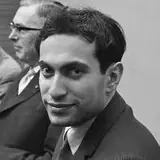
Mikhail Tal
No one ever made chess look so much like sorcery. Mikhail Tal played as if the rules of material were a rumour he had chosen not to believe — flinging pieces into the fire, conjuring attacks out of positions that engines still cannot fully explain, and dragging opponents, in his own famous image, into a deep dark forest where two plus two makes five and the only path out is too narrow for two. He took the crown at twenty-three, the youngest champion the game had yet seen, and though a failing body would soon loosen his grip on the title, it never dimmed the fire. To the end he remained what Riga had christened him: the Magician, who loved chess more than almost anyone and made it beautiful and dangerous in the same move.
◈The boy from Riga
Tal was born in Riga in 1936 into a Jewish family, a frail and precocious child — he was reading by three, and carried through life a congenital deformity of the right hand (ectrodactyly) that never stopped him from playing the piano. He joined the chess club at the Riga Palace of Young Pioneers, and at thirteen, in a 1949 simultaneous exhibition, beat the master Ratmir Kholmov with a combination already unmistakably his own. That same year the trainer Alexander Koblents took him on, and the boy's improvement turned vertical.
The milestones came fast. Latvian champion in 1953 and a Candidate Master; Soviet Master in 1954; and then, in 1957, at the age of twenty, the youngest player ever to win the Soviet Championship, scoring 14 out of 21. He retained the title in 1958. He had meanwhile taken a degree in literature at the University of Latvia, writing his thesis on the satirists Ilf and Petrov, and briefly taught school in Riga — a champion who arrived already in love with words as well as combinations.
◈The art of complication
Tal's chess was a refutation of caution. Where others calculated to safety, he sacrificed to create chaos — pouring material into the position not always because it was sound, but because the resulting complications were a maze in which his intuition saw further than anyone alive. Many of his most celebrated combinations have never been fully refuted; many were objectively dubious; almost all of them won. “There are,” he liked to say, “two kinds of sacrifices: correct ones, and mine.”
He told the secret himself, in his autobiography. Deep in a tangled game against Vasiukov he found himself unable to calculate the consequences of a knight sacrifice, and his mind drifted absurdly to a children's rhyme about dragging a hippopotamus out of a swamp — block and tackle, levers, specialists — until he laughed to himself, let it drown!, stopped trying to compute the incomputable, and simply made the move. That was the method behind the magic: at the edge of the calculable, he trusted the leap. To play for a draw with White, he wrote, was “to some degree a crime against chess.”
◈The crown at twenty-three
The world title campaign was a comet. He won the 1958 Portorož Interzonal at 13½/20, then the 1959 Candidates Tournament across Bled, Zagreb and Belgrade with 20/28, finishing ahead of Paul Keres and winning every one of his four individual games against the teenage Bobby Fischer.
In 1960 he faced Mikhail Botvinnik, the patriarch of Soviet chess, over twenty-four games in Moscow, and overwhelmed him 12½–8½ — six wins to two — to become, at twenty-three, the youngest World Chess Champion the game had yet known. The sixth game, in which he sacrificed a knight on dubious ground and watched Botvinnik fail to find the refutation, became the emblem of the whole match.
The reign was brief. Botvinnik invoked his right to a 1961 rematch and prepared it like a scientist, steering the games into the slow, technical channels where Tal's fire could not catch — and the challenger, already weakened by the kidney disease that would shadow his life, was advised by his Riga doctors to postpone. He played anyway, and lost 13–8. He would never hold the title again.
◈The fragile flame
Tal's body betrayed him for most of his life. He suffered chronic kidney disease, underwent a major kidney removal in 1969, smoked and drank heavily, and was in and out of hospitals for decades. And yet the chess never stopped burning. Between July 1972 and April 1973 he went 86 games without a loss; then, from October 1973 to October 1974, an astonishing 95 consecutive games unbeaten — a record that would stand for forty-four years, until Ding Liren surpassed it.
He won the Soviet Championship six times across his career and played in twenty-one of them. In 1988, at the age of fifty-one, he won the World Blitz Championship, finishing ahead of Garry Kasparov and Anatoly Karpov. And barely a month before his death, having slipped out of his hospital bed to play a Moscow blitz event, he sat down across from Kasparov, the reigning world champion — and beat him.
◈The man who loved the game
Away from the board Tal was warm, quick-witted and adored. He edited the Latvian chess magazine Šahs from 1960 to 1970, and his books — above all The Life and Games of Mikhail Tal — are counted among the finest ever written, self-deprecating and brilliant in the same breath. In 1959 he married the actress Sally Landau; the marriage ended in 1970, and his later years brought further companions and constant friends.
What everyone remembered was the love. “It sounds trite,” the American grandmaster Robert Byrne told The New York Times after Tal died, “but few love the game as much as he did.” More of his games appear in the great anthologies of brilliancies than those of any other player — the statistical fingerprint of a man who treated every game, as one biographer put it, like a poem.
“There are two kinds of sacrifices: correct ones, and mine.”
“To play for a draw, at any rate with White, is to some degree a crime against chess.”
“It sounds trite, but few love the game as much as he did. You could just see it. Some players consider it labor. This man loved chess.”
“Every game for him was as inimitable and invaluable as a poem.”
◈From the archive
◈Legacy
Tal died in Moscow on 28 June 1992 of an esophageal hemorrhage, aged fifty-five; a friend wrote that effectively his whole organism had simply ceased to function, worn out long before its time. The Mikhail Tal Memorial later gathered the world's elite to Moscow in his name, and his influence runs straight through the attacking players who followed — most directly Alexei Shirov, who studied under him. He is the patron saint of every player who has ever chosen beauty and danger over safety, the Magician from Riga who proved that a chess game could be a work of imagination first and a contest second — and who, even with a failing body and a lost crown, never once stopped loving the board.