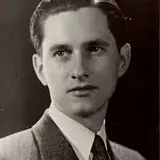
Paul Keres
Paul Keres was a champion in every way that did not require the title. For four decades he sat among the very best players in the world, beat nine of the men who held the crown, and reached the doorstep of a World Championship match five times — and five times the door did not open. History remembers him as the Eternal Second, but that name is too small. Keres carried Estonia onto the world stage, survived two occupations, and made of an unjust fate the most honourable career chess has ever known.
◈A boy and a thousand games copied by hand
Keres was born in Narva in 1916 and grew up in Pärnu, on the Estonian coast, the son of Peeter and Marie Keres. His father and older brother showed him the moves; the rest he taught himself, copying out by hand close to a thousand games from chess columns in newspapers because there were no books to be had. From that quiet apprenticeship grew one of the most natural attackers the game has known.
Correspondence chess made him. He played by post on a scale almost unimaginable today — up to a hundred and fifty games at once, perhaps five hundred in all — and in 1935 he won the international championship of the IFSB. The endless analysis bred a player who saw combinations the way other men saw the squares of the board. While he was still a student of mathematics at the University of Tartu he began to win abroad as well.
◈AVRO 1938 — the next challenger
In 1938 the Dutch broadcaster AVRO gathered the eight strongest players on earth — Alekhine, Capablanca, Botvinnik, Euwe, Reshevsky, Fine, Flohr and the twenty-two-year-old Keres — and sent them on a fortnight's road tour across the Netherlands to choose Alekhine's next challenger. Keres tied for first with Reuben Fine on 8½/14, taking outright first on tiebreak after their head-to-head went his way 1½–½. He had beaten Capablanca over the board the year before in Semmering–Baden 1937 (where he also finished first); now he had outscored the rest of the world at twenty-two.
Negotiations for a title match with Alekhine were opened. They never finished. In September 1939 Germany invaded Poland, the world that had built AVRO collapsed, and in June 1940 the Red Army marched into Estonia. The match that should have followed AVRO 1938 vanished into the war — and with it, almost certainly, Keres's clearest chance at the crown.
◈Through two occupations
What followed was the cruellest stretch of any great player's life. Under the German occupation Keres was allowed — required — to play in tournaments organised by the Nazi chess official Ehrhardt Post: Salzburg, Munich, Prague, Madrid, Posen, Tallinn. He won most of them and finished second to Alekhine in the others, sharing first with the world champion at Salzburg 1943 on 7½/10. It was in one of those wartime games — against Bogoljubow at Salzburg 1943 — that he first played the sharp 6.g4 lunge against the Sicilian Scheveningen that the world now calls the Keres Attack.
When the Soviets returned in 1944 the war's footprints on his career caught up with him. An autumn escape attempt failed; a 1942 newspaper interview was dragged back out as anti-Soviet evidence; he was interrogated, kept under suspicion, barred from leaving the Union, and held off the international circuit for years while contemporaries played on. Unlike his Latvian colleague Vladimirs Petrovs, who died in the Gulag, Keres survived — but only by absorbing the slow administrative violence of a regime that did not forget.
Then, at the 1948 match-tournament that finally chose a successor to the late Alekhine, Keres lost his first four games to Mikhail Botvinnik. He won the last. He finished joint third on 10½/20. Whispers have followed those games for the better part of a century, and no investigation has ever proven them: the historian Taylor Kingston, after going through the surviving Soviet correspondence, concluded that the authorities had given Keres "strong hints" not to hinder Botvinnik but that Keres almost certainly did not throw the games on the board. The truth, as so often with Keres, is somewhere in the shadow the Soviet century left over chess.
◈The Eternal Second
From 1953 to 1962 Keres finished second in four straight Candidates Tournaments — the qualifying competition for the world title — and second again at Curaçao in 1962 by half a point to Petrosian. Zurich 1953: second behind Smyslov. Amsterdam 1956: second behind Smyslov. Bled–Zagreb–Belgrade 1959: second behind Tal. Curaçao 1962: tied second with Geller, half a point behind Petrosian, in the tournament whose Soviet collusion Bobby Fischer would so famously denounce. In 1965, when the cycle moved to knockout matches, he lost his quarter-final to Spassky by 4–6. Five times he was the man closest to the throne. Five times he did not sit on it.
Out of that pattern the chess world coined his nicknames — "Paul the Second", "The Crown Prince of Chess", "The Eternal Second" — and beneath the gentle cruelty of those phrases lived an extraordinary fact: he was one of only three players in history (with Korchnoi and Beliavsky) to defeat nine undisputed world champions. He won the Soviet Championship three times (1947, 1950, 1951); he was Estonian champion four times. He beat Alekhine, Capablanca, Botvinnik, Smyslov, Tal, Petrosian, Spassky, Fischer and Euwe across the board over a span of nearly forty years.
◈The teacher and the team man
If his individual record was tragic, his team record was magnificent. Across eleven Olympiads — first for Estonia, then for the USSR — he scored +97 −13 =51 in 161 games, a 76.1 per cent share that ranks among the highest in the event's history. From 1952 to 1964 the Soviet team won the gold medal at seven Olympiads in a row with Keres on its boards, and from 1954 to 1960 he took four consecutive individual board golds, a streak no one else has matched. At the European Team Championships of 1957, 1961 and 1970 he again won team and individual gold each time, scoring 14/18.
Off the board he gave chess back what it had given him. He wrote the canonical English-language collection Grandmaster of Chess (his own best games annotated by himself), the timeless Practical Chess Endings, and, with Alexander Kotov, The Art of the Middle Game. He contributed Volume C of the Encyclopaedia of Chess Openings in 1974, founded and edited the Riga journal Šahs, and left behind 180 composed problems and 30 studies. The Keres Attack against the Scheveningen, the Keres Defence (1.d4 e6 2.c4 Bb4+), a Closed Ruy Lopez line, an English system — his ideas seeded the openings of the next half-century.
◈Vancouver, and home
In the spring of 1975, fifty-nine years old, Keres flew to Vancouver to play one last tournament. He won it. On the long journey back his heart gave out during the stopover in Helsinki on 5 June 1975. They brought him home to Tallinn, where roughly a hundred thousand people followed the cortège through the streets and Max Euwe, the president of FIDE, walked beside the coffin. He was buried in Metsakalmistu cemetery.
His country has kept his name as carefully as he kept its honour. From 1992 to 2011 the Estonian 5-kroon banknote carried his portrait. A Soviet commemorative stamp followed in 1991. In Tõnismägi park in Tallinn, and in Narva on his hundredth birthday in 2016, his statues stand. Streets in Nõmme, Narva and Pärnu carry his name. In 2000 Estonia voted him Sportsman of the Century; FIDE made 2016 the Year of Paul Keres. The Paul Keres Memorial Tournament, held in Tallinn since 1969, is the longest-running tournament of its kind dedicated to a single player — and Keres himself won the 1971 and 1975 editions, the last only weeks before he died.
“Keres was too mild a person to give his all in order to defeat his opponents. He was one of the nicest people you could meet — he made friends easily, was good-natured and kind.”
◈From the archive
◈Legacy
Paul Keres was the only player ever to defeat nine men who held the undisputed World Championship and never play a match for the title himself. He is the patron saint of the Eternal Second — but his real legacy is wider than that sad name. He carried a small country's flag into the highest councils of chess; he gave the world the Keres Attack, Practical Chess Endings, The Art of the Middle Game, and the standard he set for grace under historical injustice. A century after his birth, his face is still the one Estonia put on its money.