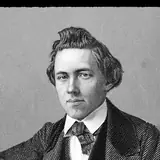
Paul Morphy
He arrived out of New Orleans like weather, and for eighteen months the strongest masters of Europe could not find shelter. Paul Morphy was twenty-one years old when he crossed the Atlantic in 1858; twenty-two when he sailed home with every reputable rival beaten and the unofficial championship of the chess world in his pocket. Then, almost without warning, he stopped. The career that gave the game its modern principles of development, open lines and the initiative was over before he turned twenty-three — and the rest of his life was a slow, sorrowful silence. He is the pride of chess because no one before him had played so well, and its sorrow because no one ever played him at his best again.
◈A New Orleans childhood
Paul Charles Morphy was born on 22 June 1837 in New Orleans, into a cultured Creole household where chess was an evening pastime. His father Alonzo was a Louisiana State Supreme Court Justice, attorney general and state legislator, of Spanish and Irish ancestry; his mother Louise Thérèse Felicitie Thelcide Le Carpentier came from a prominent French Creole family and was a musically gifted woman. The boy grew up fluent in French, English, Spanish and German.
He learned the moves around the age of eight or nine, watching his father and his uncle Ernest Morphy play; the family later told the story that he picked up the game by observation alone. The talent was startling. By twelve he was the strongest player in New Orleans, and when the Hungarian master Johann Löwenthal visited the city in 1850 the boy played him three games — and lost none of them, with accounts recording either two wins and a draw or all three to Morphy.
◈The scholar lawyer
Chess was, for Morphy, never a profession. He took his bachelor's degree from Spring Hill College in 1854 and his master's the following year with highest honors, then his law degree from the University of Louisiana on 7 April 1857. He was said to have committed the Louisiana Civil Code very nearly to memory. Admitted to the bar but still too young to practice, he agreed — to fill the waiting year — to play in the First American Chess Congress in New York that autumn.
The Congress was the first national tournament of its kind in the United States, a sixteen-master knockout in which drawn games did not count. Morphy went through it without alarm, and in the final he met Louis Paulsen, a player famous for thinking forever over a move. The match ran +5 −1 =2 to Morphy, who refused the $300 first prize and accepted a silver service instead. He was twenty years old and the unofficial champion of America.
◈Eighteen months in Europe
In June 1858 Morphy crossed the Atlantic to chase the strongest players in the world. The New Orleans Chess Club had already issued a formal challenge to Howard Staunton, the foremost English master, inviting him to come to New Orleans and meet Morphy. Staunton wrote in The Illustrated London News that the young American must take advantage of his own visit to Europe; he was, he said, working on his edition of the complete works of Shakespeare. The match never took place. Morphy made the trip anyway, and the masters who did agree to play him paid the price.
In London he ground through the leading English players in turn — Löwenthal +9 −3 =2, Henry Bird +10 −1 =1, John Owen +4 −1, and Thomas Barnes +19 −7 in a long series — and then crossed the Channel to Paris. At the Café de la Régence, the chess capital of Europe, he overwhelmed Daniel Harrwitz +5 −2 =1, and then, between 20 and 28 December 1858, played the match the chess world had been waiting for against Adolf Anderssen, hero of the Immortal and London 1851. Morphy won +7 −2 =2. Anderssen, generous in defeat, said the American treated chess with the earnestness and conscientiousness of an artist, and remarked that Morphy won his games in seventeen moves where he himself needed seventy. In a final touch Morphy took apart Augustus Mongredien +7 =1 in early 1859. He was, beyond serious dispute, the best player in the world.
◈An opera box and eight blindfold boards
The two performances that have outlived everything else from that European year were not match games at all. At the Café de la Régence in September 1858 Morphy sat down to play eight strong players simultaneously without sight of any board, and beat them. Crowds gathered in the street; the feat was talked about across Europe.
And on an evening in late October or early November 1858, in a private box at the Salle Le Peletier opera house in Paris, Morphy played a casual consultation game against Karl II, Duke of Brunswick, and Count Isouard de Vauvenargues. The opponents chose the Philidor Defence. Morphy answered with a stream of developing moves and sacrifices and finished the game in seventeen moves with a rook delivering mate down the back rank — the move now called the Opera Mate. It is the most famous teaching game ever played: every principle of development, initiative and open lines that Morphy brought to chess is contained in those seventeen moves.
◈The long silence
He sailed home in the spring of 1859 to a hero's welcome — banquets in Boston and New York, public tributes, the United States' first true sporting celebrity. And then he stopped. He declared that he would play no further formal match without offering his opponent at least pawn-and-move odds. There were no takers worth the trouble. He wanted to be a lawyer; the world only wanted him to be a chess player, and his attempts at a practice came to nothing. He retreated into private life in New Orleans.
The retreat became something darker. By the 1870s the man who had once read the strongest minds in Europe at a glance had grown suspicious and quarrelsome, suing his brother-in-law and trying to provoke a friend to a duel. When Wilhelm Steinitz, by then the reigning master of the game Morphy had remade, came to New Orleans in 1883 and met him on the street, Morphy refused to discuss chess. On 10 July 1884 he was found dead in his bathtub at home, aged forty-seven, of congestion of the brain brought on by entering cold water after a long walk in the midday heat. He was buried in the family tomb in Saint Louis Cemetery No. 1.
◈The first modern player
Morphy's chess looks, even now, almost shockingly modern. He developed every piece before he attacked, he opened lines for his rooks before he committed his king, and he punished his opponents the moment their pieces tangled. Richard Réti called him the first positional player, with a wonderful talent for combinations. Bobby Fischer, who shared his American genealogy and something of his fate, judged him perhaps the most accurate player who ever lived — a man who could find winning possibilities in situations that looked hopeless. Garry Kasparov simply called him the forefather of modern chess.
He left no school, no opening named after him on the scale of those that would come, no late masterpieces; what he left was a way of playing. After Morphy chess could not be played quite the same way again. The Scottish chess editor Walter Cook Spens called him the Pride and Sorrow of Chess, and the phrase has stuck — as good a summary as the game has produced of the boy from New Orleans who climbed to the top of the world, looked at it once, and walked away.
“Chess never has been and never can be aught but a recreation.”
“I cannot describe better the impression that Morphy made on me than by saying that he treats chess with the earnestness and conscientiousness of an artist.”
“[Morphy] wins his games in Seventeen moves, and I in Seventy. But that is only natural.”
“Perhaps the most accurate player who ever lived.”
“Forefather of modern chess.”
◈From the archive
◈Legacy
Morphy played for barely a decade and his serious career lasted less than two years, yet he shifted the whole centre of gravity of the game. The principles he showed in his European tour — rapid development, control of open lines, the relentless use of the initiative — became the grammar of modern chess, and every romantic king-hunt that came after owes him a debt. Réti named him the first positional player; Fischer called him perhaps the most accurate ever; Kasparov wrote him into My Great Predecessors as the forefather of the modern game. His tomb in Saint Louis Cemetery No. 1 still draws chess players who come to leave a pawn at the stone, and the epithet first written down by Walter Cook Spens — the Pride and Sorrow of Chess — has outlived every other thing said about him.