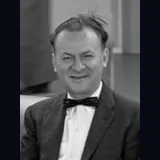
Reuben Fine
For a few years in the late 1930s Reuben Fine was, by the measure of results, among the two or three strongest players on earth — a Bronx prodigy who beat reigning and former World Champions on their own continent and shared first prize at the most fearsome tournament ever assembled. And then, with the highest title in chess arguably within reach, he set the pieces down and never seriously picked them up again. He left to become a psychologist, a teacher, a writer of books that outlived his playing career, and the chess world has spent the better part of a century wondering what it lost. He is the great unfinished sentence of American chess: the champion who chose not to be one.
◈A Bronx prodigy
Reuben Fine was born in the Bronx in 1914 to Russian-Jewish immigrant parents and was raised by his mother alone from the age of two. An uncle taught him the moves when he was eight, and the game took hold quickly. He sharpened it at the Marshall and Manhattan chess clubs, the twin engines of New York chess, and at the City College of New York he captained the team to a national collegiate title in 1931, taking his bachelor's degree the following year at just seventeen.
His arrival in the wider chess world was emphatic. At seventeen he won the first of his U.S. Open Championships at Minneapolis in 1932, and he would go on to win all seven U.S. Opens he ever entered — 1932, 1933, 1934, 1935, 1939, 1940 and 1941, a perfect record in the event. The one prize that always eluded him was the U.S. Championship itself, where time and again he finished just behind his great rival Samuel Reshevsky; in four attempts at the national title he scored better than seventy-eight per cent and still never took it.
◈The world's stage
In the second half of the 1930s Fine carried American chess onto the European stage and won there, repeatedly, against the strongest opposition alive. He shared first at Hastings 1935–36, finishing ahead of Salo Flohr, and in 1937 he travelled into the Soviet Union and won at Leningrad and shared first at Moscow — a rare feat for a foreigner on Soviet soil. At the Stockholm Olympiad of 1937 he took the board gold medal with eight and a half points from nine, anchoring the United States team.
Across three Olympiads — 1933, 1935 and 1937 — he won five medals, four of them gold, with a personal score that ran comfortably in the team's favour. By the late 1930s the retrospective rating tables place him firmly among the world's top handful of players, an American who could meet Alekhine, Euwe, Keres and Botvinnik across the board and more than hold his own.
◈AVRO 1938
Fine's high-water mark came at the AVRO tournament in the Netherlands in 1938 — a double round-robin gathering of the eight strongest players in the world, staged in part to identify a challenger for World Champion Alexander Alekhine. The field was the most formidable ever assembled to that point: Alekhine, Capablanca, Euwe, Botvinnik, Keres, Reshevsky, Flohr and Fine.
Fine began like a man who had decided the tournament was his, scoring five wins and a draw in his first six games, and he finished tied for first with Paul Keres on eight and a half points from fourteen. Along the way he beat the reigning World Champion Alekhine in both of their games — a double over the man who held the crown, at the very event meant to find his challenger. By the strictest reading of results, Reuben Fine had played his way to the threshold of a title match. History, and a world war, would see to it that he never crossed it.
◈The crown declined
When Alekhine died in 1946 still holding the title, FIDE organised a tournament of the world's best to fill the vacant throne. As an AVRO co-winner Fine was invited — and he turned it down. His stated reason was the psychology doctorate he was completing at the University of Southern California, but his own later writing made plain a deeper dissatisfaction: with an American chess federation he found indifferent to its masters, with a rescheduled event to be split between Holland and the Soviet Union, and with what he suspected the Soviet players might arrange among themselves. “Dissatisfied with this arrangement and the general tenor of the event,” he wrote, “I withdrew.”
It was not a passing mood. He declined the 1950 Candidates Tournament as well, and after the war he never again entered serious top-flight competition with any regularity. FIDE awarded him the International Grandmaster title in 1950, in the first list of official titles, but by then the player it honoured had effectively already gone. His last major event was the Wertheim Memorial in New York in 1951, where he placed fourth — a quiet coda to a career that ended not in defeat but in departure.
◈The other board
Fine gave the rest of his life to the mind off the board. During the Second World War he had put his analytical gifts to work for the U.S. Navy, calculating the probabilities of where German U-boats might surface in the Atlantic and serving as a translator. Afterward he completed his doctorate and became a psychoanalyst, professor and author, teaching at City College, Amsterdam, Florence and elsewhere, founding his own Creative Living Center, and publishing some fourteen books on psychology — among them a critical re-evaluation of Freud and a full history of psychoanalysis.
Yet he never wholly left chess on paper. As the first world-class player to edit Modern Chess Openings, he transformed that standard text; The Ideas Behind the Chess Openings (1943) taught players to grasp the why beneath the moves; and Basic Chess Endings (1941) became one of the most respected endgame manuals ever written. He even turned his two disciplines on each other in The Psychology of the Chess Player, a Freudian reading of the masters that the chess and psychology worlds received with equal unease. Whatever else he abandoned, the teacher in him never stopped working.
“Dissatisfied with this arrangement and the general tenor of the event, I withdrew.”
“A loss for chess — and a draw, at best, for psychoanalysis.”
◈From the archive
◈Legacy
Fine died in New York on 26 March 1993. He was inducted into the U.S. Chess Hall of Fame in 1986 as a member of its charter class, and his books long outlived his playing days — Basic Chess Endings, the 1941 compendium that generations learned from, is still consulted as a standard reference more than eighty years on. He had walked away near his peak, leaving behind a record against World Champions that few Americans before or since could match and a question that has never been answered: what might Reuben Fine have done had he chosen the crown over the couch? In 1963 he sat down for a handful of friendly games against the young Bobby Fischer — one of them good enough that Fischer included it in My 60 Memorable Games — a brief, late echo of a talent that the chess world never stopped mourning the early loss of. He remains the most haunting of all American chess might-have-beens.