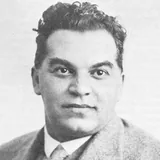
Richard Reti
Richard Réti was a mathematician who treated the chessboard as a space to be reimagined. Where the old masters had been taught that the centre must be seized with pawns, he held it at arm's length — controlling it from the wings with pieces, inviting his opponents forward so that their own advances became their undoing. He gave the game an opening that still bears his name, a book that taught a generation how to think, a blindfold record that seemed to defy memory itself, and a single tiny endgame study that proved a chess king does not move the way our eyes believe. Then, a week after his fortieth birthday, he was gone. He was on the board for barely two decades, and he changed how all of it is understood.
◈A mathematician among the pieces
Richard Réti was born in 1889 in Bazin, a small town in Austria-Hungary now called Pezinok in Slovakia, into a Jewish family; his father was a physician serving the Austrian military. He went to Vienna to read mathematics, and the discipline never quite let go of him — the precision and the love of pure form would surface again and again in the way he played and, above all, in the endgame studies he composed. His elder brother Rudolph Reti became a noted pianist, composer and musical theorist, so the family produced two kinds of artist from the same house.
His early chess bore no resemblance to the reputation that would follow. The young Réti was a sharp combinative player who delighted in the King's Gambit and the open, tactical positions the classical romantics loved. It was the First World War, and the chess that came after it, that turned him into something new.
◈The hypermodern turn
After the war Réti became one of the two chief architects — alongside Nimzowitsch — of the movement that would be called hypermodernism. Its central heresy was a direct attack on the teaching of Siegbert Tarrasch and the classical school: that the centre had to be occupied by pawns from the very first moves. Réti argued, and then demonstrated over the board, that the centre could instead be controlled from a distance, by fianchettoed bishops and well-placed knights, and that a tempting pawn centre could be lured forward and then surrounded and destroyed.
His name was fixed to the idea by the opening he pioneered: 1.Nf3 d5 2.c4, the Réti Opening, in which White declines to plant a pawn in the centre at all and instead pressures Black's from the flank. His 1923 book Modern Ideas in Chess set the new thinking out in clear, almost philosophical prose, tracing the evolution of chess from the romantics through Steinitz to the hypermoderns. It became, with Nimzowitsch's My System, one of the two founding texts of the movement, and it is still read today not as a relic but as a living argument about how the game should be understood.
◈New York 1924
Réti's method announced itself to the world at the great New York tournament of 1924. There, with his still-young opening, he beat the reigning World Champion José Raúl Capablanca in thirty-one moves — Capablanca's first defeat in eight years, his first loss since becoming World Champion, and the only time Réti ever beat him. To a chess world that regarded the Cuban as nearly unbeatable, the result was a thunderclap, and it stamped the new ideas with an authority no book could supply.
It was not even his only scalp. At the same tournament Réti defeated the future World Champion Alexander Alekhine — again in thirty-one moves, and the only win he would record against him — and produced, against Efim Bogoljubov, a game so finely finished that it took the event's brilliancy prize, its conclusion singled out for praise by Alekhine himself. Three of the strongest players alive, beaten by one man at a single event, two of those games begun with the opening that carried his name. New York 1924 remains the clearest snapshot of Réti at his peak.
◈The mind that saw without seeing
Réti possessed a memory and a power of visualisation that astonished even his peers. In 1925 he set a world record for blindfold simultaneous play, contesting twenty-nine games at once without sight of a single board, and finishing with twenty-one wins, six draws and only two losses. Alekhine — himself one of history's great blindfold players — is recorded as reckoning that he and Réti were plainly the best in the world at it.
That same restless intellect drew him into chess journalism and writing, which he poured himself into for the rest of his short life. The English master and historian Harry Golombek would later note, with affectionate regret, that Réti "had fallen victim to a disease that is often fatal to a chess master — he had become a chess journalist." The books and columns cost him playing time; they also ensured that his ideas, not merely his results, would outlive him.
◈A king that moves like no king
If one position were to stand for Réti's genius, it would not be a tournament game at all but a study he published on 4 December 1921 in the Ostrauer Morgenzeitung. The setting looks hopeless for White: a lone king and a single pawn against a king and a passed pawn that appears to be racing home untouchable, while White's own pawn seems too far back to promote. Common sense says White is simply lost.
Réti showed that common sense is wrong. The white king travels a diagonal path that, by the strange arithmetic of the chessboard, manages to threaten to catch the enemy pawn and to support its own at the very same time — two errands accomplished in the same set of moves — and the game is drawn. It is the most famous demonstration that distance on the sixty-four squares is not measured the way the eye measures it: the king's shortest route is not always the straight one. The little study, barely a handful of pieces, is reprinted in nearly every endgame book ever since, and it captures what made Réti unlike anyone else — a player who looked at the board and saw a geometry no one had noticed was there.
“First-class players lose to second-class players because second-class players sometimes play a first-class game.”
“He had fallen victim to a disease that is often fatal to a chess master — he had become a chess journalist.”
◈From the archive
◈Legacy
Réti died of scarlet fever in Prague on 6 June 1929, only a week after turning forty, at the height of his powers and his influence; his ashes were laid in his father's grave in Vienna's Zentralfriedhof. He left behind far more than a short career's worth of tournament results. Modern Ideas in Chess and the posthumously published Masters of the Chessboard remain among the most admired books ever written about the game — not manuals of variations but arguments about how chess thinks. The Réti Opening, 1.Nf3 d5 2.c4, is still played at the very top of the modern game, and his 1921 study is reproduced in nearly every serious endgame manual as the purest demonstration that geometry on a chessboard is not the geometry of the eye. Hypermodernism, the heresy he and Aron Nimzowitsch preached, long ago became orthodoxy: every player who fianchettoes a bishop and dares to leave the centre empty is, knowingly or not, playing the chess Réti imagined.