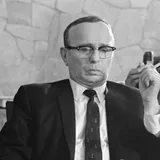
Samuel Reshevsky
He was a wonder of the world before he was ten — a tiny boy in a sailor suit who toured the capitals of Europe and America taking on grown masters twenty at a time, and beating them. The astonishing thing about Samuel Reshevsky is not that the prodigy arrived, but that he never left. Seven decades later, an Orthodox accountant who would not touch a chessboard on the Sabbath was still at the board, still grinding world champions into dust deep into time-trouble. He never wore the world crown — the timing, and the politics, never fell his way — but he played eleven of the first twelve men who did, and he beat seven of them. American chess has known nothing else quite like his stubborn, eighty-year-long refusal to lose.
◈The boy who toured the world
He was born Szmul Rzeszewski in Ozorków, near Łódź, in 1911 — then part of Russian-ruled Poland — and he learned the moves at four. By eight he was a touring marvel, giving simultaneous exhibitions across Europe against adult players and winning nearly all of them; at a 1920 exhibition in Paris the eight-year-old beat every opponent in the room. Crowds came not only for the chess but for the impossibility of it.
In November 1920 his parents brought him to the United States to display his gift, and the boy played thousands of exhibition games up and down the country. In 1922, very likely the youngest competitor ever in so strong an event, he played the New York Masters tournament and defeated the old warhorse David Janowski. But a childhood spent on the exhibition circuit meant no schooling, and a Manhattan court took up the question of his guardianship. The philanthropist Julius Rosenwald, co-owner of Sears, Roebuck, stepped in to guarantee the boy's education. Reshevsky went on to graduate from the University of Chicago in 1934 — with a degree in accounting.
◈The accountant who would not play on the Sabbath
Reshevsky never made chess his living. He worked as an accountant his whole adult life, supporting a family — he married Norma Mindick and they raised three children — and fitting the greatest tournaments of the age around a day job. It made him, in a sense, the eternal amateur among professionals, and he believed that lack of full-time study, as much as anything, kept the world title out of his hands.
He was a devout Orthodox Jew, and he would not play on the Sabbath or on the major Jewish holidays. Organizers learned to build their schedules around him; his games were postponed, doubled up, or rearranged so that Friday sundown to Saturday sundown stayed his own. That he reached the very summit of world chess while honouring that line, decade after decade, is its own quiet monument.
◈America's grandmaster
From the mid-1930s he was simply the best player his country had. He won the U.S. Championship eight times between 1936 and 1972 and competed in a record twenty-one of them, with the most top-three finishes, the most games played, and the most games won of anyone — and he had already taken the U.S. Open in 1931 at Tulsa and shared it with Reuben Fine in 1934.
His international breakthrough came in a single golden stretch. In 1935 he ran away with Great Yarmouth on 10/11 and then took first at Margate, where he beat the former World Champion José Raúl Capablanca with the Exchange Variation of the Queen's Gambit Declined — a game still taught as a model of that structure. He shared third behind the elite at Nottingham 1936, tied for first at Kemeri in 1937, and in 1938 finished joint fourth at the legendary AVRO tournament in the Netherlands, a field of arguably the eight strongest players alive.
◈So close to the summit
Twice the crown came within reach. At the 1948 World Championship match-tournament in The Hague and Moscow — held to find a champion after Alekhine's death — he finished joint third with Paul Keres, behind only Mikhail Botvinnik and Vasily Smyslov. In 1950 FIDE named him a Grandmaster on its very first list. Then came his best chance of all: the Zurich Candidates of 1953, where he tied for second with Bronstein and Keres, two points behind Smyslov. Years later, in his book Secret Notes, David Bronstein wrote that the Soviet players had been instructed to stop Reshevsky from winning — a collusion other grandmasters later confirmed.
He kept knocking. He qualified again for the Candidates and lost a 1968 quarterfinal match to Viktor Korchnoi. Along the way he beat reigning and former world champions at will: leading the United States against the Soviet Union in 1955, he defeated the reigning champion Botvinnik over their short match. In all he faced eleven of the first twelve World Champions — from Emanuel Lasker to Anatoly Karpov, a span no one else managed — and defeated seven of them: Lasker, Capablanca, Alekhine, Euwe, Botvinnik, Smyslov and Fischer.
◈Fischer, time-trouble, and the unending game
The fiercest rivalry of his later years was with the young Bobby Fischer, more than thirty years his junior. In 1961 they began a sixteen-game match across New York and Los Angeles; after eleven games it stood dead level — two wins each, seven draws — when it collapsed in a scheduling dispute with the organizer Jacqueline Piatigorsky, and Reshevsky was awarded the winner's share. He had outscored Fischer only once over a whole event, at Buenos Aires 1960, which he won while the young American faltered; of the prospect he had supposedly quipped that he would settle for nineteenth place, so long as Fischer finished twentieth. Fischer, for his part, reckoned that for a stretch of the 1950s Reshevsky had been the strongest player in the world.
His style was practical, tenacious and deeply positional, lit by sudden tactics when the moment came. Famously he poured enormous time into the opening and then had to play whole endgames in seconds — a habit that produced both miraculous escapes and the occasional blunder, and that he admitted may have cost him the title. He set it all down in books read for generations: Reshevsky on Chess, How Chess Games Are Won, and The Art of Positional Play.
And he never really stopped. He won the Reykjavík Open in 1984 at the age of seventy-two, and as late as 1991 — in his eightieth year — he was still beating Vasily Smyslov, the man he had chased across a board four decades earlier. He died a few months later, in April 1992, having competed almost to the end.
“I am essentially a positional player, although I can conduct an assault with precision and vigor when the opportunity arises. My style lies between that of Tal and Petrosian.”
“I would settle for nineteenth place — if Fischer placed twentieth.”
“For a period of about ten years — between 1946 and 1956 — Reshevsky was probably the best chessplayer in the world.”
“Reshevsky had extraordinary tenacity and fighting spirit.”
◈From the archive
◈Legacy
Samuel Reshevsky died of a heart attack at his home in Suffern, New York, in April 1992, at the age of eighty — a competitor across nine decades of chess, from beating masters as a child before the First World War to beating Smyslov in his last full year. He is remembered as the second-greatest American champion, surpassed only by the rival who finally eclipsed him; as the prodigy who became a master and never faded; and as the observant accountant who reached the threshold of the world title without ever once trading away the Sabbath. Few players have ever been so hard, for so long, to beat.