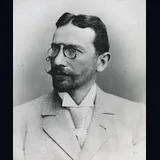
Siegbert Tarrasch
He was the best player who never wore the crown, and the teacher who mattered more than any crown could. Siegbert Tarrasch was a doctor of medicine who spent his life proving that chess obeyed laws — that beauty over the board was not luck or genius but the visible result of right principles, learnable and teachable by anyone willing to study. He took the hard, half-spoken discoveries of Wilhelm Steinitz and turned them into clear rules a club player could carry in his head, and in doing so he gave the game some of the most beloved sentences ever written about it. They called him Praeceptor Germaniae, the Teacher of Germany. He taught the world.
◈The doctor who played chess
Tarrasch was born in Breslau in 1862, in the Prussian east, and trained as a physician — a profession he never abandoned for the game that made him famous. He settled into a medical practice in Nuremberg, raised a large family, and pursued chess as the most serious of avocations. It is one of the quiet tragedies of chess history that the demands of his patients, more than any failing of his play, kept him from the world title in his prime.
For when his prime came, it was overwhelming. By the early 1890s he had beaten the aging world champion Wilhelm Steinitz in their tournament games — +3 −0 =1 — and stood, by common consent, as the strongest active player on earth. Yet in 1892, offered the chance to challenge Steinitz for the championship itself, Tarrasch declined: his practice, he said, could not spare him. The crown he might have taken went instead, a few years later, to a young mathematician named Emanuel Lasker — and that missed door would shadow the rest of his life.
◈The best player who never was champion
What he could not win in a title match he won everywhere else. Tarrasch took first prize at Breslau 1889, Manchester 1890, Dresden 1892, and Leipzig 1894 — an unbroken run of victories that established him as the dominant tournament player of his era. He won the great Vienna tournament of 1898 after a play-off with Harry Pillsbury, and as late as 1907, at Ostend, he finished ahead of Schlechter, Janowski, Marshall, Burn and Chigorin to claim one last grand first prize.
In 1893 he travelled to St Petersburg to face Mikhail Chigorin in a match that has become legend for its ferocity: twenty-two games, no quarter given, ending dead level at +9 −9 =4. Two years later he beat Lasker himself at Hastings 1895. Against Frank Marshall in 1905 he was simply crushing, winning their match +8 −1 =8. For a decade and a half he was a fixture at or near the top of every elite field he entered — the eternal contender, garlanded everywhere but the one place he most wanted to stand.
◈Praeceptor Germaniae
Tarrasch's deepest gift was not competition but instruction. Steinitz had discovered the principles of positional chess but expressed them obscurely, in dense and difficult prose; Tarrasch translated them into rules so clear that a beginner could learn and a master could not dismiss them. Control the centre. Develop with purpose. Give your pieces room — for a cramped position, he taught, carries within it the germ of defeat. His most famous maxim, the Tarrasch rule, still governs endgame play: rooks belong behind passed pawns, behind one's own to drive them forward, behind the enemy's to hold them back.
He poured these ideas into books that taught generations: Dreihundert Schachpartien (Three Hundred Chess Games), the monumental Die moderne Schachpartie, and at the last his most beloved manual, Das Schachspiel — translated as The Game of Chess. His openings entered the permanent canon: the Tarrasch Defence to the Queen's Gambit, which accepts an isolated pawn for free, active piece play, and the Tarrasch Variation of the French Defence. Of his own defence, attacked by the experts, he wrote with characteristic defiance: "The future will decide who has erred in estimating this defence, I or the chess world."
His dogmatism could be maddening, and the hypermodern school that followed delighted in showing the exceptions to his laws. But the laws were sound, and they were his, and to this day a club player who has never read a word of Tarrasch still thinks in the language he built.
◈Lasker
The title he had declined in 1892 finally came within reach in 1908, when at last he sat across the board from Emanuel Lasker with the World Championship at stake. The two men despised each other — a cold, lifelong antipathy of temperament and philosophy — and the match was less a contest than a verdict. Lasker won it decisively, by eight wins to three with five draws.
Legend holds that at their introduction before the match, Tarrasch clicked his heels, bowed stiffly, and said: "To you, Dr. Lasker, I have only three words — check and mate." Whether or not the story is true, the board told a colder one. Lasker's flexible, fighting, deeply human chess simply had no answer in Tarrasch's beautiful certainties; the rules met the man who knew when to break them. They met once more over a match in 1916, and again Lasker prevailed. Tarrasch would never hold the highest title — but a single win from the 1908 match survives in this archive, proof that even in defeat the teacher could still play.
◈The gathering dark
Tarrasch had been born Jewish and converted to Christianity in 1909; he was, in his own heart, a thoroughly patriotic German. He and his wife raised five children, and the First World War took one of his sons — a private grief beneath the public career.
Even in his fifties he could still humble the very best. At the towering St Petersburg tournament of 1914 — won by Lasker ahead of Capablanca and Alekhine — Tarrasch finished fourth in a field of legends and, along the way, defeated the young José Raúl Capablanca, the man who would soon be champion of the world. He kept teaching, kept writing, kept editing chess journals to the end. He died in Munich in 1934, as the regime that would have hated him for his birth was taking hold of his beloved Germany — the Teacher of Germany, outliving the country he had loved into something he would not have recognised.
“Chess, like love, like music, has the power to make men happy.”
“Before the endgame, the Gods have placed the middlegame.”
“He who fears an isolated queen's pawn should give up chess.”
“From Anderssen I learned the art of making combinations; from Tarrasch I learned how advantageously to avoid making them.”
◈From the archive
◈Legacy
Tarrasch died in Munich on 17 February 1934, a patriotic German who had lived long enough to feel the first cold of the antisemitism that was rising around him. The hypermodern generation — Nimzowitsch, Réti, Breyer — had already made a sport of rebelling against his rules, mocking the dogmatism with which he laid them down; yet every rebellion was built on the foundation he had poured. His openings are still played at the highest level: the Tarrasch Defence to the Queen's Gambit and the Tarrasch Variation of the French Defence carry his name into the 21st century. His Das Schachspiel — translated as The Game of Chess — remained a beloved primer for decades after his death. He is remembered, above all, as the man who took the scattered truths of positional chess and made them a common language: the doctor who taught the world how the game is played.