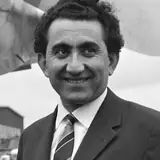
Tigran Petrosian
They called him Iron Tigran, and the name was not about force but about resistance. Tigran Petrosian built a fortress out of every position he touched, then waited — patient as stone — for the opponent across the board to overreach. Out of a childhood erased by war he made himself into the hardest man in the world to beat, and along the way he taught chess a kind of beauty that does not shout: the beauty of danger that never arrives, of catastrophe quietly foreseen and refused.
◈A childhood swept from the rubble
Petrosian was born in Tbilisi in 1929 to Armenian parents. His father Vartan was illiterate and wanted no part of a life spent over a chessboard. The Second World War took both parents and left the boy orphaned, sweeping streets to survive. It was during those years that his hearing began to fail — an impairment he carried for the rest of his life.
He had learned the moves at eight, and he learned to read, in part, from chess books. With ration money he bought Aron Nimzowitsch's Chess Praxis — the book, he later said, that had the greatest influence on him as a player — and Rudolf Spielmann's The Art of Sacrifice in Chess. The games of José Raúl Capablanca were an early love. At twelve he came under the wing of Archil Ebralidze at the Tiflis Palace of Pioneers, who steered him away from wild tactics toward the scientific, positional chess that would define him. Within a year the boy beat the visiting Soviet grandmaster Salo Flohr in a simultaneous exhibition.
◈The long climb
The ascent was patient, like his chess. Candidate Master in 1946, Master in 1947, International Master in 1951 after a second-place finish in the Soviet Championship — the same year he held Botvinnik to a draw across two adjournments and eleven hours of play. In 1952 he placed second at the Stockholm Interzonal and earned the Grandmaster title. Then came the Candidates cycles — eight of them across his career — and the slow accumulation of respect from a generation of giants who simply could not find a way through his defences.
He won the Soviet Championship four times (1959, 1961, 1969 and 1975), and in 1962 he played a full year of tournament chess without losing a single game. That same year he won the Candidates Tournament in Curaçao ahead of Keres, Geller, Fischer, Tal and Korchnoi, earning the right to challenge for the crown.
◈The crown
In 1963 he faced Mikhail Botvinnik — the patriarch of Soviet chess — over twenty-four games, and took the world title from him. Petrosian became the ninth World Chess Champion.
He defended the title in 1966 against Boris Spassky, and did it the hardest way of all: by winning the match outright rather than clinging to a drawn score. It was the first time since Alekhine turned back Bogoljubov in 1934 that a champion had defended by winning. Three years later Spassky returned, and in 1969 took the crown by 12½–10½. Petrosian had held the highest title in chess for six years.
◈The art of not losing
Petrosian's genius was prophylaxis — the idea, inherited from Nimzowitsch, of preventing the opponent's plan before advancing one's own. He spent more effort smothering threats than creating them, rarely attacking until his position was utterly secure, and he won, again and again, simply by remaining standing while more aggressive men overreached and fell. He had a deep affinity for the knight and an almost supernatural sense for danger several moves before it became real.
His signature was the positional exchange sacrifice — giving up a rook for a minor piece not for any immediate gain but for long-term control, a resource, as Garry Kasparov put it, that few players were even capable of seeing. The most celebrated example came against Samuel Reshevsky at the Zurich Candidates of 1953. His name lives on in opening theory too: the Petrosian System against the King's Indian (7.d5) and the Petrosian Variation of the Queen's Indian (4.a3) are still mainline weapons at the highest level.
Critics called it dull, even un-Soviet — chess was supposed to be daring. Petrosian answered them plainly: “They say my games should be more interesting. I could be more interesting — and also lose.” And when the position was ripe, the tiger did pounce: he won games seven and ten of the 1966 Spassky match in sharp, sacrificial style, proof that the defender always carried a hidden blade.
◈The man behind the board
In 1952 he married Rona Yakovlevna, a graduate of the Moscow Institute of Foreign Languages who worked as an English teacher and interpreter; they raised two sons. He settled in Moscow but never stopped calling himself a Soviet Armenian: “Abroad, they call us all Russians,” he said. “I am a Soviet Armenian.” He campaigned for a national chess newspaper, which became the magazine 64, and edited it for years. He earned a degree in philosophy from Yerevan State University, writing his 1968 thesis on the logic of chess thought.
The deafness produced its own folklore. Once, offered a draw by Svetozar Gligorić, he had switched off his hearing aid, never heard the second offer, and went on to win. In a 1971 Candidates match the noise of Seville so rattled Robert Hübner that he withdrew — while Petrosian, untroubled, played on. Yet for all that, he was a devoted lover of classical music and a fixture at concerts, and away from the board he kept up football, backgammon, table tennis, cross-country skiing and his garden.
“I'm absolutely convinced that in chess — although it remains a game — there is nothing accidental. I like only those games in which I have played in accordance with the position's requirements. I believe only in logical, right play.”
“Petrosian reminds me of a hedgehog. Just when you think you have caught him, he puts out his quills.”
“In those years, it was easier to win the Soviet Championship than a game against Iron Tigran.”
“Playing him was like trying to put handcuffs on an eel. There was nothing to grip.”
◈From the archive
◈Legacy
Petrosian died of stomach cancer in Moscow in 1984 and was buried in the city's Armenian cemetery; the lectures he was working on at the end were edited by Rona and published as Petrosian's Legacy. In 1987 Garry Kasparov unveiled a memorial at his grave — a laurel wreath and the sun rising over the twin peaks of Mount Ararat. Armenia, where he is credited with sparking a national chess boom, has honoured him with a Yerevan monument (2006), a commemorative stamp (2005) and his portrait on the 2,000-dram banknote (2018). He has been called the hardest player to beat in the history of chess — but he is remembered, above all, for showing that defence could be an art.