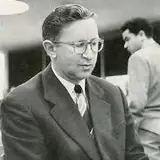
Vasily Smyslov
Boris Spassky called him simply Hand — because Smyslov's hand seemed to know, before the mind had finished speaking, exactly which square wanted which piece. Here was a champion who heard chess the way he heard music: not as a fight but as a search for harmony, for the arrangement in which every piece quietly supports every other. Vasily Smyslov wore the crown for barely a year, yet he stayed near the summit of the game for half a century — a baritone who once auditioned for the Bolshoi, an endgame virtuoso who was still beating grandmasters at seventy, and one of the most natural, unhurried talents the board has ever known.
◈A father's gift
Smyslov was born in Moscow in 1921 and grew up over a chessboard. His father, Vasily Osipovich Smyslov, was an engineering technician who had himself studied the game under Mikhail Chigorin, and he became his son's first teacher. The boy took to chess at six; the book his father pressed on him was Alexander Alekhine's My Best Games of Chess 1908–1923, and from that volume, alongside the games of Capablanca and Lasker, he taught himself the classical foundations of the game.
The rise was swift and quiet. He won the USSR Junior Championship in 1938. In the 1940 Soviet Championship, at nineteen, he scored 13/19 to finish third — ahead of Mikhail Botvinnik — and in the 1941 Absolute Championship of the USSR he again placed third, behind only Botvinnik and Paul Keres. When FIDE drew up its first list of grandmasters in 1950, Smyslov's name was on it.
◈The long duel with Botvinnik
Smyslov's road to the title ran straight through the patriarch of Soviet chess. Three times he faced Mikhail Botvinnik for the world championship. The first match, in 1954, ended dead level at 12–12 — and under the rules the champion kept his crown. Smyslov went away, came back through the Candidates, and in 1957 returned to win the rematch 12½–9½ (+6 −3 =13), becoming the seventh World Chess Champion in the game's history.
His reign lasted a single year. Botvinnik exercised his right to a return match in 1958 and took the title back 12½–10½, Smyslov hampered by illness during the play. Across all three matches the two men were almost inseparable — Smyslov with eighteen wins to Botvinnik's seventeen, and thirty-four draws between them. Twice in those years, in 1949 and 1955, Smyslov had also shared the Soviet Championship, that fiercest of all national titles.
◈A sense of harmony
Smyslov is remembered above all for positional clarity and a command of the endgame that bordered on the uncanny. He distrusted forcing tricks; he preferred to coax a position toward order until the win was simply there. His own credo was disarmingly modest — that he would make forty good moves, and if his opponent could match them, the game would be a draw. The deeper idea was musical: a mutual understanding with the pieces, a sense of harmony that, he believed, revealed truths pure calculation could not reach.
It would be a mistake to call him merely safe. He could calculate sharply when a position demanded it, and his name is stamped across opening theory: the Smyslov Variation of the Grünfeld Defence (with the early 5.Qb3), a respected line of the Closed Ruy Lopez, and a system in the Slav all carry his name and are still played at the highest level.
◈The singer
Chess shared his life with music. Smyslov was a trained operatic baritone of real quality, and in 1950 he auditioned for the Bolshoi Theatre. The audition did not lead to a contract, and the decision settled itself: he gave himself fully to chess. But he never stopped singing. He gave recitals during tournaments — sometimes accompanied at the piano by his fellow grandmaster Mark Taimanov, himself a concert pianist — and once even recorded an EP of songs.
The two arts were, for him, one pursuit. The harmony he listened for in music was the same harmony he sought on the board, each piece, like each voice, assisting the others. Few players have made the link between beauty and chess so literal.
◈The long evening
What sets Smyslov apart even among champions is how long the light stayed on. He represented the Soviet Union at nine Olympiads between 1952 and 1972 and amassed an all-time record haul of medals. And he never really stopped: in 1983–84, at sixty-two, he fought his way to the Candidates final, where he met a twenty-one-year-old named Garry Kasparov and lost 8½–4½ to the man who would become champion. The torch had passed, but Smyslov had reached for it.
In 1991, at seventy, he won the inaugural World Senior Chess Championship. He remained on FIDE's top-100 list until that same age — a span of nearly four decades at world class. As his eyesight failed in his last years he turned to composing endgame studies, the purest distillation of the harmony he had chased all his life.
“I will make 40 good moves and if you are able to do the same, the game will be a draw.”
“'Mutual understanding' with the pieces enables a player to see that which often remains concealed to purely logical analysis. It is then that the innate ability of a player, which I call a sense of harmony, manifests itself.”
“Smyslov is a chess player with a fantastic intuition. I call him 'Hand' because his hand knows exactly on which square to put which piece.”
“The play of the youthful Smyslov is of unusual profundity, originality and versatility.”
◈From the archive
◈Legacy
Smyslov died in Moscow on 27 March 2010 of congestive heart failure, three days after his eighty-ninth birthday. He had once written that he had no reason to complain of his fate — that he had fulfilled his dream and become the seventh world champion in the history of chess. He left behind a body of endgame artistry studied to this day, the record books of the Olympiad, and a name that even reached the cinema: Stanley Kubrick named a character after him in 2001: A Space Odyssey. Champion for only a year, he is remembered for something more durable than a reign — for showing that chess, played truly, can sound like music.