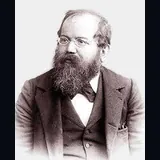
William Steinitz
Before Steinitz, chess was an art of fireworks — the bold sacrifice, the headlong attack, glory to the player with the most daring hand. Wilhelm Steinitz, a small, lame, quarrelsome man born in the Prague ghetto, looked at that splendour and asked a heretical question: why did the attacks succeed? He answered it with a theory — that a winning attack is never a gift of genius but the earned interest on small advantages quietly accumulated — and in proving it he made himself the first official champion of the world and turned a game into a science. He died penniless on an island in the East River, his mind failing, but he had already remade chess in his own image, and it has never gone back.
◈Out of the Prague ghetto
Wilhelm Steinitz was born in 1836 in the Jewish quarter of Prague, one of the youngest in a large and poor family, and raised to study the Talmud. He learned the moves of chess at twelve. In 1857 he left for Vienna to study mathematics at the Polytechnic, and there the game took him over: he climbed from third in the Vienna city championship to first by 1861, winning thirty of thirty-one games and earning the nickname that announced his ambition — the Austrian Morphy.
He was never an imposing figure. Barely five feet tall and lame from birth, he carried a temper that made him as many enemies as admirers, and he would spend his whole life a poor manager of money. But across a chessboard the small man was without equal, and he knew it.
◈The conqueror of Anderssen
The 1862 London International was his door onto the world stage. He finished sixth but won the tournament's brilliancy prize for a dazzling victory over Augustus Mongredien, and he stayed in London, turned professional, and began dismantling the strongest players in Britain — among them the young Joseph Blackburne, who had been playing for barely two years.
Then, in 1866, he challenged Adolf Anderssen — the man who had stood as the world's finest player since Morphy's retirement, the high priest of the romantic attacking school. Over fourteen games in London, with no draws to soften it, Steinitz won eight and lost six. The result made him, by common consent, the best player alive. It is one of history's quiet ironies that the man who would bury romantic chess won the throne playing exactly that way — all fire and combination. The revolution came later, and it came from inside the champion himself.
◈The crown made official
For two decades Steinitz reigned by reputation, unbeaten in match after match. But there was no formal title — only the understanding that he was the strongest. In 1886 that changed. He met Johannes Zukertort, his great rival and the other claimant to supremacy, in a match played across New York, St. Louis and New Orleans and explicitly designated for the Championship of the World.
Zukertort tore out to a 4–1 lead after the New York games. Then the science took hold. Steinitz won game after game while his opponent — exhausted, his health breaking — managed only one more victory in the final fifteen. The final score was 12½–7½. On 29 March 1886 Wilhelm Steinitz became the first official World Chess Champion. He defended the title against Mikhail Chigorin in Havana in 1889, against Isidor Gunsberg in New York in 1890–91, and against Chigorin again in 1892 — a desperately close fight he won 12½–10½ when a single blunder by the Russian handed him the last game.
◈The revolution of small advantages
The deeper revolution had begun in 1873. At Vienna that year, and then through twenty years of analysis and argument in print, Steinitz overturned the assumptions of romantic chess. Do not, he taught, hunt for combinations at the start; abstain from violent moves; aim instead for small, durable advantages — a better pawn structure, a knight on a strong square, the two bishops, more space — accumulate them patiently, and only then, when the position has ripened, look for the combination and strike with everything. The attack, he insisted, belongs by right only to the player who already stands better. Combinations are not invented; they are earned.
It was heresy, and it was fought bitterly. Critics called the new method cowardly, dull, a betrayal of the game's spirit, and Steinitz waged the so-called Ink War through the chess press against Zukertort and Leopold Hoffer for years. He had the platforms for it: he had been chess correspondent of The Field in London, and in New York he founded and edited the International Chess Magazine. In 1889 he laid out his system in The Modern Chess Instructor. He held idiosyncratic convictions to the end — that the king was a strong piece that could fend for itself in the middlegame, that the defender's resources were deeper than anyone believed — and he proved them at the board. By the early 1890s the chess world had stopped laughing. It had started imitating him.
◈The long defeat
In 1894 a 25-year-old named Emanuel Lasker challenged the 58-year-old champion — the widest age gap in the history of the title. Steinitz, confident and inclined as ever to test strange, experimental ideas at the highest stakes, was overwhelmed: Lasker won the match 12–7, the first serious match defeat of Steinitz's life. A rematch in Moscow in 1896–97 was worse, a 12½–4½ rout, and shortly after it Steinitz suffered a breakdown and was confined for forty days in a Moscow sanatorium.
His last years were a slow ruin. His daughter Flora had died at twenty-one; his first wife followed; money, never his friend, abandoned him entirely. He spent his final months in institutions in New York, and on 12 August 1900 he died of a heart attack on Wards Island, penniless. His widow kept the family afloat by running a small shop. The first champion of the world had given chess its modern mind and had almost nothing left for himself.
“A win by an unsound combination, however showy, fills me with artistic horror.”
“Only the player with the initiative has the right to attack.”
“In the beginning of the game ignore the search for combinations, abstain from violent moves, aim for small advantages, accumulate them, and only after having attained these ends search for the combination — and then with all the power of will and intellect.”
“I who vanquished him must see to it that his great achievement, his theories, should find justice, and I must avenge the wrongs he suffered.”
“Steinitz was the first to realise that chess, despite being a complicated game, obeys some common principles. He pointed out that chess obeys laws that should be considered.”
◈From the archive
◈Legacy
Steinitz was buried in the Cemetery of the Evergreens in Brooklyn, survived by his second wife and two young children. He is remembered, with Paul Morphy, as the founder of modern chess: the man who replaced inspiration with method and showed that the game obeys laws. Emanuel Lasker, the man who took his crown, made it his life's debt to defend the old champion's ideas — and chess kept that promise for him. Every player who speaks of pawn structure, weak squares, the two bishops, or the right to attack is speaking Steinitz's language, more than a century after the small man from the Prague ghetto first wrote it down.