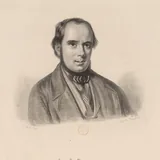
Adolf Anderssen
Before there were world champions there was Adolf Anderssen, and before chess learned caution it had his fire. A mathematics professor from Breslau who played the game for love and never for a living, he gave the board two of the most beautiful games ever recorded — the Immortal and the Evergreen — and won the first international tournament the world had ever staged. He gave away queens the way other men offer pawns, not from recklessness but from a faith that the attack, pursued with courage and exactness, was the truest form of the game. The romantic era had many heroes. Anderssen was its king.
◈A mathematics master from Breslau
Adolf Anderssen was born in Breslau in 1818 and stayed bound to the city his whole life. He passed through its gymnasium and its university, studying mathematics and philosophy, and graduated in 1847 to become an instructor — and in time a Professor of Mathematics — at the Friedrichs-Gymnasium. In 1865 the University of Breslau awarded him an honorary doctorate. He never married. He shared a quiet household with his widowed mother and an unmarried sister, and lived what one historian called a stable, responsible, respectable middle-class life.
Chess, for Anderssen, was never a trade. He earned his bread at the blackboard and gave the board his heart, and the strange, beautiful contradiction of his life is that this careful, dutiful provincial schoolmaster played the most daring attacking chess the world had yet seen. Reuben Fine would later note the curious contrast between his over-the-board brilliance and his uninspired, safety-first attitude in everyday affairs. At the chessboard, the safe man vanished.
◈London, 1851: the first crown
In 1851 the chess world gathered in London for the first international tournament ever held — a knockout staged alongside the Great Exhibition. The favourite was the Englishman Howard Staunton, the strongest player of the previous decade and the tournament's chief organiser. Anderssen swept the field. He put out Lionel Kieseritzky, József Szén, Staunton himself, and finally Marmaduke Wyvill, winning each match by a margin of at least two games, and finished with the first prize of roughly £335 — a small fortune.
The organisers had spoken, half in earnest, of contesting the baton of the World's Chess Champion. There was no official title yet — Wilhelm Steinitz would not claim the first one for another twenty years — but from that summer until Paul Morphy's brief comet in 1858, Anderssen was regarded as the strongest player alive.
◈The Immortal and the Evergreen
Two of the games Anderssen played were never official contests at all, yet they outlived every tournament he won. During a break in the London event, on 21 June 1851, he played a casual game against Kieseritzky and, to force checkmate, gave up a bishop, both rooks, and finally his queen, mating with the few minor pieces that remained. It became known as the Immortal Game, and it is still, more than a century and a half later, the most famous single game of chess ever played.
The following year, in Berlin, he produced its companion against Jean Dufresne — a cascade of two knight sacrifices, a rook, and at last the queen, ending in a forced mate of breathtaking economy. The German master Wilhelm Steinitz christened it Evergreen, the game that would never fade. Together the two works fixed Anderssen forever as the supreme artist of the attack: a player who treated material as fuel for beauty and sought not merely to win but to win in a way that left the spectator speechless.
His style was the romantic style in its purest form — rapid development, open lines, gambits offered without flinching, and the king-hunt as the highest expression of the game. He even gave his name to an opening, the quiet flank move 1.a3, the Anderssen Opening, which he tried three times against Morphy; it never caught on, but it remains one of the few openings named for a player who used it almost as a joke.
◈Morphy and Steinitz: the tide turns
In the winter of 1858 a young American came to Paris, and the romantic age met something faster and deeper than itself. Paul Morphy beat Anderssen in their match by seven wins to two, with two draws — a defeat as decisive as it was gracious on both sides. Anderssen, no sulker, said plainly that Morphy was the finer player, and when Morphy retired the following year Anderssen quietly resumed his place at the top.
The second reckoning was closer and more historic. In 1866, in London, Anderssen met Wilhelm Steinitz across fourteen games with no draws between them, and lost by eight wins to six, Steinitz taking the final two. That match is generally seen as the moment Steinitz succeeded Anderssen as the world's leading active player — the old romantic giving way to the man who would make chess a science. There was no rancour. Steinitz revered him, and learned from him.
◈The late renaissance
Most masters fade after such defeats. Anderssen did the opposite. In his late forties and fifties he rededicated himself to the game, this time studying the endgame and positional play he had once raced past, and produced the finest sustained results of his career. He dominated the great London tournament of 1862 — the first major round-robin — with twelve wins in thirteen games, two full points clear of Louis Paulsen.
His masterpiece of endurance came at Baden-Baden in 1870, one of the strongest tournaments of the nineteenth century. There, past fifty, Anderssen finished first ahead of Steinitz, Joseph Blackburne, Gustav Neumann and Paulsen — beating the very man who had dethroned him four years before. Across the years from 1862 to 1878 he placed first in five major tournaments and never stopped competing, an elder statesman to whom the whole of European chess turned for advice and arbitration.
◈The man behind the board
Away from the pieces Anderssen was modest, generous, and trusted absolutely. He edited the Deutsche Schachzeitung for nearly twenty years and helped found the Neue Berliner Schachzeitung, doing as much with his pen and his judgement to nurture the game as he ever did with his sacrifices. Steinitz, who beat him and replaced him, wrote of him with unguarded warmth: Anderssen was honest and honourable to the core, and his sincere disinterestedness was so patent that his word alone was usually enough to settle a dispute.
He kept his teaching post to the end, returning each season from his tournaments to the classroom in Breslau. In March 1879, not long after his last events, his heart gave out in the city where he had been born and had never really left. He was sixty years old, and he had spent a lifetime proving that a quiet man could be, on sixty-four squares, the boldest in the world.
“Move that one of your pieces which is in the worst plight, unless you can satisfy yourself that you can derive immediate advantage by an attack.”
“We all may learn from Morphy and Anderssen how to conduct a king's-side attack, and perhaps I myself may not have learned enough.”
“Anderssen was honest and honourable to the core. Without fear or favour he straightforwardly gave his opinion, and his sincere disinterestedness became so patent that his word alone was usually sufficient to quell disputes.”
◈From the archive
◈Legacy
Adolf Anderssen never held an official world title, for none existed in his prime — yet Arpad Elo's retrospective ratings made him the first player to cross 2600, and the historians' consensus places him as the world's leading player from 1851 to 1858 and again from 1862 to 1866. His true monument is not a ranking but two casual games. The Immortal and the Evergreen are taught to nearly every player who ever learns the openings, the first beauty most of us meet on the board, and through them the careful professor of Breslau became, and remains, the immortal artist of the attack.