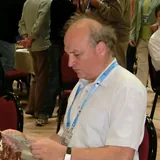
Alexander Beliavsky
Some players are remembered for a title they won. Alexander Beliavsky is remembered for the men he beat. Across a career spanning half a century he defeated nine undisputed World Champions — every one from Vassily Smyslov to Magnus Carlsen save Bobby Fischer — a feat matched only by Paul Keres and Viktor Korchnoi. He was never world champion himself, but for decades he was among the most feared competitors alive: a four-time champion of the Soviet Union, an uncompromising attacker who despised the safe half-point, and a craftsman of such determination that the strongest players of every generation he met walked away having lost to him. They called him Big Al, and the name fit a player who never knew how to play small.
◈The boy from Lvov
Beliavsky was born in 1953 in Lvov, in the western Ukraine of the Soviet Union. He announced himself to the world young: in 1973, at nineteen, he travelled to Teesside in the north of England and won the World Junior Championship, the traditional proving ground of future elite grandmasters. The senior title — Grandmaster — followed in 1975.
He did not have to wait for greatness. As early as 1974 he won the Championship of the Soviet Union, sharing first place with none other than the former world champion Mikhail Tal. To win that title even once was among the hardest achievements in chess, the USSR Championship being routinely stronger than most of the world's elite tournaments. Beliavsky would win it four times.
◈Four times champion of the Soviet Union
Beliavsky took the Soviet crown in 1974, 1980, 1987 and 1990 — four titles wrested from the deepest talent pool the game has ever known, across a sixteen-year span that proved his durability as much as his strength. Few players in history have stood atop that particular mountain even twice; Beliavsky did it four times, against fields that on any given year contained much of the world's top ten.
He was a pillar of the Soviet team in the era of its total dominance, winning Olympiad team gold for the USSR in 1982, 1984, 1988 and 1990, and taking the individual gold medal on his board at the 1984 Olympiad. To the tournament circuit he brought the same ferocity: first at Tilburg in 1981, a share of first at Wijk aan Zee in 1984, and a string of victories at the Vidmar Memorial that stretched into the new century.
◈Uncompromising
Beliavsky played a powerful, creative, attacking game built on classical openings and an almost legendary appetite for hard work. He distilled his entire philosophy into the title of his 1998 book, Uncompromising Chess — for him the draw was a last resort, never a goal, and he pursued the full point with a single-mindedness that unsettled even the greatest opponents. Mikhail Tal caught the essence of him in a sentence: You can't play to draw and to win at the same time.
It was a quality his rivals understood all too well. Garry Kasparov, who knew the danger first-hand, judged that Beliavsky's greatest qualities — his determination and remarkable efficiency at the chess table — make him a very dangerous opponent. Across the board he was relentless; in his preparation he was tireless; and in his refusal to settle he found the edge that toppled champion after champion.
◈Nine world champions
It is the statistic that defines him. Over the course of his career Beliavsky defeated nine undisputed World Chess Champions in classical play — Smyslov, Tal, Petrosian, Spassky, Karpov, Kasparov, Kramnik, Anand and Carlsen — every undisputed champion from Smyslov to Carlsen except Fischer. Only two players in the entire history of the game, Paul Keres and Viktor Korchnoi, have ever matched that haul of crowned heads.
What makes the record extraordinary is its reach across time. He beat a reigning Anatoly Karpov with the black pieces in 1977, schooled a sixteen-year-old Garry Kasparov at the 1979 Soviet Championship, and three decades later defeated a teenage Magnus Carlsen — three of his nine victims spanning nearly thirty years of chess history. He reached the Candidates in the 1982–84 cycle but fell there to the rising Kasparov, the one barrier between Big Al and a shot at the title itself.
◈Big Al in Slovenia
In 1996 Beliavsky settled in Slovenia and took its citizenship, becoming the anchor of the small nation's chess and leading its national team for years. FIDE named him a Senior Trainer in 2004, and he poured his vast theoretical knowledge into a series of instructional books, many co-written with his longtime friend and collaborator Adrian Mikhalchishin.
His competitive longevity bordered on the absurd: he remained among the world's elite into his fifties, lingering in the top hundred when most of his contemporaries had long retired. A composer of elegant endgame studies and a coach to a new generation, Beliavsky carried into his later years the same uncompromising spirit that had made him, for so long, one of the hardest men in the world to beat.
“Beliavsky's greatest qualities — his determination and remarkable efficiency at the chess table — make him a very dangerous opponent.”
“You can't play to draw and to win at the same time.”
◈From the archive
◈Legacy
Beliavsky's record speaks in a language every chess player understands: he beat Smyslov, Tal, Petrosian, Spassky, Karpov, Kasparov, Kramnik, Anand and Carlsen — nine world champions across nine different eras, a span of dominance shared with only two other men in history. He never reached a title match, falling to the young Kasparov in the 1983 Candidates, yet he remains one of the most respected fighters the game has produced, a player whose name on the other side of the board meant there would be no easy draw. Settled in Slovenia, still composing endgame studies and coaching into his eighth decade, Big Al endures as the embodiment of his own one-word creed: uncompromising.