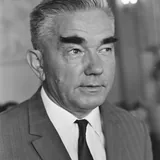
Alexander Kotov
Alexander Kotov was an engineer who taught the world how grandmasters think. On the board he was a fearless attacker — the man who won the 1952 Interzonal by three clear points without losing a game, and who immortalised himself with one of the most famous queen sacrifices ever played. But his deepest mark on chess was made with a pen. In Think Like a Grandmaster he tried to do something no one had quite managed before: to describe, honestly and systematically, what happens inside a master's head when the position is complicated and the clock is running. Generations of players learned to find candidate moves and build a tree of analysis because Kotov first wrote those ideas down. Few players have shaped how the rest of us understand the game so profoundly.
◈The engineer from Tula
Kotov was born in 1913 in Tula, a city of gunsmiths and steel south of Moscow, to a working-class family. He came to top-level chess relatively late, moving to Moscow in 1939 to study engineering even as his play was reaching national class. That same year, in his very first Soviet Championship, he stunned the chess world by finishing second — losing the title to Mikhail Botvinnik only in the final round. The result earned him the Soviet Grandmaster title, making him just the third holder after Botvinnik and Grigory Levenfish.
His engineering was no hobby. When war came, Kotov worked as an engineer in the Soviet defence industry, and for his contributions to the development of new armaments he was awarded the Order of Lenin — one of the country's highest honours. The discipline of the technical mind, the patient breaking-down of a problem into its parts, would later become the very heart of his chess writing.
◈The attacker
Over the board Kotov was anything but cautious. He embraced complications, played sharp and combative chess, and was willing to hurl his pieces forward in pursuit of the king. He favoured closed openings with White and was a dangerous handler of the Sicilian Defence with Black, where his taste for double-edged positions found its natural home.
After the war his results climbed. He won a tournament at Venice in 1950 ahead of Vasily Smyslov, took the Soviet title jointly with David Bronstein in 1948, and represented the USSR at the Helsinki (1952) and Amsterdam (1954) Olympiads, helping his team to gold both times. Later he would win Hastings in 1963 and, at Groningen in 1964, defeat both Botvinnik and Euwe in a single event — an attacker still dangerous into his fifties.
◈Saltsjöbaden 1952
Kotov's supreme result as a player came at the Saltsjöbaden Interzonal of 1952. In a field stacked with the world's best, he scored an overwhelming 16½ out of 20 — and won by three full points ahead of Tigran Petrosian and Mark Taimanov, without losing a single game. It remains one of the most dominant performances in the history of the qualifying cycle.
The triumph carried him into the Candidates Tournament at Zurich in 1953, the famous double-round marathon that decided Botvinnik's challenger. There, against Yuri Averbakh, Kotov produced the game that would carry his name into legend.
◈The immortal queen sacrifice
At Zurich in 1953, playing Black against Averbakh, Kotov sacrificed his queen deep in the middlegame — not for an immediate forced win, but for a lasting, suffocating attack against the white king. Move by move the pieces closed in, and the assault eventually crashed through to mate. The game won the tournament's Brilliancy Prize and is still studied as one of the greatest sacrificial achievements ever played.
It is a fitting centrepiece for Kotov, because it captures both halves of him: the fearless attacker willing to give up the strongest piece on the board, and the rigorous analyst who could see, far in advance, exactly how the long combination would resolve. The same mind that found that queen sacrifice would soon explain to the world how such ideas are found at all.
◈How grandmasters think
Kotov's greatest legacy is on the page. In Think Like a Grandmaster (1971) he set out to describe the actual mechanics of master calculation. Rather than telling readers where to put their pieces, he taught them a method: identify the serious candidate moves in a position, then analyse each in turn — building a “tree of analysis” whose trunk is the move under consideration and whose branches are the opponent's replies — until each line reaches a clear verdict.
He was also honest about how calculation goes wrong. He named the phenomenon, now called the “Kotov syndrome,” in which a player thinks hard for a long time in a complex position, fails to find a clear path, and then — short of time — abruptly makes a poor move, often a blunder. Alongside the trilogy of Think, Play and Train Like a Grandmaster, he wrote a four-volume biography of Alexander Alekhine that helped rehabilitate the émigré champion's name in the Soviet Union, served as deputy chairman of the Soviet Chess Federation, and even wrote a novel and play, Black and White, about the world of Russian chess. He died in Moscow in 1981, leaving the game a sharper picture of its own mind.
“First of all you make a list of all the moves which, even at first glance, seem to warrant attention — the candidate moves.”
“The trunk of this tree is the main move we are considering; the opponent's replies form the main branches.”
“Kotov is best remembered for trying to describe how strong players think when several serious moves are available — pushing club players to stop drifting and build a disciplined decision process.”
◈From the archive
◈Legacy
Kotov died in Moscow in January 1981, but his influence has only grown. Think Like a Grandmaster and its companions, Play Like a Grandmaster and Train Like a Grandmaster, remain among the most widely read instructional books ever written, and the vocabulary they introduced — candidate moves, the tree of analysis, the dreaded “Kotov syndrome” of the rushed blunder after long thought — is now simply how players talk about calculation. His four-volume study of Alexander Alekhine helped restore the exiled champion to honour in his homeland. Remembered as a brilliant attacker, a war-era engineer decorated for his country, and above all as the man who put the grandmaster's thought process into words, Kotov gave chess not only great games but a way of understanding itself.