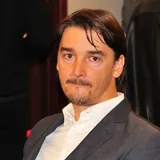
Alexander Morozevich
In an age when the elite converged on the same engine-approved lines, Alexander Morozevich went the other way. He played the openings the books had quietly buried — the Chigorin, the Albin Countergambit, gambits a century out of fashion — and he played them against the strongest men on earth, and he won. Where his rivals sought clarity, he sought complication, the thicket so dense that pure calculation and nerve decided everything. He climbed to world No. 2 on imagination alone, and even when he stepped away from the grind he did so on his own terms, a free artist to the last in a profession that had largely stopped believing in them.
◈A Moscow original
Alexander Sergeyevich Morozevich was born in Moscow on 18 July 1977 and came up through the formidable Soviet and Russian chess schools — but he was never their obedient son. From early on his instinct ran toward the unusual and the sharp, toward positions that resisted tidy explanation. He earned the grandmaster title in 1994, at seventeen, and announced his arrival to the wider world the following year with a staggering 9½/10 at a strong open in Lloyds Bank, London.
What marked him out was not merely talent but temperament. Other prodigies absorbed the reigning theory; Morozevich seemed almost to resent it, hunting instead for the forgotten byway, the line that engines and grandmasters alike had written off. He would spend his career proving the byways were not dead at all — only unexplored.
◈The climb to No. 2
Through the 2000s Morozevich was one of the most feared competitors alive. He won the elite Biel tournament in 2003, 2004 and 2006, triumphed repeatedly at Melody Amber — the rapid-and-blindfold festival in Monaco — taking it outright in 2002 and sharing first across several later editions, and he captured the Russian Championship in 1998 and again in 2007.
In July 2008 the climb reached its summit: a peak rating of 2788 and the world No. 2 ranking, second only to Anand and ahead of nearly every great name of the era. He did it, remarkably, while playing the most uncompromising chess at the top — refusing the safe draws that smoothed other careers, preferring positions in which someone, often gloriously, had to lose.
◈The openings nobody dared
Morozevich's repertoire was a standing provocation. He wheeled out the Chigorin Defence and the Albin Countergambit — replies to the Queen's Gambit that respectable theory had filed under "dubious" — alongside the Evans Gambit, the King's Gambit and other relics of the romantic age, and he scored with them against the world's best.
As the commentator Dennis Monokroussos observed, it was not just that he played unusual openings: his creative play extended to every phase of the game. He could, Monokroussos wrote, defeat anyone playing practically anything. Behind the bravado lay deep, idiosyncratic preparation and a calculating power equal to the chaos he courted — the willingness to walk into complications was not recklessness but a wager he kept winning.
◈The reluctant genius
For all that the chess world hailed his imagination, Morozevich wore the label uneasily. Asked about his celebrated creativity, he answered with characteristic irony — that he must, on the contrary, be boring, since professionals found his play boring. It was the deflection of a man who simply played the moves he believed in and let others supply the adjectives.
By the end of the decade the strain of elite competition was telling. "2009 was already a tough year," he later admitted; he felt he had begun to play badly, and rather than grind on for ranking points he chose to compete less and less at the classical top, on his own schedule and his own terms.
◈Beyond the sixty-four squares
Morozevich never fully retired, surfacing for rapid and blitz events and the occasional classical tournament, but his centre of gravity shifted. His restless, pattern-hungry mind found a new home in the ancient Asian game of Go, in which he reached the rank of 1-dan — a serious amateur standard — by 2018.
It was a fitting second act for a player who had always been drawn to the unmapped. He remains, in the memory of the chess public, the elite grandmaster who treated the opening book as a challenge rather than a scripture — the man who proved that even at the summit of the modern game there was still room to invent.
“I think I must be boring, because professionals find my play extremely boring.”
“Not only can he defeat anyone, he can do it playing practically anything: the Chigorin, the Albin, the King's Gambit, the Evans Gambit. It's not just that he plays unusual openings; his creative play extends to all phases of the game.”
◈From the archive
◈Legacy
Morozevich is remembered as the most imaginative player of his generation — proof, in a computerised age, that originality could still beat preparation at the very top. He reached world No. 2 with a rating of 2788, won the supertournaments at Biel and the Amber rapid/blindfold events, took two Russian Championships, and anchored Russian Olympiad teams to gold. He revived openings the profession had abandoned and made them respectable again at elite level. And when the relentless cycle of modern chess wore on him, he walked away from the very top without bitterness, turning his restless mind to the game of Go. He leaves behind a body of games admired less for trophies than for their sheer inventive courage — the work of a player who would rather create than coast.