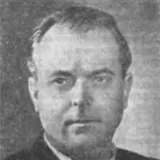
Alexander Tolush
Alexander Tolush played chess the way a cavalry officer charges — forward, always forward, with the pieces drawn like sabres. “Forward, Kazimirych!” he would mutter at the board, urging himself on by his own patronymic, and the games that followed were storms of sacrifice and counter-sacrifice that he won and lost beautifully because he fought, as a friend said, to the last pawn. He never wore a world champion's crown. But he did something rarer: he took two of the most gifted players of the century under his wing, poured his own fearless, self-sufficient style into them, and helped carry Boris Spassky all the way to the summit. The attacker from Leningrad left his fingerprints on the history of the game twice over — once in his own brilliant, reckless play, and once in the champion he made.
◈Forward, Kazimirych
Alexander Kazimirovich Tolush was born in Saint Petersburg in 1910 and was, in the deepest sense, a Leningrad man — he was born, came of age, and died within the same city across its three names. He rose through the chess life of the city in the 1930s and 1940s, winning the strong Leningrad Championship four times: shared first in 1937, outright in 1938 and 1946, and shared again in 1947.
His chess had a single, unmistakable signature: attack. Tolush played for the initiative the way other men breathe, hunting for sacrifices and complications, willing to burn his own position to the ground for the sake of a flaming kingside assault. He even talked himself into the charge, famously rallying himself at the board with the cry “Forward, Kazimirych!” — addressing himself by his own patronymic, as though the attacker and the man were two soldiers in the same regiment.
◈The master of the surprise
Tolush was, by the testimony of those who faced him, one of the most dangerous and unpredictable opponents of his generation. “Playing against Tolush was very interesting, but also difficult,” the master Mikhail Yudovich recalled. “He was a chess master who could create surprises that changed the character of the fight sharply.” He had a gift for finding hidden traps and resources in difficult positions, and a temperament that refused to settle for the safe road.
Mikhail Botvinnik, the great theoretician of Soviet chess, fixed Tolush's essence in a single sentence — and tied it forever to his most famous pupil. “Spassky prefers to play in a style that used to be employed by Alexander Tolush,” Botvinnik observed. “Tolush had weak technique, but an amazing, self-sufficient style.” It was both a limitation and a glory: the technique that might have made him champion was missing, but the imagination that made him unforgettable never was.
◈Bucharest, 1953
Tolush's finest hour as a player came at Bucharest in 1953. In a field thick with the coming and reigning giants of Soviet chess, he finished clear first with 14 out of 19 — ten wins, one loss, eight draws — losing only to Vasily Smyslov and finishing a full point ahead of Tigran Petrosian, Isaac Boleslavsky, the young Boris Spassky, and László Szabó. The victory earned him the international Grandmaster title, awarded that same year.
It was the crowning result of a career studded with near-misses at the very top. His best Soviet Championship finish was second place in 1950, scoring +8 −3 =6 behind Paul Keres, and he placed fourth in both 1952 and 1957 — the latter year tying with the rising Spassky. He never played in a Chess Olympiad, but represented the USSR in European team competition, the attacking specialist always trusted to make something happen on his board.
◈The maker of champions
If Tolush's own play never carried him to the world title, his teaching carried others. From 1947 he worked as a trainer and second to Paul Keres through the brutal Candidates cycles of the early 1950s, when Keres was perennially the strongest player never to play a title match. Then, in 1951–52, came the partnership that would define his legacy.
He took over the training of the teenage Boris Spassky from the patient pedagogue Vladimir Zak, and the match of temperaments was perfect: where Spassky already loved the attack, Tolush set it on fire. They had first met in 1947 at the Leningrad Palace of Pioneers, when young Boris — entrusted with relaying the moves of a telegraph match — was also sent to the buffet to buy Tolush more cigarettes. The bond that grew from it lasted the better part of a decade. Tolush's fearless, sacrificial chess became the foundation of Spassky's, and the seed he planted bore its ultimate fruit in 1969, when Spassky won the crown.
◈The man at the board
Away from his own games, Tolush gave his energy to the wider chess world as a journalist and radio commentator, work that suited his vivid, combative voice. He was, by all accounts, a character — a chain-smoker who, the story goes, would stuff his cigarettes with cotton wool, and a man who dispensed his wisdom in unforgettable, slightly conspiratorial bursts.
Spassky carried one such lesson all his life. “Remember,” Tolush warned him, “even if you play against someone who doesn't know chess at all, never be sure of a hundred-per-cent win, because anything is possible. What if you suddenly have a heart attack, or something? No player is ever sure of a hundred-per-cent win.” It was the creed of a man who had seen too many won positions slip away and lost ones miraculously saved — the wary humility of a lifelong gambler with the pieces.
“Remember, even if you play against someone who doesn't know chess at all, never be sure of a hundred-per-cent win, because anything is possible. No player is ever sure of a hundred-per-cent win.”
“Spassky prefers to play in a style that used to be employed by Alexander Tolush. Tolush had weak technique, but an amazing, self-sufficient style.”
“Playing against Tolush was very interesting, but also difficult. He was a chess master who could create surprises that changed the character of the fight sharply.”
◈From the archive
◈Legacy
Tolush died in Leningrad on 3 March 1969, not yet fifty-nine, in the city where he had spent almost his entire life. His widow Valentina — the couple had no children of their own and had long regarded the young Spassky as a son — compiled a memorial collection of ninety-two of his games. He is remembered as one of the great attacking players of Soviet chess, a master who could change the character of a fight in a single surprising move, and whose name survives in the Tolush–Geller Gambit of the Slav. But his deepest mark on the game is written in others: in Paul Keres, whom he seconded through the hardest years of the Candidates, and above all in Boris Spassky, the tenth World Champion, whose fearless, attacking soul was in no small part Tolush's gift.