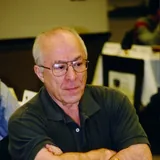
Anatoly Lein
Anatoly Lein was a big, burly, intimidating man who played the quietest possible chess. He came up the hard way and the slow way — a grandmaster only at thirty-seven, in a Soviet Union overflowing with younger genius — and he made his name not with fireworks but with patience: the endless, grinding will to nurse a microscopic advantage to the very last square. When he crossed an ocean in middle age and walked into the American open tournaments that grandmasters of his rank usually disdained, he taught a whole generation what a fighter looked like. He played for the win until the kings came off the board, and then he played some more.
◈A fighter out of Leningrad
Anatoly Yakovlevich Lein was born in Leningrad on 28 March 1931. He matured into a chess master inside the most crowded talent pool the game has ever known — the post-war Soviet Union — and he did it without the early-prodigy halo that surrounded so many of his rivals. FIDE made him an International Master in 1964 and a Grandmaster only in 1968, when he was already thirty-seven. For most players that age marks a plateau; for Lein it was a beginning.
His credentials were forged in the unforgiving arena of Soviet domestic chess. He won the USSR Armed Forces Championship in 1962 and the Russian (RSFSR) Championship in 1963, and he became a fixture in the finals of the USSR Championship — the strongest national event on earth, where a single point could be wrung only from a world champion or a future one.
◈Among the giants
Across the late 1960s and early 1970s Lein beat, over the board, names that read like a roll-call of Soviet chess: the former world champion Vassily Smyslov, the World Championship finalist David Bronstein, and grandmasters Lev Polugaevsky, Leonid Stein and Mark Taimanov. He defeated two world champions in his career — Smyslov and the magician Mikhail Tal — the surest measure that on his day he belonged in any company.
The tournament wins came too. He shared first at Moscow in 1970, took the Moscow Championship in 1971 after a play-off, and then ran off a string of international victories: first at Cienfuegos in 1972 and first at Novi Sad in both 1972 and 1973. He was, by then, a grandmaster in full — and on the verge of the boldest decision of his life.
◈The crossing
In 1976 Lein emigrated to the United States. The price of leaving was steep and characteristically Soviet: to get out he had to sign papers promising never to work in any scientific profession again, lest he carry state secrets abroad. Cut off from the career he had trained for, he chose to live by the board itself — playing tournaments for prize money and teaching a few students on the side.
America met him at once. In his arrival year he tied for first in the U.S. Open with Leonid Shamkovich and tied for first in the World Open with Bernard Zuckerman. Where established grandmasters of the era often held themselves above the weekend Swiss opens, Lein dove straight into them, and his presence raised the stakes for everyone in the room. He played for the United States at the 1978 Chess Olympiad.
◈The art of the small advantage
There has rarely been a sharper contrast between a player's body and his style. Lein was, in Joel Benjamin's words, "a big burly intimidating presence" — and yet across the board he was a pure technician who lived for long, dry, technical endgames. He had an endless determination to prosecute the smallest of advantages, an appetite for the grind that struck genuine fear into the young Americans who had to face him.
His sitzfleisch — the sheer staying power to sit and squeeze — was just as formidable in defence. He could dig in and hold a grim position for hours, or gamble to turn the game around when holding was not enough. Off the board he was confrontational and quick-tempered; on it he was endlessly, almost serenely, patient. Benjamin, who lost to him many times before he ever won, said his impact on American chess ran far deeper than the tournaments and games he won — a whole generation learned by playing him, watching him, and listening to his ideas.
◈The man and his library
He played a tournament in Mentor, Ohio, met a woman named Barbara, and married her; their marriage lasted some forty years. In 1998 they settled permanently in the Cleveland area, and Lein went on to win the New Jersey Championship three years running, 1992 through 1994, well into his sixties. In 2005 he was inducted into the World Chess Hall of Fame.
Away from chess he was a voracious reader who built up a vast library of great literature — when he finally had to move to a nursing home, his stepson recalled, what pained him was not the loss of his freedom but the books he could not take with him, the collection that had filled two-thirds of his apartment. He died in Beachwood, Ohio, on 1 March 2018, one week after Barbara. He was, his stepson wrote, "one of life's great characters."
“When I was a heavy smoker I would get upset when I lost a game. Now that I no longer smoke, I get very upset when I lose a game.”
“Lein's sitzfleisch was also remarkable in defense. He could grimly defend, or he could take a gamble to try to turn things around.”
“He was more interested in the progress of my games than his own.”
◈From the archive
◈Legacy
Lein never wore a crown, but he carved out something rarer: the respect of two chess cultures. In the Soviet Union he proved, late and against the odds, that he could take points from world champions; in America he became a teacher by example, the burly grandmaster who would deign to play the open Swiss and grind a teenager into the floor with flawless technique, then share what he knew. The World Chess Hall of Fame enshrined him in 2005. He is remembered as a fighter to the last move — and, in his stepson's phrase, as one of life's great characters.