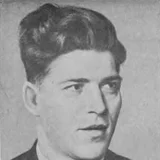
Andre Lilienthal
He outlived an entire age of chess. Andor Lilienthal was born when Lasker still wore the crown and died when Carlsen was nearly upon it, and across that impossible span he sat down against ten different World Champions and beat seven of them. The world remembers him for a single, perfect afternoon — the day he offered his queen to José Raúl Capablanca and watched the greatest natural genius the game had known reach across the board to shake his hand. But the truer marvel of Lilienthal is the length of the bridge he became: a living thread running from the era of Lasker and Capablanca all the way to the era of Fischer and Kasparov, the last surviving man of the first generation of grandmasters, carrying the old beauty forward in person for ninety-nine years.
◈Born in Moscow, raised in Budapest
Lilienthal was born in Moscow in 1911, but the city kept him only as an infant: when he was two his family moved to Hungary, and it was in Budapest that he grew up, a boy of Jewish descent in a household of modest means. He learned the moves young, and chess soon became less a pastime than a livelihood.
By his late teens he had turned professional in the only way a poor young master could — on the road. Through the late 1920s and early 1930s he wandered the cafés and tournament halls of Western Europe, living game to game, sharpening himself against the strong and the famous. It was an itinerant, precarious education, but it carried him into the company of the very best players in the world, and it taught him that he belonged there.
◈The immortal queen sacrifice
At the Hastings Christmas Congress of 1934–35 he produced the game that would follow him for the rest of his life. With the white pieces against Capablanca — the former World Champion, the man who in his prime had gone years without losing — Lilienthal reached a sharp middlegame and, on the twentieth move, gave up his queen with 20.exf6, opening the e-file against a king still stranded in the centre. A few moves later Capablanca's position collapsed.
"The motif of the queen sacrifice," Lilienthal explained, "is to exploit the poor position of the enemy king and Black's lag in development. A decisive factor in the attack is the opening of the e-file." What he remembered most, though, was the response: "Without waiting for my reply, Capablanca smiled and held out his hand, congratulating me on my win. I couldn't conceal that I was happy." He was one of the very few players to hold an even lifetime score against the great Cuban — and for decades afterward, wherever he travelled, audiences asked him to play through this one game again.
◈Among the champions
The Capablanca brilliancy was no accident of a single night. Lilienthal played three Olympiads for Hungary — 1933, 1935 and 1937 — and took individual gold on the first two, with unbeaten and near-unbeaten scores. In 1935, after the great Moscow tournament, he settled in the Soviet Union, becoming a Soviet citizen in 1939 and entering the deepest pool of talent the game has ever held.
There he reached his own summit. At the 1940 USSR Championship — one of the strongest national events ever staged — Lilienthal tied for first place with Igor Bondarevsky, finishing ahead of Smyslov, Keres, Boleslavsky and the future World Champion Botvinnik. Across his long career he sat down against ten men who held the world title and defeated seven of them — Lasker, Capablanca, Alekhine, Euwe, Botvinnik and Smyslov among them, along with the women's champion Vera Menchik. No one else has left such a span of scalps.
◈The teacher behind the throne
When FIDE named its first official grandmasters in 1950, Lilienthal was among them. But by then he had already begun a second life in chess, quieter and just as consequential — as a trainer and second to the men who would rule the game. He worked with the young Tigran Petrosian through the 1950s, helping shape the most unbeatable defender chess would produce, and he served as a second to his close friend Vasily Smyslov in Smyslov's World Championship matches against Botvinnik.
He retired from serious tournament play in 1965, his last competitive outing coming at Zamárdi in 1980. In 1976 he returned to Hungary, the country of his childhood, having spent four decades inside Soviet chess and given much of his strength to others' crowns. The friendships endured: his bond with Smyslov, begun in 1938, lasted the rest of their lives.
◈Ninety-nine years
Lilienthal simply would not stop. He lived to be ninety-nine — the longest-lived grandmaster in history, and at the end the last surviving member of that original 1950 class, the final living link to a vanished world of champions. To meet him was to touch the whole arc of modern chess at once.
Bobby Fischer understood as much. When the two met again in 1992, on the eve of Fischer's return match with Spassky, the reclusive American greeted the old Hungarian not with hello but with a chess move — "Pawn e5 takes f6" — naming, by heart, the sacrifice against Capablanca from fifty-seven years before. Fischer's regard ran deeper still: he is said to have approved only three men to carry his coffin, and Lilienthal was one of them. Andor Lilienthal died in Budapest in 2010, three days after his ninety-ninth birthday, having outlasted every rival of his youth and carried their game gently into a new century.
“Wherever I went on an exhibition tour, both in the Soviet Union and elsewhere, chess players and fans always asked me to show them how I sacrificed the queen against the great Cuban.”
“Without waiting for my reply, Capablanca smiled and held out his hand, congratulating me on my win. I couldn't conceal that I was happy.”
“Pawn e5 takes f6.”
◈From the archive
◈Legacy
Andor Lilienthal gave chess one of its most beloved combinations, an even account against Capablanca, and a record of victories over seven World Champions that no one is likely to match. But his rarest gift was simply endurance with grace: he was the bridge between the worlds of Lasker and Carlsen, the last living man of the first generation of grandmasters, a teacher who poured his strength into Petrosian's defence and Smyslov's title runs and never seemed to resent the giving. He died three days past his ninety-ninth birthday, having spent nearly a century proving that the beauty of a single perfect move can outlast everything — even the age that made it.