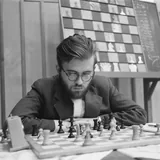
Bent Larsen
For two decades he was the most dangerous free man in chess — the lone Westerner who walked into the Soviet machine and beat it on its own board, again and again, with openings the textbooks had left for dead. Bent Larsen played 1.b3 against world champions and won. He demanded board one ahead of Bobby Fischer and took it. He believed, with a confidence that delighted the public and infuriated the experts, that a fighting game with a flaw in it was worth more than a flawless draw. "The strongest player born in Denmark," the record says — but the truth is larger: for much of the 1960s and 70s, only Fischer stood between Larsen and the world.
◈An engineer who chose the board
Larsen was born in 1935 in the small Jutland village of Tilsted, near Thisted, and came to chess as a boy with a scientist's appetite for systems. He trained as a civil engineer, but the game would not let him go. He was Danish Champion six times — in 1954, 1955, 1956, 1959, 1963 and 1964 — and in 1956, on board one for Denmark at the Moscow Olympiad, he scored a gold medal and was awarded the Grandmaster title in the same stroke.
He came from a tiny chess country with no tradition of champions and no Soviet-style apparatus of trainers and seconds behind him. Everything he became, he built largely alone — and he built it in open defiance of fashion, convinced that the orthodox openings the masters leaned on had become a kind of comfortable cowardice.
◈The best of the West
Through the 1960s Larsen climbed into the small circle of players who could trouble the Soviets at will. He shared first place at the 1964 Amsterdam Interzonal — alongside Smyslov, Spassky and Tal — qualifying for the Candidates. In the 1965 cycle he beat Borislav Ivkov, then pushed Mikhail Tal to the very end of their semifinal before falling 4½–5½; four years later he turned the tables and crushed Tal 5½–2½ in a 1969 rematch. He won the 1967 Sousse Interzonal by a clear margin and strung together a run of tournament victories — Havana, Palma de Mallorca, Monte Carlo, the U.S. and Canadian Opens — that made him, by common consent, the second-strongest non-Soviet player in the world behind only Fischer.
The recognition was made literal in 1970. When a USSR team met a Rest of the World side in Belgrade, the question of who would take board one for the West came down to Larsen and Fischer — and it was Fischer who stepped aside, ceding the top board to the Dane. Larsen repaid the trust by beating the reigning world champion Boris Spassky in their game and scoring 2½ of 4 against Spassky and Leonid Stein. In 1967 he had already been voted the very first Chess Oscar as the year's outstanding player.
◈Denver, 1971
Then came the cruelest afternoon of his career. In the 1971 Candidates, Larsen disposed of Wolfgang Uhlmann and reached a semifinal against Bobby Fischer, who was mid-way through one of the most terrifying runs the game has ever seen. In the heat of Denver, Fischer beat Larsen 6–0 — six games, six wins, not a single draw, a result without precedent at that level of chess.
Larsen never hid from it, but he never accepted that it measured him, either. "The organizers chose the wrong time for this match," he said afterward. "I was languid with the heat and Fischer was better prepared for such exceptional circumstances." The match remains the great shadow on a luminous career — and a reminder that the man who walked into it had earned the right to sit across from Fischer with the title in view.
◈Why not the Philidor?
Larsen's chess was a standing argument against caution. He revived and legitimised 1.b3 — the Nimzo–Larsen Attack — at the highest level, and made a home in lines other grandmasters wouldn't be seen in: Bird's Opening, the Grand Prix Attack against the Sicilian, the Scandinavian, the old Philidor Defence. In 1971 he published a monograph with the gloriously contrarian title Why Not the Philidor Defense?, and a year later won a famous game with the Scandinavian — 1.e4 d5 — against the young Anatoly Karpov.
Samuel Reshevsky wrote that Larsen "is a firm believer in the value of surprise." It was more than a trick. Larsen genuinely believed that a sharp, original, double-edged game served chess better than the bloodless precision the elite prized, and he was willing to lose for that belief — which is precisely why he so often won. His annotations, collected in Larsen's Selected Games of Chess, 1948–69, were as candid and combative as his play, full of psychology and self-criticism rarely found in a master's own notes.
◈The long Argentine evening
From the early 1970s Larsen divided his life between Las Palmas and Buenos Aires, settling at last in Argentina with his wife Laura Beatriz Benedini. He kept writing — books, columns, tournament reports turned out with a journalist's speed — and kept playing into old age, even as diabetes slowed him. In 1988 he became the first grandmaster to lose to a computer in tournament play, falling to Deep Thought; in 1993 he took his revenge, winning a Copenhagen match against an early Deep Blue 2½–1½.
He won games against every world champion from Botvinnik to Karpov, and he is, with Magnus Carlsen, one of only two truly world-class players Scandinavia has produced. Bent Larsen died of a cerebral haemorrhage in Buenos Aires in 2010, aged 75.
“The organizers chose the wrong time for this match. I was languid with the heat and Fischer was better prepared for such exceptional circumstances.”
“Larsen is a firm believer in the value of surprise.”
◈From the archive
◈Legacy
Bent Larsen proved that a player from a country with no chess pedigree, working largely alone and on his own iconoclastic terms, could meet the Soviet school as an equal and beat its champions one by one. He gave the game an opening that still bears his name, a body of fighting, fearless games, and a creed — that originality and risk are worth more than safety — that outlived the era he dominated. Until Magnus Carlsen, he stood unchallenged as the strongest player Scandinavia had ever produced; he remains the proof that chess belongs to whoever is bold enough to take it.