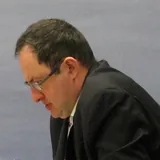
Boris Gelfand
Some players burn brightly and are gone; Boris Gelfand simply never left. For nearly three decades he stood among the strongest players on earth, a son of the Soviet school who carried its deepest virtues — patience, logic, the long strategic plan — into the computer age and made them sing. He took the classical chess of his hero Akiba Rubinstein as his inheritance and his creed, refusing every shortcut, trusting only ideas. And then, at forty-three, an age when most grandmasters are written off, he climbed the entire mountain again to play for the World Championship itself — coming within a whisker of the crown, and never once compromising who he was to reach it.
◈A son of Minsk
Boris Abramovich Gelfand was born on 24 June 1968 in Minsk, the capital of the Byelorussian Soviet Socialist Republic, to Abram and Nella, both engineers. He came to chess very young, and in the great machinery of Soviet chess he found his teacher in the Minsk trainer Albert Kapengut, who guided him into the classical understanding that would define his whole career.
From the beginning Gelfand looked backward to look forward. He fell in love with the games of Akiba Rubinstein, the tragic Polish master of the early twentieth century, and made Rubinstein's method — deep opening preparation, the patient realisation of a long strategic plan — the foundation of his own. The grandmaster title came in 1989, when the boy from Minsk was twenty-one and already pushing toward the world's elite.
◈Among the elite
The rise was swift. By July 1990, at just twenty-two, Gelfand had climbed to world No. 3 — and there, for all practical purposes, near the very top, he would remain for the rest of his career. He shared first at Wijk aan Zee and at the Alekhine Memorial in Moscow in 1992, won the Biel Interzonal outright in 1993, and beat the reigning generation of champions head to head, defeating Anatoly Karpov, Vladimir Kramnik, and his great contemporary Vassily Ivanchuk along the way.
When the Soviet Union dissolved, Gelfand's life changed with it. In 1998 he emigrated to Israel, settling in Rishon LeZion, and for the next decade and a half he was the heart of Israeli chess — leading its Olympiad team and carrying its flag at every World Championship cycle. He had become a wanderer between worlds, but his chess never wavered.
◈The long pursuit
Few players have chased the World Championship as long, or as faithfully, as Gelfand. He was a Candidate again and again across more than two decades — in 1991, 1994–95, 2002, 2007, 2011, and 2013 — always near the prize, never quite through. Then, in his forties, when the chess world had filed him away as a permanent contender, he produced the run of his life.
In 2009 he won the World Cup as top seed, surviving a brutal knockout field before defeating Ruslan Ponomariov in the final. Two years later, in 2011, he won the Candidates Tournament — past Shakhriyar Mamedyarov, past Gata Kamsky, and finally past Alexander Grischuk in the final — to earn, at forty-three, the right to challenge for the World Championship. It was a triumph of endurance over fashion: the old classicist had out-lasted them all.
◈Moscow 2012
The match against the reigning champion Viswanathan Anand was held in May 2012 at the Tretyakov Gallery in Moscow, and it was desperately close. Gelfand struck the first blow, scoring the only classical win either man managed in the early going to take the lead in the match. Anand levelled almost at once — winning the next game in a startling seventeen moves, the shortest decisive game in World Championship history — and after twelve classical games the score stood even, 6–6.
It went to a rapid tiebreak, and there the champion's speed told: Anand kept the crown 2½–1½. Gelfand had come within a handful of moves of the title, and he had done it on his own terms. When Garry Kasparov had offered to help him prepare, Gelfand refused — "For me it was unthinkable," he said, "to receive help from somebody who has access to the secrets of my colleagues." He lost the match, but he never lost himself.
◈The teacher and the torch
Gelfand's chess is the chess of understanding. He was never a natural attacker, the analyst Jacob Aagaard observed, but "a deep strategic player who likes to get into the logic of a position" — and Vladimir Kramnik, writing of him, praised the "inexorable consistency in the realisation of his strategic conceptions" that marked him as one of the rare truly universal players. That consistency was literal: he stayed inside the world's top thirty for twenty-seven straight years.
In his later career he became one of the game's great teachers. His books with Aagaard — Positional Decision Making in Chess, Dynamic Decision Making in Chess, and Technical Decision Making in Chess — distilled a lifetime of classical thought and are treasured by ambitious players the world over. Away from the board he is a devoted family man, married to Maya and father of two, and a passionate supporter of FC Barcelona. He remains, in every sense, the keeper of a flame the rest of the chess world had nearly let go out.
“For me it was unthinkable to receive help from somebody who has access to the secrets of my colleagues.”
“Chess makes me happy.”
“An inexorable consistency in the realisation of his strategic conceptions — he is a highly universal player.”
“Gelfand is not a natural attacker; he is a deep strategic player who likes to get into the logic of a position.”
◈From the archive
◈Legacy
Gelfand's career is a monument to consistency. He held a place in the world's top thirty for twenty-seven unbroken years, from 1990 to 2017 — a span almost no one in chess history can match — and within it he won the World Cup, the Candidates Tournament, and supertournament after supertournament against four generations of rivals. His journey carried him from Soviet Minsk to a new life in Israel, where he became the standard-bearer of his adopted country's chess. In retirement from the very top he turned teacher, and his Decision Making series, written with Jacob Aagaard, is among the most admired instructional chess writing of the modern era. He is remembered as the last great classicist — the man who proved that depth, integrity, and sheer endurance could keep you at the summit for a lifetime.