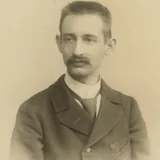
Carl Schlechter
They called him the man without style, and they meant it as the highest praise: Carl Schlechter could play any way the board demanded — bold or cautious, sharp or serene — and beat you with whichever you least expected. In the winter of 1910 the gentlest man in chess came within a single move of taking the world crown from Emanuel Lasker, and let it slip. He never complained. He gave away brilliancy prizes, deducted time from his own clock when an opponent arrived late, and offered draws to men who looked unwell. Eight years later, in a Budapest broken by war, he quietly starved.
◈A son of the Vienna cafés
Carl Adalbert Hermann Schlechter was born in Vienna on 2 March 1874, into the great age of Austro-Hungarian café chess. The smoke-filled coffeehouses of the capital were the finest finishing school a young master could have, and it was there that Schlechter sharpened a game built on the deep positional principles of Wilhelm Steinitz. He took up serious competition in 1893, and over the next two decades played in more than fifty international tournaments — a workload that made him one of the most travelled and respected professionals of his era.
His rise was steady rather than meteoric. First prizes and shared firsts accumulated at the strongest events of the day: Munich 1900, Coburg 1904, the celebrated Ostend tournament of 1906, Stockholm 1906, Vienna and Prague in 1908, and the great Hamburg congress of 1910. Three times — 1911, 1912 and 1913 — he won the Trebitsch Memorial in his home city. By the eve of the First World War, no list of the world's elite was complete without his name.
◈The man without style
Schlechter was famous for his draws, and the nickname the Viennese drawing master clung to him for life. But the label flattered his caution and hid his range. “He plays all styles,” wrote Lasker, “aggressive, defensive, logical, simple, complicated, combinative, trappy, sound.” He was a profound student of the openings — feared above all in the Ruy Lopez — yet equally at home grinding an endgame or conjuring an attack out of a quiet position.
That very completeness was why contemporaries called him the man without style: he had no single weapon to prepare against, because he commanded them all. His high draw rate was the by-product of a player who almost never overreached and almost never lost — a steadiness that served him superbly in match play even as it sometimes cost him clear first in a tournament.
◈Within a move of the crown
In 1910 Schlechter played Emanuel Lasker for the World Championship — a ten-game match split between Vienna and Berlin, and the first time the long-reigning Lasker faced a truly serious challenger. Schlechter struck first, winning the fifth game, and carried a one-point lead into the tenth and final encounter, played in Berlin on 8–10 February. A single draw would have made him champion of the world.
What followed became one of the most agonising stories in chess. In a long, tense struggle Schlechter reached a position that was at the least equal and very possibly winning — then, around his 39th move, the steadiest player of his generation went wrong. The advantage curdled into a draw, the draw into defeat. Lasker won the game, the match was tied 5–5 (+1 −1 =8), and the champion kept his title.
Whether Schlechter had needed to win by two clear points to claim the crown has never been settled — no signed match contract has ever surfaced, and historians from Edward Winter onward have weighed the witnesses for decades. What is beyond dispute is that an unassuming Viennese gentleman came within one careful move of dethroning the greatest player in the world, and bore the loss without a word of self-pity.
◈The gentleman of the board
If the chess public remembers Schlechter's results, those who knew him remembered his decency. He was, by universal account, the kindest competitor of his age. When an opponent arrived late, he would quietly deduct an equal amount of time from his own clock, saying nothing. When an opponent looked ill, he offered a draw rather than press an unfair advantage. He mentored younger rivals, among them Oldřich Duras.
At Ostend in 1906, having taken first prize, he declined to compete for any of the brilliancy prizes. “I have won enough,” he said. “Let others get something too.” Isidor Gunsberg, watching, wrote that Schlechter “accepted all things and all arrangements with equanimity amounting almost to indifference.” It was the equanimity of a man who simply did not need to win at another's expense.
◈Scholar of the openings
Away from the board Schlechter was a serious theoretician, journalist, and problem composer. His monument in chess literature is the eighth and final edition of Bilguer's Handbuch des Schachspiels — the great German openings encyclopedia. Published in eleven parts between 1912 and 1916 and running to more than a thousand pages, it drew on contributions from Spielmann, Tarrasch and Teichmann, and has been called the last work to encompass the whole of opening theory between two covers.
His name survives in the books in his own right. The Schlechter Variation of the Slav Defence — answering the queen's pawn with an early kingside fianchetto — remains a respected line, and Schlechter gambits and variations are scattered through the French, the Danish and Bird's Opening. For a player so often filed under “draws,” he left a remarkably deep imprint on how the game is played.
“I have won enough. Let others get something too.”
“He plays all styles, aggressive, defensive, logical, simple, complicated, combinative, trappy, sound.”
“Schlechter was the one competitor who accepted all things and all arrangements with equanimity amounting almost to indifference.”
◈From the archive
◈Legacy
Schlechter died in Budapest on 27 December 1918, aged 44 — of pneumonia and starvation, a casualty of the famine that gripped central Europe in the wreckage of the First World War. He was buried there on 31 December. For decades he was remembered only as the man who drew with Lasker, but Warren Goldman's 537-page Carl Schlechter! Life and Times of the Austrian Chess Wizard (1994) restored the fuller picture: a universal master, a generous teacher, and one of the strongest players never to wear the crown. A memorial tournament has carried his name, and historians still debate, a century on, whether a famous clause robbed him of the title that for one evening was almost his.