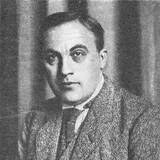
Efim Bogoljubov
Efim Bogoljubov played chess the way a gambler plays a winning streak — with total, unshakeable faith in himself. "When I am White I win because I am White," he liked to say; "when I am Black I win because I am Bogoljubov." For a few dazzling years in the 1920s the bravado was simple truth: at Moscow 1925 he finished ahead of both Emanuel Lasker and the reigning champion Capablanca, and twice the chess world made him challenge Alexander Alekhine for the crown. He never wore it. War interned him, revolution disowned him, and history would judge his compromises harshly — but across the board he remained, to the end, a fighter who believed every position could be won.
◈From the seminary to the chessboard
Efim Dmitrievich Bogoljubov was born on 14 April 1889 in the village of Stanislavchik, near Kiev, in what was then the Russian Empire and is today Ukraine. His father was an Orthodox priest, and the path laid out for the boy ran toward the Church: he studied at a theological seminary in Kiev before turning to agriculture at the Kiev Polytechnic. He came to chess late — he did not learn the moves until he was about fifteen, and only took the game seriously a few years after that.
It was a late start for a future world-title challenger, but Bogoljubov made up the ground quickly. By 1911 he was sharing first place in the Kiev championship, and within a few years he had thrown over both the seminary and the farm for the only vocation that ever truly held him. Chess was not a path he had been given; it was the one he chose for himself, and he gave it the whole of his life.
◈Interned in the Black Forest
In the summer of 1914 Bogoljubov travelled to Germany to play in the great tournament at Mannheim. He never finished it. When the First World War broke out, the Russian players on German soil were arrested as enemy aliens and interned — Bogoljubov among them — in the Black Forest town of Triberg, where they would remain for the duration of the war.
Captivity, oddly, made his career. Cut off from home, the interned masters organised tournaments and matches among themselves, and Bogoljubov played chess almost continuously through the war years, sharpening himself against strong opposition with nothing else to do. He also met a local woman, Frieda Kaltenbach, a schoolteacher's daughter; they married in 1920 and would raise two daughters. By the time peace returned, the young Russian had put down roots in Germany — and Triberg, the place of his confinement, had become the place he would call home for the rest of his life.
◈The summit: Moscow 1925
The early 1920s were Bogoljubov's golden years. He won the great tournament at Bad Pistyan in 1922, shared the top at Karlsbad in 1923, and in 1924 and 1925 took the Soviet Championship in successive years. In 1925 he managed something no one else ever has: he held the championships of both Germany and the Soviet Union in the same year.
His masterpiece was Moscow 1925 — at the time the strongest tournament ever held, a field that included the reigning World Champion José Raúl Capablanca and the former champion Emanuel Lasker. Bogoljubov won it, finishing clear of both: Lasker second, Capablanca third. Three years later he triumphed again at Bad Kissingen in 1928 (+6 −1 =4), once more ahead of Capablanca and a field of the world's best, and twice that year he defeated the rising Max Euwe in match play, both times by 5½–4½. For a stretch of years there were few players on earth anyone would have rated above him — and Bogoljubov, never burdened by modesty, would have said there were none.
◈Two shots at the crown
Twice the chess world sent Bogoljubov to play Alexander Alekhine for the World Championship, and twice he came home without it. In 1929 he challenged the reigning champion across Germany and the Netherlands and lost 15½–9½ (+11 −5 =9 to Alekhine). He earned a rematch in 1934, played out across more than two dozen German cities, and fell again, 15½–10½. He had reached the very threshold of the title — the only honour his confidence never quite delivered.
Yet he was never outclassed in the way the scores suggest: he won handsome individual games off Alekhine in both matches, and at his best he matched the champion blow for blow. Bogoljubov's chess was dynamic and combative rather than coolly positional — he trusted his pieces, sought the initiative, and played for the win from the first move with White or Black alike. His lasting contribution to theory, the Bogo-Indian Defence, is of a piece with the man: an active, fighting answer to the Queen's Pawn that refuses to sit still.
◈Caught between empires
Bogoljubov had returned to the Soviet Union in the mid-1920s, but the new regime kept its champions on a short leash — travel abroad required official permission — and in 1926 he emigrated to Germany for good. The Soviet response was total: his name was struck from the record, his achievements unmentioned, and the two-time world-title challenger became, in his homeland, a non-person for the rest of his life.
Germany gave him no easy refuge either. When the Nazis came to power he was barred for years from the national team and championship as a foreigner; in 1938 he joined the Nazi party — by his own account and that of contemporaries, to secure his daughters' admission to university — and sources have long disagreed over how far the membership reflected real conviction, with some who knew him insisting it was a formality he privately despised. It is the shadow over his story, and an honest account cannot leave it out. He played on through the war years in occupied Europe, and survived to see the German championships reopen to him after 1945, winning at Bad Pyrmont in 1949 and Augsburg in 1951. The man who had once stood above Lasker and Capablanca lived out his final years as a respected but diminished figure, far from the summit he had briefly owned.
“When I am White I win because I am White; when I am Black I win because I am Bogoljubov.”
“People who understand nothing about chess or character analysis claim that I am an optimist. I maintain that I am by nature a pessimist.”
“He possesses inexhaustible fantasy. His disadvantage is that in a bad position he does not have the necessary calm.”
“Bogoljubow merits only respect, for he always remained very cool-blooded even if the situation was not fortunate.”
◈From the archive
◈Legacy
Bogoljubov died of a heart attack on 18 June 1952 in Triberg im Schwarzwald, the Black Forest town where the First World War had once interned him — aged 63, and still playing. FIDE had granted him the Grandmaster title only the year before, after Western masters protested its initial refusal. The Soviet Union, which had erased his name for a quarter-century, rehabilitated him only after perestroika. What survives is the chess: the Bogo-Indian Defence (1.d4 Nf6 2.c4 e6 3.Nf3 Bb4+) still bears his name in the opening books and at the highest level of play, a quiet monument to a player who fought every game as if the title still hung on it. He is remembered as one of the strongest players in the world in his prime, a two-time challenger for the highest honour in chess, and the most confident man ever to sit down at the board.