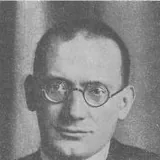
Ernst Grünfeld
Ernst Grünfeld never wore a champion's crown, and he never wanted the kind of fame that comes from a brilliancy on the board. What he wanted was to be right. Out of a Viennese childhood of poverty — and the loss of a leg before he was grown — he built the most complete knowledge of the openings that anyone of his age possessed, until his small flat overflowed with the books and card-indexes of a lifetime's study. He gave the game an opening that still bears his name and is wielded by world champions to this day, and he gave it a quieter gift too: the example of a man who loved chess not for glory but for truth, and who claimed, with some justice, that he simply did not make mistakes in the opening.
◈A boyhood in poverty
Ernst Franz Grünfeld was born in 1893 in the Josefstadt district of Vienna, the capital of an empire then near its height. His own beginnings were far humbler: he grew up in poverty, and an accident in early childhood cost him a leg. None of it kept him from the chessboard. He discovered the game young, and in chess the poor Viennese boy found the one arena where method, memory and patience counted for more than circumstance.
He rose without a patron and without fanfare, the slow and sound way. Before he was twenty he was already contributing articles on the Ruy Lopez to the Wiener Schachzeitung, the leading German-language chess journal of the day — the first sign of the scholar he would become, and of a mind that preferred to understand a position thoroughly rather than merely to dazzle with it.
◈The man who would not err in the opening
Grünfeld modelled his chess on Akiba Rubinstein — the supreme classical technician — and built his whole game on soundness. He played 1.d4 almost to the exclusion of all else, steered clear of wild complications, and was content, again and again, to draw a correctly played game rather than gamble on a sharper continuation. Critics found him cautious, even dull; his admirers understood that the caution was the point.
His boast was simple and, in its way, unanswerable: he claimed that he did not make mistakes in the opening. For a man whose knowledge of the first phase outstripped almost everyone alive, it was less arrogance than plain report. Where other masters trusted intuition, Grünfeld trusted preparation — and in the opening, at least, he was very nearly impossible to surprise.
◈The Grünfeld Defence
In April 1922, at the great tournament of Bad Pistyan, Grünfeld unveiled the idea that would carry his name into history. In the seventh round he met Friedrich Sämisch with a defence that calmly invited White to build a broad pawn centre — and then set about undermining it from the flanks. The game was drawn in twenty-two moves, but the concept was born. Later that same year, in Vienna, he employed the new defence to defeat no less a player than Alexander Alekhine, soon to be world champion.
The Grünfeld Defence was a quietly revolutionary thing: a hypermodern answer to 1.d4 that surrendered the centre on purpose, trusting in dynamic counterplay against it. Its creator, characteristically, used it only sparingly. But the world did not. Today it is a mainstay of elite practice, championed across the decades by Vasily Smyslov, Bobby Fischer, Garry Kasparov and the strongest players of the present day — a far more combative weapon in their hands than in the careful ones that forged it.
◈The encyclopedist of Vienna
If Grünfeld's tournament results made him respected, his scholarship made him singular. Over more than forty years he wrote on opening theory for journals across Germany, Belgium and the Soviet Union; because his work was mostly chess notation, it crossed borders and languages with ease. Bulgaria was a steady customer — and, in the hard years, paid him for his articles in food rather than money. His books, among them The Queen's Pawn Game and the Queen's Gambit Declined (1924) and the Taschenbuch der Eröffnungen im Schach (1953), distilled a vast accumulated knowledge.
Above all there was the library. Grünfeld gathered chess material on an almost obsessive scale, until the collection filled the living room of his small Viennese flat. He was, in the phrase his contemporaries reached for, a walking encyclopedia of the openings — a man who seemed to hold the whole evolving map of theory in his memory, and who kept the rest meticulously catalogued on his shelves. In an era before databases, he was the database.
◈The tournaments and the long twilight
Grünfeld's playing record in the 1920s was that of a genuine international force. He won at Vienna (1920 and 1927), Margate (1923), the German Chess Federation congress at Frankfurt (1923), Merano (1924) and Budapest (1926), and at his peak around 1924 he stood among the very strongest players in the world. He represented Austria on top board at four Chess Olympiads — 1927, 1931, 1933 and 1935 — and his finest showing came at the 1927 Olympiad, where he scored 9½ out of 12 against the best boards in the field.
When FIDE created its official grandmaster title in 1950, Grünfeld was among the inaugural recipients, a fitting recognition of a career spent in the front rank. By then competitive play had largely given way to his beloved library. He made his final tournament appearance at Beverwijk in 1961, where, aged sixty-seven, he still found the resources to defeat the young Dutch master Jan Hein Donner. He died in Vienna the following spring.
“I do not make mistakes in the opening.”
◈From the archive
◈Legacy
Grünfeld died in Vienna in 1962, the city of his birth, having spent his last years not at the board but among the chess library that had become his life's work. His name endures every time the Grünfeld Defence appears on a tournament board — a counterattacking weapon adopted by Bobby Fischer, Garry Kasparov and the modern elite, far bolder than the cautious master who first essayed it in 1922 would ever have played it himself. He is remembered as one of the great opening theoreticians of the twentieth century: the walking encyclopedia of Vienna, who carried the whole map of the openings in his head and on his shelves, and who proved that a profound, patient love of the game's first principles could be a kind of genius all its own.