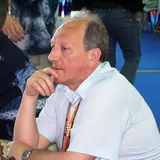
Evgeny Sveshnikov
Most players spend their lives memorizing opening theory. Evgeny Sveshnikov wrote it. Out of an industrial city in the Urals came a stubborn, brilliant theoretician who took a line every authority of his day had condemned as unsound, believed in it when no one else would, and through sheer force of analysis turned it into one of the most popular weapons in chess — a variation now carrying his name into the games of world champions. He thought of chess not as a contest of nerves but as a mathematical problem to be solved, and he gave his whole life to solving it: as a grandmaster, as a writer, as a trainer of champions, and — into his seventies — as a fighter who could still beat the men who had once worn the crown.
◈A boy from Chelyabinsk
Sveshnikov was born in 1950 in Chelyabinsk, an industrial city on the eastern slope of the Urals. He took to games almost before he could read — learning checkers at two and chess at five — and by eight he had already won a tournament. Remarkably for a player of his eventual standing, he had only one chess teacher in his whole life, Leonid Gratvohl, and otherwise made himself a master by the method that would define everything he did: relentless, systematic study.
The titles came in the middle of the 1970s — International Master in 1975, Grandmaster in 1977 — and by 1978 he had climbed into the world's top twenty-five. But the conventional markers of a chess career never told Sveshnikov's real story. His true work was not winning tournaments. It was finding the truth in a position, and defending it against the whole weight of received opinion.
◈The line nobody believed in
In the late 1960s and early 1970s, Sveshnikov and his friend Gennadi Timoshchenko fell in love with a disreputable corner of the Sicilian Defence — the old Lasker–Pelikan line, where Black answers with the provocative 5...e5, accepting a backward d-pawn and a hole on d5 in return for piece activity and dynamic chances. Every authority of the day judged it dubious, even bad. The two young men disagreed, and they did something rare: they kept playing it, at the highest level, with remarkable success, refusing to abandon a line they had analysed more deeply than anyone alive.
Slowly, the verdict turned. What had been a curiosity became respectable, then fashionable, then a mainline weapon of the world elite. Today it is known simply as the Sveshnikov Variation, and it appears in the repertoires of players up to and including world champions Magnus Carlsen and Vladimir Kramnik. Mark Taimanov called it the last great discovery in chess opening theory — a system rescued from the scrapheap and made permanent by one man's faith in his own analysis.
◈More than one opening
The Sicilian line that bears his name was never the whole of Sveshnikov's contribution. He was a theoretician across the board, pouring decades of work into the c3 Sicilian (the Alapin), the Advance Variation of the French Defence, and other systems, always seeking the same thing: clarity, structure, a position whose logic he could trust. He won the 1983 Soviet Championship and the great Hastings tournament of 1984/85, and across his career he claimed more than a hundred tournament victories.
He thought about the game in a way few others did. An opening should result in an endgame, he liked to say — chess was for him an exact problem, to be approached from both ends and reasoned through to its conclusion. He distrusted bluff and improvisation; he believed that good chess was found, not invented. It was the philosophy of an engineer, and it produced both a unique body of theory and a steady, deeply principled style of play.
◈The senior champion
Where many grandmasters fade, Sveshnikov simply kept competing. Through the 2000s he represented Latvia, winning the Latvian Championship in 2003 and again in 2010, and playing for the country at four Olympiads. Age took nothing from his appetite for the fight: in 2016 he led Russia's 65+ team to gold at the World Senior Team Championship, and in 2017 he became individual World Senior Champion in the 65+ section.
And he could still draw blood against the very best. In 2015, at the age of sixty-five, he sat down across the board from former world champion Anatoly Karpov in a rapid game in Riga — and won. The opening theorist had become a living monument, but he never once played like one.
◈The advocate
Sveshnikov was famously outspoken, and his principles ran deeper than chess. He campaigned, against the indifference of the whole chess establishment, for the idea that the players who create a game are its intellectual authors and ought to hold a form of copyright in it. If you are the owner of a draw in ten moves, nobody will buy it, he argued; but fighting chess will find its customers. It was a crusade he never won, but it was of a piece with the man — convinced that chess deserved to be taken seriously as a creative art.
He gave much of himself to others. Over the years he worked as a trainer with players including Anatoly Karpov, Lev Polugaevsky, Alexei Shirov and Alexandra Kosteniuk, and he wrote a series of respected books passing on his theoretical discoveries. He married twice and raised four children; his son Vladimir Sveshnikov became an International Master, carrying the family name back to the board his father had loved his whole life.
“Chess is an exact mathematical problem. The solution comes from two sides — the opening and the endgame. The middlegame does not exist: the middlegame is a well-studied opening.”
“An opening should result in an endgame.”
“If you are the owner of a draw in ten moves, nobody will buy it. But fighting chess will find its customers.”
“The last great discovery in chess opening theory.”
◈From the archive
◈Legacy
Sveshnikov died in 2021, but his name is spoken thousands of times a day at every chessboard in the world. Every time 1.e4 c5 2.Nf3 Nc6 3.d4 cxd4 4.Nxd4 Nf6 5.Nc3 e5 appears on a board — in a club game or a World Championship — it is called the Sveshnikov, and it stands as proof that one player's conviction can permanently change the way the game is played. He left behind a body of theory, a shelf of books, a generation of grandmasters he helped train, and an example of intellectual honesty that the chess world has not forgotten. Few players have a single great idea named after them. Sveshnikov built one from a line the textbooks had thrown away.