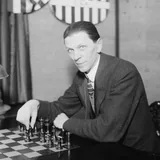
Géza Maróczy
For a few years at the dawn of the twentieth century, the strongest tournament player on earth was a soft-spoken Hungarian civil servant who had never set out to be a professional at all. Géza Maróczy won by giving nothing away. He smothered complications before they could begin, traded down into endings other masters feared, and there — in the bare arithmetic of queen and pawns — proved himself almost untouchable. He came within a signature of challenging Emanuel Lasker for the world title, then walked quietly back to his ledgers. Chess remembers him twice over: in the pawn formation that still bears his name, and as the gentle teacher who built the first women's world champion.
◈An amateur among professionals
Maróczy was born in Szeged in 1870, in the Hungarian half of the Austro-Hungarian empire. Chess was never meant to be his living: he was educated for a steady professional life and would spend his working years as a clerk and auditor, eventually as a chief auditor in the Hungarian civil service. He came to serious play late by the standards of prodigies, and his rise was built not on youthful fireworks but on patience, study and an unusually cool head.
His arrival on the international stage came at Hastings 1895 — the legendary tournament that drew nearly every great player of the age — where the young Hungarian won the secondary tournament. It was the announcement of a talent that, within a few years, would climb past nearly all of them.
◈The best in the world
Between 1902 and 1908 Maróczy was a fixture at the top of every great tournament he entered, gathering five first prizes and five seconds across thirteen events. He won Monte Carlo outright in 1902 and again in 1904, and in 1905 carried off both Ostend and Barmen — a run of dominance that left no doubt about who the premier tournament competitor of the era was.
By the retrospective rating systems that historians later applied to the period, Maróczy held the world No. 1 ranking across some thirty separate months between 1904 and 1907, peaking around 1906. For those few years the strongest active player on the planet — Lasker, the reigning champion, apart — was this unassuming Hungarian who would rather have been balancing accounts.
◈The match that never was
It was the natural next step. In 1906 Maróczy agreed terms for a World Championship match against Emanuel Lasker, and for a moment the chess world prepared to see the great defensive technician challenge the great champion. But the arrangements — money, venue, conditions — could never quite be made to hold together, and the match collapsed before a single move was played.
It is one of the quiet tragedies of chess history. Maróczy's head-to-head record against the champions of his time was a losing one — he never beat Lasker, Capablanca or Alekhine in a serious game — yet at his absolute peak, in 1905 and 1906, he was as close to the throne as any challenger of the era. After 1908 he stepped back from front-line competition to attend to his career, and the chance did not come again.
◈The art of the endgame
Maróczy's style was the antithesis of the romantic attacking chess that still dominated his youth. He was a positional player of the purest kind: sound, exact, allergic to unnecessary risk, and supremely confident once the queens came off. His mastery of queen-and-pawn endings was proverbial in his own lifetime, and he won countless games simply by steering a balanced middlegame into technical waters where his judgement outlasted everyone else's.
His enduring gift to opening theory carries the same fingerprint. The Maróczy Bind — White planting pawns on c4 and e4 against the Sicilian — is not an attacking weapon but a restraining one: it denies Black the freeing breaks and the counterplay the Sicilian lives on, then squeezes. That a structure built entirely on prevention should bear his name is the most fitting tribute the game could offer.
Even his admirers granted the cost of that caution. José Raúl Capablanca, who knew him well, judged that 'as a chessplayer he was a little lacking in imagination' — and in the same breath called him 'one of the greatest masters of his time.'
◈The elder statesman
The First World War swept away the world Maróczy had risen in, and he was nearly fifty when international chess resumed. Yet the old technician returned — competing through the 1920s and into the 1930s, decades after his peak. At the turn of 1927–28 he defeated the reigning Hungarian champion Géza Nagy in a match (+5 −0 =3), and at the first official Chess Olympiad in London 1927 he sat at board one and led Hungary to the gold medal.
In his later years he became something rarer than a champion: a teacher whose pupils outshone him. He coached the young Vera Menchik, guiding her to become the first Women's World Champion — and Capablanca credited Maróczy directly with her rise, calling him 'a good teacher' who had greatly helped her. The man once ranked first in the world spent his last chess decades giving the game away to others, with the same correctness and kindliness that had marked him at the board.
“Maróczy in his time was superior to all the other players of today, except Botvinnik and Keres.”
“As a chessplayer he was a little lacking in imagination — but he was one of the greatest masters of his time.”
“He was very gentlemanly and correct, a kindly figure.”
◈From the archive
◈Legacy
Maróczy died in Budapest in 1951, the year after FIDE made him one of the very first grandmasters it ever named. His monument is woven into the language of the game: the Maróczy Bind — pawns on c4 and e4 clamping the centre against the Sicilian — remains a structural idea taught to every serious student, a whole way of thinking about space and restraint distilled into one man's name. Beyond theory he is remembered as the kindly mentor who coached Vera Menchik to the summit of women's chess, and as living proof that a player could stand among the very best in the world while treating the board as something gentler than a battlefield.