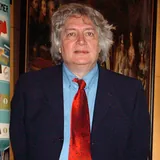
Jan Timman
For fifteen years, when the rest of the world looked for someone — anyone — to stand against the towering Soviet school, the answer was a chain-smoking Dutchman with a fighter's heart. Jan Timman was the Best of the West: the strongest player outside the Soviet Union through the long Karpov years, a man who would walk straight into an opponent's strongest opening just to test himself against it. He chased the world title to its very last door, edited the game's finest magazine, and at the end gave his deepest love to the most distilled beauty chess can offer — the composed endgame study.
◈The boy from Amsterdam
Jan Hendrik Timman was born in Amsterdam on 14 December 1951 and grew up inside the small but proud Dutch chess tradition that Max Euwe had carried to a world title. In 1974 Timman earned the grandmaster title, becoming only the third Dutch grandmaster in history, after Euwe and Jan Hein Donner.
At home he was without rival. Timman won the Dutch Championship nine times, and from his earliest years on the international circuit it was clear that the Netherlands had produced a player who would not merely make up the numbers among the world's elite — he would lead it.
◈The Best of the West
Through the late 1970s and into the 1990s, Timman was the strongest player outside the Soviet Union, and the chess world gave him a name to match: the Best of the West. By January 1982 he stood second in the world rankings, behind only Anatoly Karpov, and his rating peaked at 2680 in January 1990 — figures that placed him squarely among a handful of genuine title contenders.
The tournament wins came in a flood: Hastings, Wijk aan Zee in 1981 and 1985, Bugojno in 1984, Linares in 1988, and many more across two decades. Perhaps the sweetest single result came at the 1991 Immopar rapid in Paris, where in a single knockout he beat Gata Kamsky, Karpov, Viswanathan Anand and Garry Kasparov in succession — four of the strongest players on earth, dispatched one after another.
◈A fighter in the mould of Lasker
Timman played chess the hard way, on purpose. Where others steered toward their own comfort, he sought out an opponent's strongest ground and met him there, carrying a wide and varied opening repertoire at a time when such breadth was still unusual at the top. Raymond Keene called him "a fighter, in the mould of Emanuel Lasker."
Yasser Seirawan observed that this fearlessness — a readiness to plunge into the most complicated positions — cost Timman games that a more cautious man would have drawn, but it made him a deeply feared competitor: nobody, Seirawan noted, enjoys being beaten from their own favourite positions. The boldness was the point; it was how Timman wrung beauty and danger out of the board.
◈The road to the title
Twice Timman fought to the very edge of the world title. In the 1980s cycle he won the Tilburg Interzonal and powered through the Candidates, only to lose the 1990 final to Karpov. In the next cycle he defeated Robert Hübner, Viktor Korchnoi and Artur Yusupov before falling to Nigel Short in the decisive Candidates match.
Then history handed him the chance directly. When Kasparov and Short broke away to play their 1993 title match outside FIDE, the federation staged its own World Championship — and invited Timman to challenge Karpov for it. The Best of the West had finally reached a World Championship match. Karpov proved too strong, winning 12½–8½, but Timman had stood, at last, on the title stage he had pursued for twenty years.
◈The pen and the studies
Away from competition, Timman shaped how the game was read and understood. As one of the chief editors of New In Chess, he helped make it the magazine of record for serious players, and his own books became landmarks: The Art of Chess Analysis (1980) is counted among the modern classics, and Timman's Titans (2016), his portraits of the world champions he had known, won the English Chess Federation's Book of the Year award.
In his later years his focus turned to the purest form of the art — the composed endgame study, which had fascinated him since youth for its perfection. He composed prolifically, many of his studies winning awards, and gathered them in works such as The Art of the Endgame and Timman's Studies. In 2022 he was recognized as a FIDE Master of Chess Composition, one of the strongest practical players ever to excel at composition. He remained an artist of the sixty-four squares until his death in February 2026.
“I think I am a good fighter, but I'm also fascinated by perfection.”
“A fighter, in the mould of Emanuel Lasker.”
“He will be remembered for his imaginative playing style, outstanding competitive achievements and rich literary legacy.”
◈From the archive
◈Legacy
Jan Timman died on 18 February 2026, aged 74, and the chess world mourned a giant. FIDE remembered him for his imaginative playing style, his outstanding competitive achievements and his rich literary legacy — three lives lived fully. He was the West's great hope across the Soviet era, twice within reach of the world crown and finally its FIDE challenger in 1993; the editor and author whose The Art of Chess Analysis and Timman's Titans became classics; and, in his last decades, an award-winning composer of endgame studies who earned the title FIDE Master of Chess Composition. He is remembered as the Best of the West — a fighter in the mould of Lasker, and an artist to the final move.