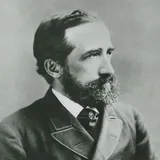
Johannes Zukertort
He came to chess late and left it early, and in between he burned brighter than almost anyone of his age. Johannes Zukertort — physician, soldier, linguist, journalist, and by his own telling a dozen other things besides — gave the nineteenth century some of its most dazzling attacking chess, and in 1886 he crossed an ocean to contest the first match ever played for the title of World Champion. He lost that match, and three years later he collapsed at a board and did not rise again. But at his height, with the position on fire and the pieces flung forward in sacrifice, there were few sights in chess more thrilling than Zukertort in full attack.
◈The man of many lives
Zukertort was born Jan Hermann Cukiertort on 7 September 1842 in Lublin, then part of Russian-ruled Congress Poland. His parents were Polish Jews who had converted to Protestant Christianity and worked as missionaries; persecution drove the family to Prussia, where the boy was raised and schooled in Breslau (today Wrocław). He took a medical degree there in 1866 and served as an army surgeon in the Prussian medical corps through the Austro-Prussian War of 1866 and the Franco-Prussian War of 1870–71.
He was also, by reputation, a magnificent embellisher of his own legend. A widely repeated account credited him with fluency in nine languages — fourteen by some tellings — together with prizes for swordsmanship, a clutch of military decorations including the Iron Cross, a seat on the staff of Bismarck's newspaper, and six thousand games played against the great Adolf Anderssen. The Oxford Companion to Chess dryly noted that there was some truth in it: he really had co-authored chess books and co-edited a chess magazine. The rest belonged to the man's gift for myth — a gift that, in its way, was part of his charm.
◈A pupil of Anderssen
He came to chess late, at around nineteen, and badly: in his first attempts he lost every game even when granted the odds of a queen. He studied the German Handbuch of Bilguer, and he found a teacher and friend in Adolf Anderssen, the romantic master who had authored the Immortal and Evergreen games. The two played constantly. By the early 1860s the pupil could beat the master at knight odds; in their final and decisive match, in 1871, Zukertort overwhelmed Anderssen five wins to two with no draws — the apprentice had become one of the strongest players alive.
Off the board he made his living in chess and ink. In Berlin he co-edited the Neue Berliner Schachzeitung with Anderssen, and after moving to London in 1872 he co-founded and co-edited, with Leopold Hoffer, The Chess Monthly, one of the leading chess periodicals of the age. London made him: a fixture of the coffee-house chess world at Simpson's Divan, and a blindfold virtuoso who in 1876 conducted sixteen games at once without sight of board or men, scoring eleven wins, four draws and a single loss.
◈London 1883
His masterpiece as a competitor came in the spring of 1883. The London tournament gathered fourteen of the world's leading players for a gruelling double round-robin, and Zukertort tore through it, winning twenty-two of his first twenty-three games before exhaustion finally caught him at the close. He finished with 22 points from 26, a full three points clear of Wilhelm Steinitz in second — the most convincing result of his life, and one that made his claim to be the strongest player in the world impossible to ignore.
It was there, against Joseph Henry Blackburne, that he produced the game posterity would call Zukertort's Immortal: a patient build-up that erupted into a storm of sacrifices and a forced mate. Steinitz himself, no ally in print, judged it one of the most brilliant games on record.
◈The first World Championship
By the mid-1880s only two men could seriously claim the summit, and in 1886 they finally met for it. The match between Zukertort and Steinitz, played in the United States from 11 January to 29 March, is generally recognised as the first official World Chess Championship — the winner to be the first to reach ten victories. Zukertort crossed the Atlantic, sat down in New York, and after losing the opening game won four in a row to lead 4–1. For a moment the crown looked his.
Then the contest moved on — to St. Louis, then to New Orleans — and Zukertort came apart. His health, never robust, failed him under the strain; the brilliant attacker grew erratic and exhausted, and Steinitz, the deeper strategist, ground him down. Steinitz reached his tenth win in the twentieth game and took the match 10–5 with five draws, becoming the first official World Champion. Zukertort would never recover the form of 1883.
◈Death at the board
The last years were a slow decline, shadowed by heart disease and failing health. He lost a return match to Blackburne in 1887 and slipped down the cross-tables of tournaments he had once dominated. On the evening of 19 June 1888, playing in a tournament at Simpson's Divan — the London chess room that had been his second home — he suffered a stroke at the board. He died the next morning, 20 June 1888, at the age of forty-five, and was buried in Brompton Cemetery.
What he left was a body of attacking chess as bright as any in his century, and a name on the opening that still bears it — the Zukertort Opening, 1.Nf3, a quiet first move from a man who loved the loudest possible middlegames. He is remembered as the great rival of chess's first champion, and as the first player ever to sit down and fight for the title of best in the world.
“One of the most brilliant games on record.”
◈From the archive
◈Legacy
Zukertort died as he had lived — at a chessboard — and the game lost one of its most electric attacking talents at only forty-five. History has not always been kind to the loser of 1886, but it has never denied his brilliance: with Steinitz he was one of the two strongest players of his era, the convincing victor of London 1883, and the author of a win over Blackburne still replayed as one of the great combinations ever played. His name endures on the Zukertort Opening (1.Nf3) and in the record books as the challenger in the first official World Chess Championship — the romantic attacker who reached, and fell just short of, the very top.