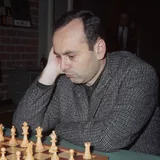
Lajos Portisch
Lajos Portisch built a chess career the way a master craftsman builds anything that lasts: slowly, soundly, and without a wasted motion. For three decades he was the West's most reliable answer to the Soviet machine — a positional purist who out-prepared and out-lasted the best players in the world, qualified for the Candidates eight times, and stood at world No. 2 without ever quite reaching the title match. He carried Hungary on his shoulders at twenty Olympiads, and in 1978 led his country to a gold medal that no non-Soviet team had managed in a generation. Off the board he is a trained musician with the voice of a baritone — proof that the discipline he brought to the sixty-four squares was, at heart, an artist's discipline.
◈A late start in a small town
Portisch was born in 1937 in Zalaegerszeg, a small town in western Hungary, and he came to chess later than the prodigies he would spend his life beating. 'I was only twelve years old when I started to play the game,' he recalled, 'and it was a very slow development as I was born in a small town in Hungary. There were no books, no computers of course, nor even chess clocks.' What he lacked in early resources he made up for in patience — and in an iron work ethic that would become his signature.
His first love was actually music. 'I wanted to become a musician,' he said; 'I played the violin when I was young, which I gave up for the sake of chess.' He briefly went to university to study economics after high school but found he had no talent for it, dropped out after a single month, and — at eighteen — committed himself fully to the life of a professional chess player.
◈The Hungarian Botvinnik
By 1961 Portisch was a grandmaster, and through the 1960s and 1970s he established himself as the strongest player in the West outside the Soviet Union. His style earned him the nickname that followed him for life — the 'Hungarian Botvinnik' — for he shared the great Soviet champion's faith in deep opening preparation, scientific positional play, and relentless consistency. 'Positional,' he said simply when asked to describe himself. 'I was always very positional.'
He won or shared the Hungarian Championship nine times across more than two decades, and posted a minus score at a major event only on the rarest of occasions — a record of durability that very few players in history can match. Where flashier rivals burned bright and faded, Portisch simply kept turning up, year after year, among the world's elite.
◈Eight times a Candidate
From 1962 onward Portisch qualified for an unbroken string of Interzonals and reached the Candidates — the tournaments and matches deciding who would challenge for the world crown — on eight separate occasions: 1965, 1968, 1974, 1977, 1980, 1983, 1985 and 1988. His deepest runs came in the 1977 and 1980 cycles, where he reached the Candidates semi-finals.
He defeated, at one time or another, virtually every great player of his era — Tal, Petrosian, Spassky, Karpov — yet the final step always eluded him. He never reached a World Championship match. It is the one gap in an otherwise monumental career, and it places him among the strongest players never to contest the title.
◈Hungary's standard-bearer
If there is a single arena that belonged to Portisch, it was the Chess Olympiad. He represented Hungary at twenty of them between 1956 and 2000 — a record of longevity spanning six decades — and played a record number of games for his country, gathering eleven medals along the way.
His crowning team achievement came at Buenos Aires 1978, where he led Hungary to the gold medal with a personal score of 10/14 on top board. It was the only time between 1952 and 1990 that a non-Soviet team won the Olympiad outright — a victory that made Portisch a national hero and broke, however briefly, the Soviet stranglehold on team chess.
◈The baritone
For all the discipline of his chess, Portisch's inner life was bound up with music. The boy who once dreamed of the violin grew into an accomplished baritone with a deep love of opera — a passion he shared with world champion Vasily Smyslov, another grandmaster who might have sung professionally. He played, he said, not for prizes but for something purer: 'I have always played for the satisfaction from the game itself and competition.'
His younger brother Ferenc Portisch became an International Master, making them one of chess's notable sibling pairs. A devout Catholic and a private man, Portisch carried into his ninth decade the same quiet seriousness that had defined him at the board — the bearing of an artist who happened to have chosen chess.
“Positional. I was always very positional.”
“I have always played for the satisfaction from the game itself and competition.”
“I wanted to become a musician. I played the violin when I was young, which I gave up for the sake of chess.”
◈From the archive
◈Legacy
Portisch never won the world title, but few players have been so universally respected for the quality of their chess. The 'Hungarian Botvinnik' became the model of the Western professional in the Soviet era: scrupulously prepared, deeply consistent, and dangerous to every champion he faced. Hungary honoured him in 2004 with the title Sportsman of the Nation, its highest sporting distinction, and a minor planet — 154493 Portisch — carries his name through the sky. He is remembered as the man who proved, year after year and Olympiad after Olympiad, that patience and preparation could stand toe to toe with the most fearsome attacking talent the game could produce.