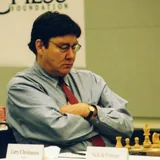
Larry Christiansen
He skipped the master's apprenticeship entirely — leaping from a California schoolboy prodigy straight to grandmaster — and he made his name not by grinding but by storming. For half a century Larry Christiansen has been America's purest attacking player: the man who needed only twelve moves to topple Anatoly Karpov, and who could turn a quiet opening into a hunt for the enemy king before the position had even settled.
◈A prodigy out of California
Larry Mark Christiansen was born in Riverside, California, on 27 June 1956, the descendant of Danish stock. He took to chess young and rose with startling speed. In 1971, still a junior-high-school student, he won the National High School Championship — by his own account the first junior-high pupil ever to do so, beating boys years his senior.
What followed was a clean sweep of American junior chess: he won the U.S. Junior Championship three years running, in 1973, 1974 and 1975. The trajectory pointed in only one direction, and Christiansen was already a name to fear in his teens.
◈Grandmaster at twenty-one
In 1977, at the age of twenty-one, Christiansen was awarded the grandmaster title by FIDE — and he did it the hard way, vaulting straight to the highest rank without ever holding the international master title in between. It is a leap few players in history have managed.
He proved at once that the title was no formality. At the elite Linares tournament of 1981 he tied for first place with Anatoly Karpov, the reigning World Champion — an extraordinary result for a young American among the Soviet and European establishment, and notice that Christiansen belonged in any field, however strong.
◈Three crowns at home
Christiansen won the U.S. Championship three times across three different decades. He shared the 1980 title with Walter Browne and Larry Evans, shared it again in 1983 with Browne and Roman Dzindzichashvili, and then, nineteen years later, took the 2002 championship outright — a span of dominance that bracketed an entire generation of American chess.
He carried the flag abroad as well, representing the United States at eight Chess Olympiads between 1980 and 2002. The American team took silver in 1990, with team bronze medals in 1982, 1984, 1986 and 1996. By July 1992 his FIDE rating had reached 2625, placing him 21st in the world.
◈The American master of attack
Christiansen described his own play as aggressive-tactical, and the description scarcely does justice to it. Where many grandmasters seek the safe square, he hunted the king. He favored sharp systems — the Sämisch against the King's Indian among them — and a sudden, violent initiative that left opponents reeling. He poured that philosophy into two widely praised books on the craft, Storming the Barricades (2000) and Rocking the Ramparts (2004).
The legend was sealed at Wijk aan Zee in January 1993. Facing Karpov in a Queen's Indian, Christiansen reached an unremarkable-looking position after eleven moves — and then Karpov's bishop stepped to a square it could not leave. With the quiet retreat 12.Qd1, threatening both the bishop on d6 and the knight on h5 at once, Christiansen won a piece outright. Karpov, one of the greatest players who ever lived, resigned on move twelve. It remains among the shortest defeats ever suffered by a world champion — loose pieces, as the maxim goes, drop off.
◈Boston, the board, and the booth
Christiansen made his home in the Boston area, and when the U.S. Chess League formed he became one of the first elite American grandmasters to join it, leading the Boston Blitz. As his tournament appearances thinned, his voice grew familiar to a new generation: a frequent commentator on chess.fm and a sought-after writer and coach, he proved as engaging in analysis as he had been deadly over the board.
Friends describe a man with a wry sense of humor — capable, it is said, of simultaneously complaining about and enjoying any activity — who spends his time exploring cities with his wife Natasha, hunting for a good steak, and firing off blitz games online. The attacking instinct, plainly, never left him.
“Aggressive-tactical — that is how I would describe my own style.”
“Larry Christiansen is an American master of attack.”
◈From the archive
◈Legacy
Christiansen never reached for the world title, but he gave American chess something rarer — a living tradition of fearless, attacking play, carried through three U.S. Championships, two acclaimed books on the art of attack, and decades in the commentary booth. He settled in Boston, led the Boston Blitz in the U.S. Chess League, and became one of the game's most beloved analysts, blessed with a wry humor that could complain about and enjoy a thing in the same breath. He is remembered, above all, as the embodiment of a single ruthless maxim — that loose pieces drop off — and as proof that an American could meet the world's best and simply attack them off the board.