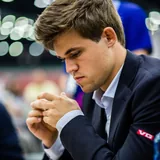
Magnus Carlsen
Magnus Carlsen does not so much defeat his opponents as wear them down to nothing. From a position the engines call dead level he will play on, and on, squeezing water from stone until the man across the board cracks — and they almost always crack. A prodigy who became the youngest world No. 1 in history and then climbed to a rating no human had ever reached, he held the World Championship for a decade and walked away from it not because anyone took it, but because he had run out of things to prove. He is, by the cold arithmetic of rating and by the warmer testimony of every rival he has crushed, the strongest chess player who has ever lived.
◈The prodigy from Tønsberg
Sven Magnus Øen Carlsen was born on 30 November 1990 in Tønsberg, Norway, the son of an amateur-chess-loving IT consultant who taught him the moves at five. The boy's mind was extraordinary from the start — he could reel off the flags, capitals and populations of the world's countries before he was old enough for school — and once chess took hold it never let go.
His breakthrough came in January 2004 at Wijk aan Zee, where, aged thirteen, he tore through the C-group with 10½/13. Later that year he became a grandmaster at thirteen years and 148 days — then the second-youngest in history. The same year, at a blitz tournament in Reykjavík, he beat Anatoly Karpov and drew a famous game with Garry Kasparov, and the chess world understood it was watching the future arrive.
◈To the summit
Carlsen's rise was relentless. In January 2010, at nineteen, he became the youngest player ever to top the world rankings, and from 1 July 2011 he has held the No. 1 spot without interruption — a span matched only by Kasparov. In May 2014 his rating reached 2882, surpassing Kasparov's old record and standing as the highest figure any player has achieved.
The nickname the Mozart of chess had attached to him as a teenager, capturing the impression of effortless, natural genius. But the deeper truth was harder-edged: Carlsen out-worked and out-lasted the field, combining a vast, flexible opening repertoire with the most punishing technique in the game.
◈The crown, won and defended
In November 2013, in Chennai, Carlsen challenged the reigning champion Viswanathan Anand and won decisively, 6½–3½, to become the sixteenth World Chess Champion. He defended the title against Anand again in 2014, then survived three more matches that ran to the wire — outlasting Sergey Karjakin in 2016 and Fabiano Caruana in 2018 in rapid tiebreaks after the classical games finished level, and turning back Ian Nepomniachtchi in 2021.
Then, in 2023, Carlsen did something no champion had done before: he gave up the title voluntarily, declining to defend it. He cited a simple lack of motivation for the gruelling match format. He had nothing left to prove in classical chess and would not pretend otherwise — a decision as characteristic, in its honesty, as any move he ever played.
◈Water from stone
The signature of Carlsen's chess is the will to keep playing. In positions the engines and his peers judged dead drawn, he would press for fifty, sixty, eighty moves, posing one small problem after another until a tiring opponent finally erred — and then the technique was merciless. Between 2018 and 2020 he went 125 consecutive classical games without a loss, the longest such streak ever recorded at the top.
His attitude was as hard as his endgames. "Some people think that if their opponent plays a beautiful game, it's okay to lose," he said. "I don't. You have to be merciless." Belief, he insisted, was half the battle: "Self-confidence is very important. If you don't think you can win, you will take cowardly decisions in the crucial moments, out of sheer respect for your opponent."
◈The all-rounder and the brand
Carlsen's supremacy is not confined to classical chess. He has been World Rapid Champion and World Blitz Champion many times over, and in 2014 became the first player to hold the classical, rapid and blitz world titles simultaneously. In 2026 he added the FIDE Freestyle (Fischer Random) world title, extending his reach into the variant he has championed as a fresher test of pure skill.
Off the board he became the game's great moderniser and its most famous face since Fischer. He co-founded the Play Magnus chess platform, drew enormous audiences to online and streamed chess, and built ventures far beyond the sixty-four squares. He married Ella Victoria Malone in 2025. Having stepped back from the championship treadmill, he plays now largely on his own terms — and remains, by common consent, the best on earth whenever he sits down.
“Some people think that if their opponent plays a beautiful game, it's okay to lose. I don't. You have to be merciless.”
“Self-confidence is very important. If you don't think you can win, you will take cowardly decisions in the crucial moments, out of sheer respect for your opponent.”
“The most brilliant final move of any world chess championship in history.”
◈From the archive
◈Legacy
Carlsen's records read like a different sport's: the highest rating in history at 2882, the longest unbeaten streak at the elite level — 125 consecutive classical games — and a reign as world No. 1 unbroken since 2011 that has no equal but Kasparov's. He won the classical World Championship in 2013 and defended it four times before relinquishing it in 2023, while simultaneously dominating rapid and blitz, holding all three world titles at once. But his deepest mark is on how chess is played: he proved that in the engine age a human could still win not through preparation but through sheer, relentless will in equal endgames, dragging out victories everyone else had given up as draws. Beyond the board he built businesses, drew millions to the game online, and made himself the most famous chess player on earth since Fischer. He is the standard against which greatness is now measured.