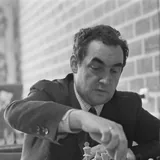
Mark Taimanov
He lived two lives at once, and refused to choose between them. Mark Taimanov was a grandmaster who beat six world champions and a concert pianist who recorded the great Romantic repertoire — a man who would close a tournament hall and open a concert hall the same week, and call the whole arrangement a holiday. The world remembers him for a single afternoon of catastrophe, the day Bobby Fischer beat him six games to none. But the truer measure of Taimanov is what he said when the wreckage was complete and the State had taken everything it could take: at least I still have my music. He had spent ninety years proving that a life given to beauty cannot be confiscated.
◈Born to two arts
Taimanov was born in Kharkov in 1926 to a Jewish father and a Russian mother, and grew up in Leningrad, the city whose conservatory and chess clubs would shape both halves of his life. The music came first. He was set to the violin as a small boy, and at ten he stepped in front of a film camera: in the 1936 Soviet picture Beethoven Concerto he appears as a young violinist, a child performer with a poise that would never quite leave him.
Chess arrived alongside the music, not after it, and the two grew up together inside the same boy. From the start Taimanov saw no contradiction between the keyboard and the board — only two disciplines that asked the same things of him: patience, structure, imagination, and the nerve to follow a line of thought all the way to its end. He would spend the rest of his life moving between them, and insisting they were one vocation wearing two faces.
◈The duo at two pianos
At the Leningrad Conservatory he studied under the pedagogue Samari Savshinsky, and there he met Lyubov Bruk. They married when they were both nineteen and formed a piano duo that became one of the most admired two-piano partnerships in the Soviet Union — husband and wife at twin keyboards, touring and recording the four-hand and two-piano literature for decades.
The recognition reached beyond the Soviet bloc only late and partially: married couples were effectively barred from travelling together to the West, so the duo remained a rumour to most of the world. Vindication came at the very end of the century, when Philips gathered the Bruk–Taimanov recordings into its landmark series Great Pianists of the 20th Century. Taimanov took a frank, delighted pride in it. I am there, he liked to say, amongst the greatest. He meant the pianists, not the chess players — and he was no less proud of that than of any tournament he had won.
◈Among the champions
On the board his rise was steady and stylish. International Master in 1950, Grandmaster in 1952, he belonged for a decade to the small group of Soviets strong enough to win their own ferocious national championship. In 1952 he tied for first in the USSR Championship with the reigning World Champion Mikhail Botvinnik, losing only the play-off; four years later, in 1956, he finished level with Yuri Averbakh and Boris Spassky and won the title outright. He played in the Candidates as early as 1953, at the great Zurich tournament, taking his place among the contenders for the world crown.
His chess was positional and clear, built on understanding rather than violence — "when he had the position under control," the grandmaster Artur Yusupov said, "he could play with great ease." Across his career he defeated six men who held or would hold the world title: Botvinnik, Smyslov, Tal, Petrosian, Spassky and Karpov. And his name settled permanently into the opening books — the Taimanov Variation of the Sicilian, a flexible system that remains a respected weapon at every level, with further Taimanov lines in the Modern Benoni and the Nimzo-Indian Defence.
◈Vancouver, 1971
Then came the afternoon that swallowed everything else. In the 1971 Candidates quarterfinal in Vancouver, Taimanov met Bobby Fischer at the start of the most terrifying run in the game's history. Fischer beat him six games to none — a perfect, merciless 6–0, without a single draw, a score that had no precedent at that level of chess. Taimanov, who knew the man across the board better than most, would only call him "an incredibly tough defender."
What the Soviet State did next was worse than the score. Convinced — or content to pretend — that a champion could only lose so completely on purpose, the authorities searched his luggage at the border, seized on a copy of a Solzhenitsyn book as their pretext, stripped him of his salary, and barred him from foreign travel and from giving concerts. The chess loss they could have forgiven; the silencing of his music was the cruelty that stung. He answered it with the line that became his epitaph in advance — at least I still have my music — and, two decades later, with a book that refused to hide from any of it, How I Became Fischer's Victim (1993).
◈One long holiday
The ban did not hold forever; the State, in time, quietly relented. Taimanov went on playing and performing into great old age, writing well-regarded books on the Sicilian and on the Soviet Championships, annotating his own games with candour, and shuttling as ever between the board and the keyboard. "When I gave concerts I was taking a rest from chess," he said, "and when I played chess I was resting from the piano. As a result, my whole life has been one long holiday."
He married four times and never lost his appetite for life — fathering twins in his late seventies, more than half a century between his eldest child and his youngest. The writer Dagobert Kohlmeyer summed him up simply: "A man who loved life." Mark Taimanov died in his beloved Saint Petersburg in 2016, ninety years old, a grandmaster to the last and a pianist to the last, the two arts still holding hands.
“At least I still have my music.”
“When I gave concerts I was taking a rest from chess, and when I played chess I was resting from the piano. As a result, my whole life has been one long holiday.”
“He was a very positive person. Taimanov never lost his humour.”
“That's how he was. A man who loved life.”
◈From the archive
◈Legacy
Mark Taimanov gave chess a flexible Sicilian that still bears his name, a body of clear and elegant games, and wins over six world champions; he gave music a celebrated two-piano partnership preserved among the great pianists of his century. But his deepest legacy is the answer he gave to ruin. When a single match was used to strip him of his livelihood and silence his concerts, he did not break — he turned to the other art that no regime could take, and he kept both alive for forty more years. He remains the proof that a life devoted to beauty is larger than any defeat, and that a man can belong, wholly and without apology, to more than one art at once.